Choosing a Taproom POS: What to Ask Before You Sign


Share the page:
The subscription price is the smallest number in a POS decision and the one every demo is built around. Processing is the large one: on $50,000 a month in card volume it runs roughly $12,000 to $18,000 a year, more than software and hardware together. Compare offers on effective rate, not headline rate, and get interchange-plus quoted in writing alongside any flat rate. Then read the contract for three things that cost more than the price: the auto-renewal window, the early termination model, and whether the hardware and the processor are locked to each other. A taproom also needs two things a restaurant does not, and most demos will not show you either.
Introduction: The Demo Is Built Around the Cheapest Number
Every POS demo follows the same shape. Here is the interface, here is how fast you can ring a round, here is the monthly price. The monthly price is real and it is also, for most taprooms, somewhere between the third and fourth largest cost in the decision.
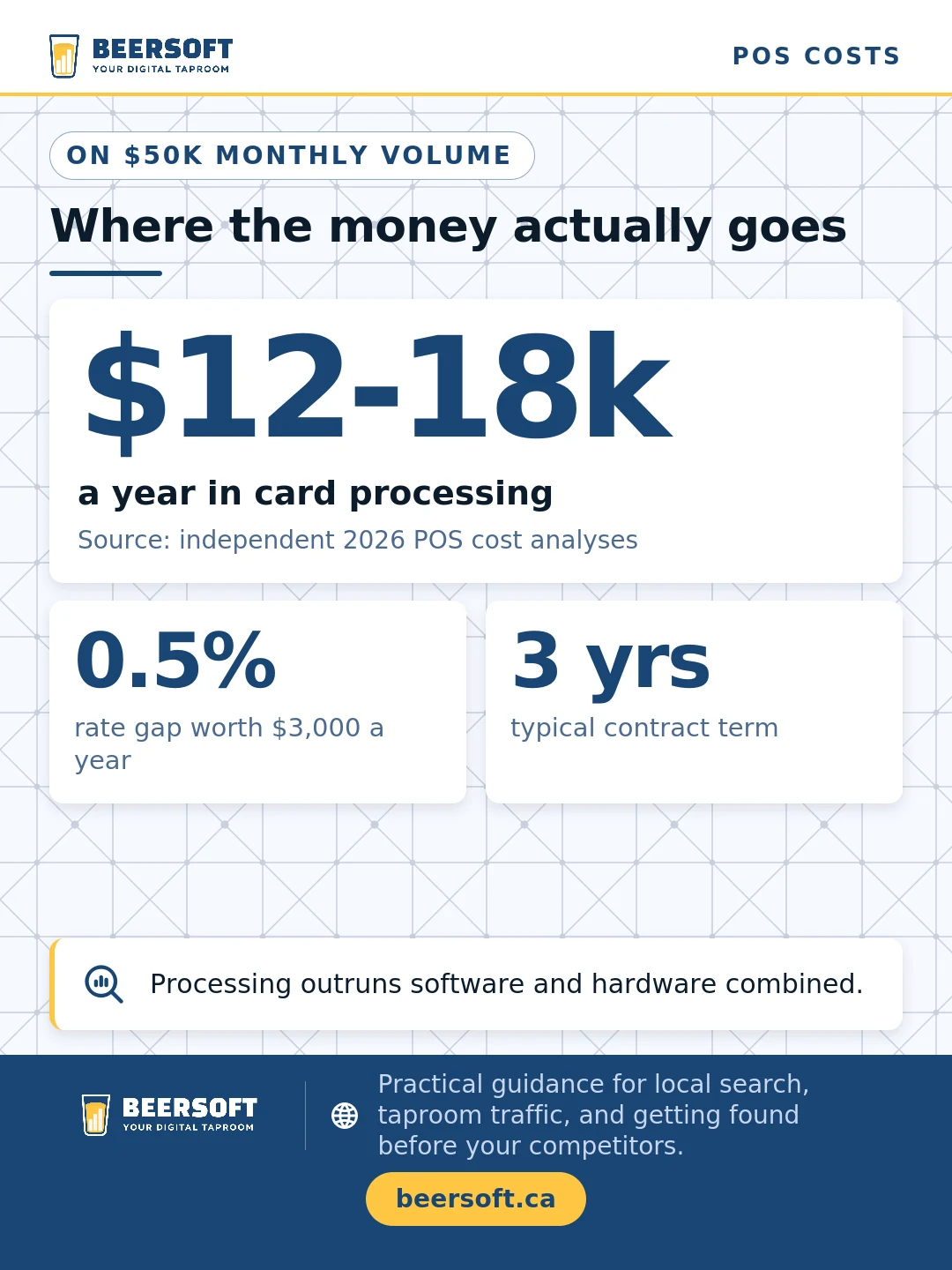
The large one is processing, and it does not appear on a slide because it depends on your volume. At $50,000 a month in card sales, published 2026 cost analyses put annual processing somewhere between $12,000 and $18,000. Software and hardware together rarely approach that. A system with a lower subscription and a worse rate can cost more over three years than the expensive-looking option, which is why comparing monthly prices tells you almost nothing.
The other thing the demo will not cover is what happens at the end. Contract length, the notice window for cancelling, what the hardware is worth if you leave, and whether the payment processing can be moved at all.
POS conversations come up constantly in BeerSoft onboarding, usually after the contract is signed and somebody is trying to get data out of it.
Here is what to ask while you still have leverage.
What Does a Brewery POS Have to Do That a Restaurant POS Doesn't?
Two things, and most hospitality systems handle neither well.
The first is producing data your federal reporting can use. A taproom pour is a taxable removal, and those numbers end up on a Brewer's Report of Operations. A system that reports revenue by category but cannot break out volume in a form that reconciles to barrels is a system that guarantees somebody rebuilds the figures by hand every reporting period. We made the case separately that this transcription is the first thing worth automating; the POS is where that data either exists cleanly or does not.
The second is member pricing tied to a physical object. A mug club is a discount that applies only when the member drinks from their own mug, which is a rule most restaurant systems express badly. If the answer involves the bartender remembering who is a member, the system is not doing the job.
Key Takeaway: Ask for a live report, not a feature list. "Yes it does that" and "here is the screen" are different answers.
Mid-decision and comparing quotes? Request a free digital audit and we will look at what your current systems already produce before you replace any of them.
Why Is the Processing Rate the Number That Matters?
Because it scales with your success and the subscription does not.
The comparison that works is effective rate: total processing fees for a month, including every line item, divided by total card sales. Not the headline rate. Two offers quoted at "2.6%" can produce different effective rates once monthly minimums, PCI fees, gateway fees, statement fees, chargeback fees and any non-qualified uplifts are counted.
The structural choice underneath is flat rate versus interchange-plus. Flat rate bundles everything into one number and is simpler to read. Interchange-plus shows you the actual card-network cost and the processor's markup separately, which makes it comparable and negotiable. Industry cost analyses put the gap between a bundled 2.5% and an interchange-plus 2.0% at over $20,000 across three years for a business doing $150,000 a month.
Most taprooms are smaller than that, and the principle scales down without changing. Half a point on $50,000 a month is $3,000 a year, which is more than most POS subscriptions cost.
Key Takeaway: Ask for an interchange-plus quote in writing alongside any flat rate, then compare both against your current merchant statement using effective rate. If a vendor will not itemize, that is the answer.
What's Actually in the Contract?
Three clauses, and they are rarely the ones discussed at the demo.
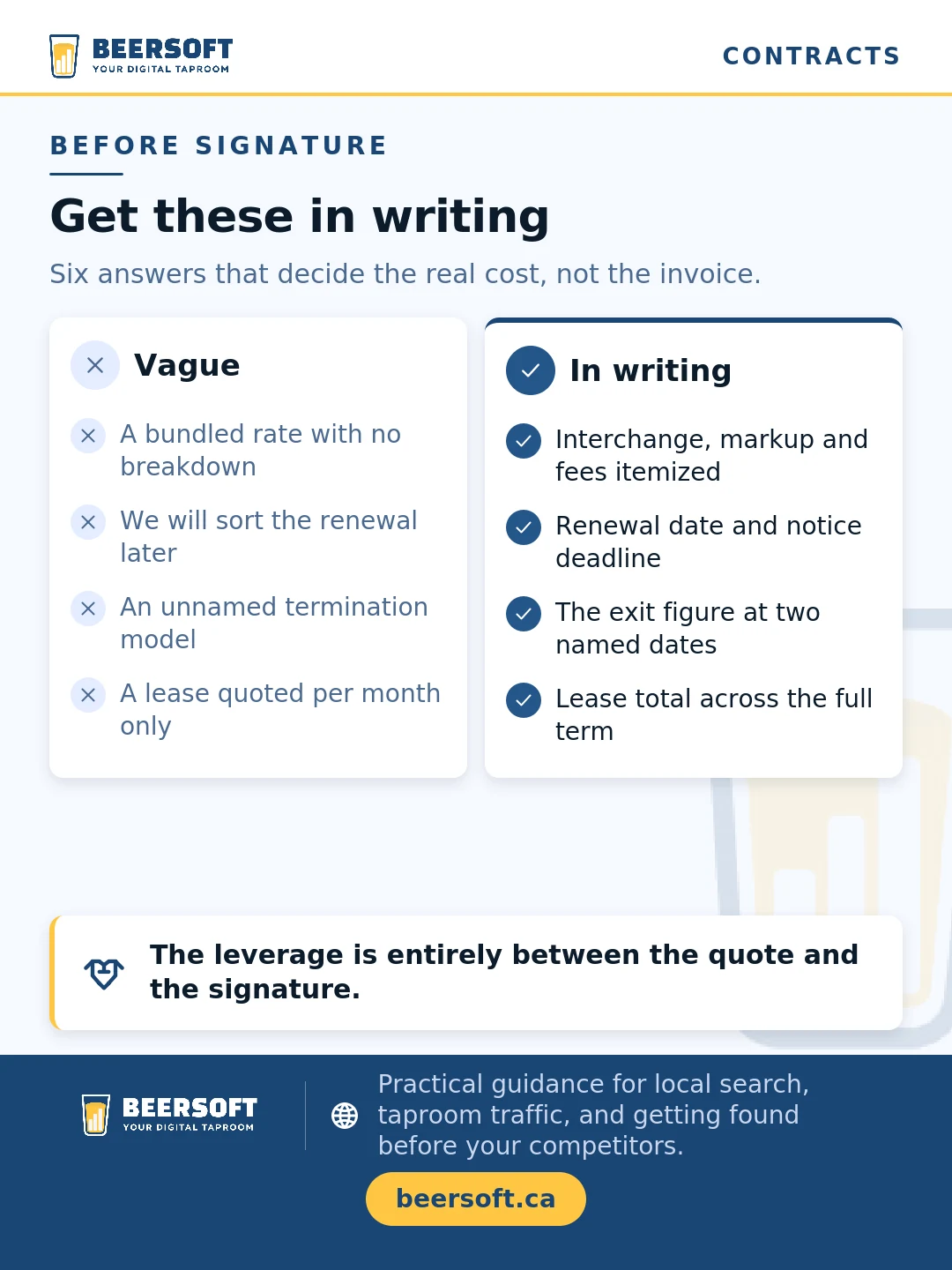
Term and auto-renewal. Multi-year terms are normal. What catches operators is the notice window: some agreements require written cancellation within a narrow period before renewal, and missing it extends the term by another year or more. Ask for the renewal date and the notice deadline in writing, and put both in a calendar the day you sign.
Early termination. There are three common models and they are not equivalent. A flat fee is a known number. A prorated model is remaining months multiplied by your monthly fee. A liquidated-damages model estimates the vendor's lost profit over the remaining term and can run into five figures. Ask which model applies and what the number would be at month thirteen and month twenty-five, specifically.
Equipment. Leased hardware is where the quiet money goes. A terminal that retails for a few hundred dollars can cost several thousand across a multi-year non-cancellable lease, and the lease frequently survives the POS contract. Buy hardware outright where you can.
Key Takeaway: Every one of these is easier to change before signature than at any point afterwards. A vendor who will not put a number in writing during the sale will not be more forthcoming later.
Who Owns Your Data When You Leave?
You do, in principle. The question is what format it comes out in and how much of your operation stops working when it does.
Ask three things. Can I export complete transaction history, not a summary, and in what format. Is the customer and member list exportable with email consent intact. And if I move to a different processor, what breaks.
That last one is the trap. Some systems are tightly coupled to their own payment processing, which means changing processor means changing POS. Others support multiple processors but degrade when you do: handhelds stop working, online ordering breaks, gift cards or stored tabs stop syncing. The answer is rarely a flat no, it is a list of things that quietly stop.
Proprietary hardware compounds it. Terminals that only run one vendor's software have no resale value and cannot be repurposed, so the switching cost includes replacing equipment that still works.
The version BeerSoft sees most often is a taproom that chose well on features, never asked the exit questions, and discovered three years later that leaving meant new hardware, a new processor, and a member list they could only export as a PDF.
Key Takeaway: Ask what breaks if you change processor, and get the export formats named. A system you cannot leave is a system that never has to earn renewal.
What Should You Ask Before You Sign?
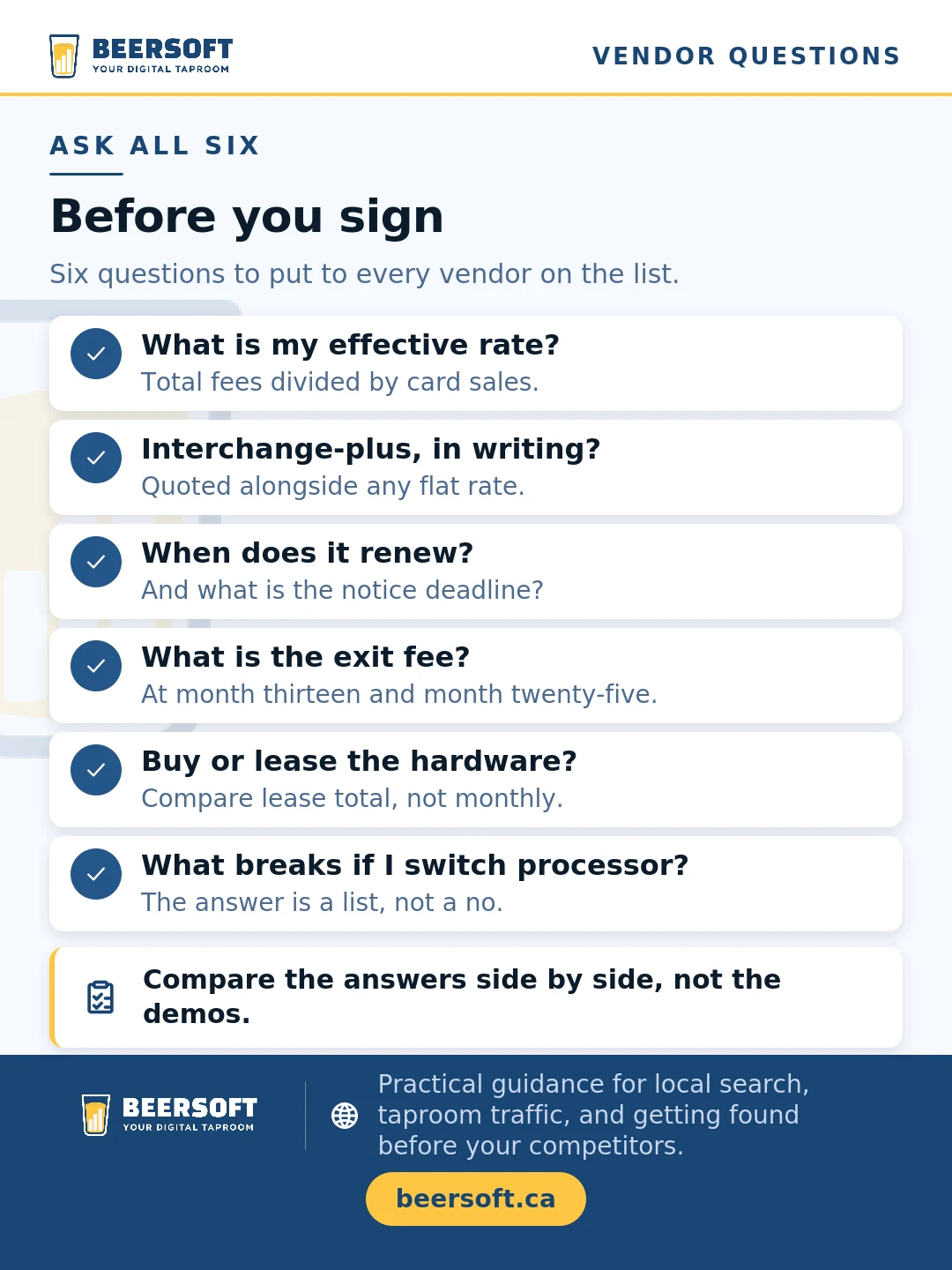
The short version, in the order that matters.
None of this requires a lawyer, though a contract of any length is worth one. It requires asking for numbers in writing and comparing on the right metric, which is effective rate against your own statement rather than a headline percentage against a competitor's headline percentage.
One practical note on timing. The leverage is entirely in the window between a quote and a signature, and it evaporates completely afterwards. Renewal is a second, smaller window, and it only exists if you know the date.
Key Takeaway: Run the same six questions past every vendor on your shortlist and compare the answers side by side. The one that answers them all in writing is usually the right choice regardless of the demo.
Frequently Asked Questions
How much does a POS system cost for a brewery?
Less in subscription than in processing. Software is commonly a monthly fee per location, hardware is a one-off or a lease, and payment processing scales with your card volume. At $50,000 a month in card sales, published 2026 analyses put annual processing in the $12,000 to $18,000 range, which exceeds software and hardware combined for most taprooms. Model your real volume rather than comparing sticker prices.
What is the difference between interchange-plus and flat-rate pricing?
Flat rate bundles the card network's cost and the processor's markup into a single percentage, which is simple to read and impossible to audit. Interchange-plus shows the two separately, so you can see what the processor is actually charging you. Interchange-plus is generally cheaper at volume and is always more comparable between offers. Ask for it in writing even if you end up choosing flat rate.
What should a brewery POS do that a restaurant POS does not?
Two things. It should report volume by beer in a form that reconciles to your federal operations reporting, because those reports are in barrels rather than dollars. And it should handle member pricing with conditions attached, such as a mug club discount that applies only when a member is served in their own mug. Ask to see both as live reports during the demo.
Can I get out of a POS contract early?
Usually, at a cost, and the cost depends on the model. A flat early termination fee is a known number. A prorated model charges the remaining months. A liquidated-damages model estimates the vendor's lost profit for the rest of the term and can reach five figures. Ask which model applies and request the specific figure at two dates, such as month thirteen and month twenty-five.
What happens to my data if I switch POS providers?
That depends on what you negotiated. Ask before signing whether you can export complete transaction history rather than a summary, what file format it arrives in, and whether the customer list exports with email consent intact. Also ask what stops working if you change payment processor, because some systems are tightly coupled to their own and others lose features such as handhelds or online ordering.
Conclusion: Ask While You Still Have Leverage
Get three numbers in writing before you sign anything: the effective rate on your actual volume, the early termination figure at two named dates, and the total cost of hardware purchased versus leased across the full term. Those three decide what the system costs. The subscription mostly decides what the invoice says.
Then put two dates in a calendar. The renewal date, and the notice deadline that sits in front of it. Missing the second one is the most common way a taproom spends another year on a system it already decided to replace.
Working out what your systems need to produce before you shop for one, and reading the contract with that list in hand, is the part that gets skipped. It is the part BeerSoft picks up: CRM and member data systems is where that work lives. Contact us with a quote you are considering and we will tell you which questions it has not answered.
If you are opening rather than replacing, the decision is a different one, and the pre-opening version is here.
Sources
- Clopos. How Much Does a Restaurant POS System Cost? 2026 Guide. July 2026.
- Addmi. Restaurant POS System Cost in 2026: Fee Breakdown. July 2, 2026.
- PaymentCollect. Restaurant POS System Cost: What Merchants Actually Pay. July 24, 2026.
- Bread Point of Sale. Restaurant POS Systems with Integrated Payments. February 18, 2026.
- Alcohol and Tobacco Tax and Trade Bureau. Requirements for Brewery Operations.
Stay Ahead - Subscribe Now!
You may also be interested
Brewery Website Migration: How to Move Platforms Without Losing Your Rankings
When a brewery actually needs to change platforms, what a migration genuinely puts at risk, the URL map that has to exist before anything moves, and the checks that close it out

Brewery Email Marketing: The Four Sends That Earn Their Keep
Why the newsletter is the weakest thing you can do with a brewery list, the four sends that replace it, where the names actually come from, and the two numbers worth reporting

Should Your Taproom Run a Chatbot?
What a taproom chatbot would actually be asked, what the 2026 data says about how chatbots perform, why the tap list is the worst thing to put in one, the narrow cases where it does pay, and what to fix instead
Beer Photography for Small Breweries: What to Shoot and When
What a small brewery actually needs photographs of, why a beer shot takes longer than it looks, what a half-day and a full day cost and deliver, which images have a window that closes, and how to write a brief
What a Brewery Website Costs, and What Drives the Number
Why quotes for the same brewery website vary by three times, what makes a taproom site structurally different from a brochure site, which decisions actually move the price, what you pay after launch, and how to compare quotes fairly
Which Taproom Workflows to Automate First
Which taproom workflows actually repeat often enough to justify automating, why federal compliance reporting is the highest-value target, what to connect after that, what to leave alone, and the order to do it in
Beer Label Design: What the Regulator Requires Before the Designer Starts
What the TTB requires on every beer label, how long approval actually takes in 2026, which rules constrain the artwork itself, what really delays a launch, and the brief a designer needs before starting
How to Start a Brewery: The Digital Foundations to Get Right First
What the federal and state approval timeline actually looks like in 2026, why your brewery name is a digital decision before it is a branding one, what to build during the approval window, and what has to be live before your first pour

The Three-Tier System, Explained for Brewery Marketers
Why the three-tier system exists, which marketing activities it forbids outright, exactly what a brewery may legally give a retailer and up to what value, why beer is treated differently from wine and spirits, and which channel you fully control
What Is a Mug Club? How Taprooms Build Recurring Revenue from Members
What a mug club is, how it differs from a points program, what the membership fee actually buys a taproom, the liquor-law rules that decide how you structure it, and how to publish the club so it can be found

ABV, IBU and SRM Explained: The Numbers on Your Tap List
What ABV, IBU and SRM actually measure, why the IBU number misleads drinkers, what the TTB requires you to print, and how to publish the specs so search engines and AI assistants can read them

Craft Beer Consumer Behavior in 2026: What the Data Means for Your Marketing Budget
How the major craft beer consumer behavior shifts of 2024 to 2026 translate into practical marketing budget decisions for taproom breweries, brewpubs, and microbreweries

Brewery Tourism Marketing: How to Attract Out-of-Town Visitors and Drive Weekend Traffic
How taproom breweries can attract out-of-town visitors, rank in tourism discovery platforms, and build the partnerships that drive consistent weekend traffic from the tourist segment in 2026
Brewery Loyalty Programs: Do Points and Perks Actually Drive Repeat Visits?
An evidence-based guide to brewery loyalty program mechanics, platform options, and ROI measurement for taproom operators considering whether and how to launch a customer loyalty program in 2026
Brewery Events as a Revenue Engine: How to Promote, Price, and Measure
How taproom breweries and brewpubs can promote, price, and measure events as a primary revenue engine rather than a secondary marketing activity in 2026
Brewery Merchandise and Secondary Revenue: How to Market Beyond the Pint
How taproom breweries and brewpubs can market merchandise, crowler programs, and beer club memberships as both a revenue diversification tool and a customer loyalty driver in 2026
12 Things Killing Your Local Search Rankings Right Now
A 12-point self-audit guide for brewery operators to identify and fix the website issues most commonly responsible for poor local search rankings and limited AI search visibility in 2026

Marketing Non-Alcoholic Beer: How Craft Breweries Can Capture the Sober Curious Consumer
How craft breweries can market non-alcoholic beer lines to sober-curious consumers, health-conscious drinkers, and younger demographics to capture the fastest-growing segment in the craft beer market in 2026
.webp)
Brewpub Marketing Strategy: How to Fill Both the Bar and the Dining Room
How brewpubs can use digital marketing to fill both the dining room and the bar by marketing the food and beer experience as a unified destination rather than two separate offerings
Microbrewery Marketing in a Shrinking Distribution Market: What to Do When Shelf Space Disappears
How microbreweries facing shrinking distributor interest and tightening shelf space can use digital marketing to differentiate their brand and pivot toward direct-to-consumer channels in 2026

Brewery Social Media Strategy for 2026: Instagram, Facebook, and When to Bother with TikTok
A platform-by-platform social media strategy for taproom breweries and brewpubs in 2026, covering Instagram, Facebook, and TikTok with content mix ratios and posting cadence

Brewery Content Marketing in 2026: What to Publish, When, and Why It Works
What to publish, when to publish it, and why a structured content marketing program is the highest-ROI long-term investment available to brewery operators in 2026
Meta Ads for Breweries: A Geo-Targeted Playbook for Taprooms and Brewpubs
A geo-targeted Meta advertising playbook for taproom breweries and brewpubs covering campaign structure, audience targeting, ad formats, and budget guidance for 2026

Multi-Location Brewery SEO: How Regional Craft Breweries Rank in Every Market
How regional craft breweries operating multiple taprooms can build an SEO architecture that ranks independently in every local market without cannibalizing results.
Brewery Review Marketing: How to Turn Guest Feedback into Local Search Fuel
Google reviews are the number two local ranking factor for breweries. Learn how to generate, respond to, and optimize reviews for local search and AI search visibility.

Google Business Profile for Breweries: The Complete 2026 Optimization Guide
How to set up, optimize, and maintain your brewery's Google Business Profile to dominate local search and drive foot traffic in 2026.

How to Make Your Brewery Visible in AI Search: A GEO Guide for Craft Breweries
How craft breweries can use Generative Engine Optimization (GEO) to stay visible in AI-powered search results in 2026