Which Taproom Workflows to Automate First

Share the page:
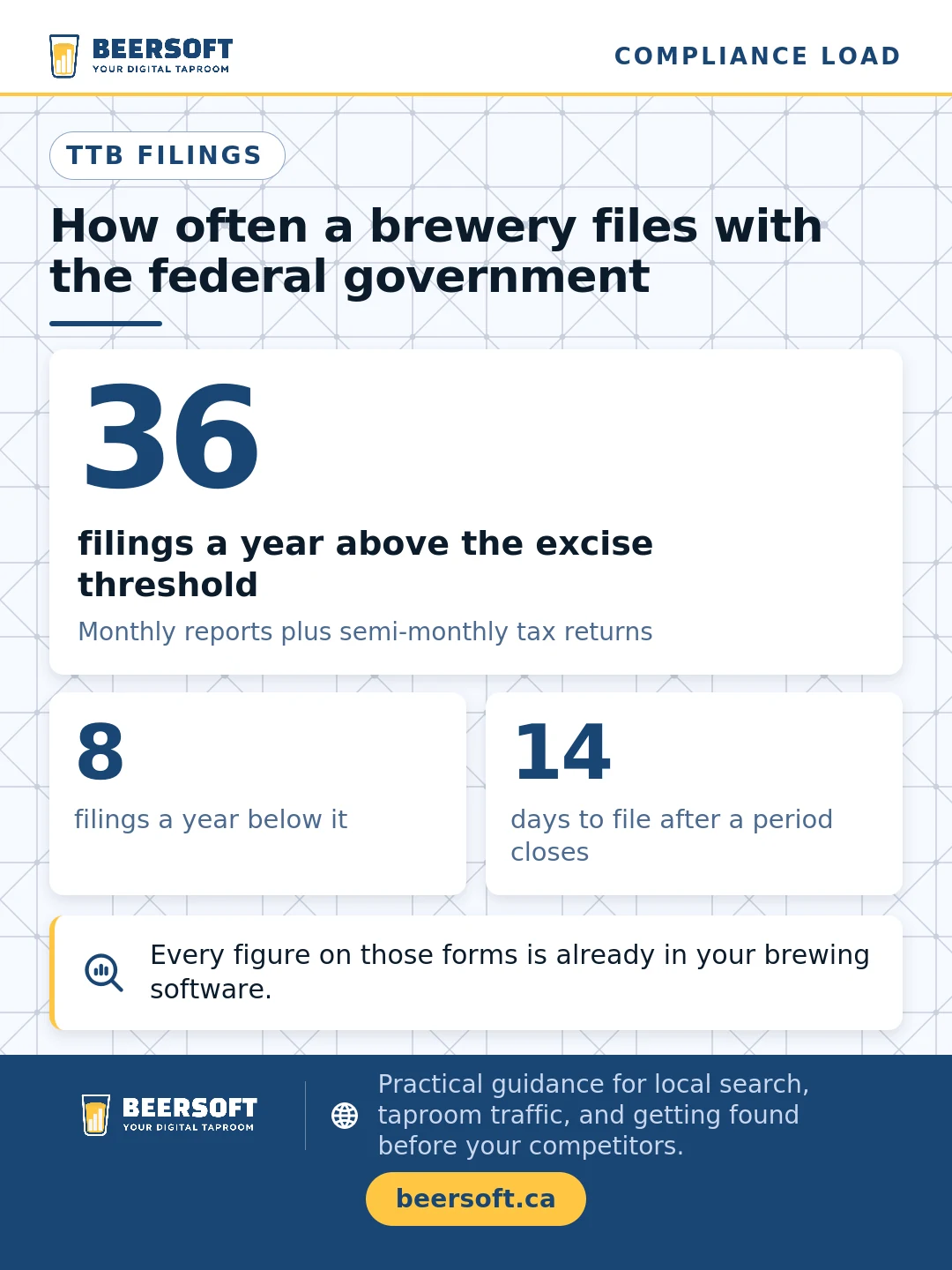
Most taproom automation advice starts with marketing email, which is the wrong end. The workflows worth automating first are the ones that are mandatory, recurring and built on data you already hold. Federal reporting is all three: a brewery over the $50,000 excise threshold files thirty-six times a year between monthly operations reports and semi-monthly tax returns, and every figure on those forms already exists in the brewing software. The work is transcription, and transcription is what should not be manual. Automate the data movement that has a deadline attached, then the facts that have to appear in more than one place, and leave anything requiring judgment about a person alone.
Introduction: Automation Advice for Hospitality Is Written for Restaurants
Search for taproom automation and you will find the same list every time. Welcome emails, birthday offers, abandoned-cart sequences, review requests. It is restaurant marketing advice with the word brewery pasted over it.
None of it is wrong. It is just not where the hours go.
A brewery is a manufacturer with a bar attached, and manufacturers carry obligations a restaurant does not. Production gets logged, removals get tracked, inventory moves between tax-determined and not, and the federal government wants a form about it on a schedule. That work is repetitive, deadline-bound and entirely built on numbers that already exist somewhere in your systems. It is the textbook case for automation, and it almost never appears on a list of things to automate because the people writing the lists have never filed a Brewer's Report of Operations.
Automation conversations are a regular part of BeerSoft onboarding, and they usually open with a request for email sequences. They usually end somewhere else.
Here is the order that actually makes sense.
Which Workflows Actually Repeat Often Enough to Automate?
The ones with a deadline and a form. Frequency is the filter, not novelty.
Run every candidate through three questions. How often does it happen. Does the data already exist somewhere. What happens if it is late. Anything that scores high on all three is worth connecting. Anything that happens twice a year, needs a human decision, or costs nothing when delayed is not.
That test disqualifies most of what gets recommended. A welcome email fires once per customer and nothing breaks if it is late. A quarterly excise return has a statutory deadline fourteen days after the period closes.
Key Takeaway: Rank candidates by how often they repeat and what it costs when they slip. Novelty and vendor enthusiasm are not inputs.
Not sure which of your systems already talk to each other? Start with a business analysis and map the workflow before you automate any part of it.
Why Is Compliance Reporting the Highest-Value Automation?
Because the volume is larger than most operators realize, the deadlines are statutory, and the numbers are already in your software.
Every brewery with an approved Brewer's Notice files a Brewer's Report of Operations, and the obligation starts with the first reporting period after approval. Which form and how often depends on one number: your beer excise tax liability for the preceding calendar year.
Under $50,000 and you may report quarterly, using either TTB F 5130.9 or the simplified TTB F 5130.26, with excise tax returns quarterly too. Over $50,000 and you report monthly on TTB F 5130.9, and your excise tax returns move to semi-monthly, twice every month.
Thirty-six filings is a filing every ten days, all year, each one built from production, removal and inventory figures. Reports are due within fourteen days of the period closing, and September splits its second period into two, which is the kind of detail a calendar reminder handles better than a person.
What makes this the strongest automation candidate is that none of the data is new. Barrels produced, barrels removed for consumption or sale, beer returned, materials used in pounds by classification: your brewing software is already recording all of it. The manual work is transcription, and transcription is exactly what should not be manual.
A caution worth stating plainly. Automating the data movement is not the same as automating the filing. Numbers that feed a federal form should be assembled automatically and signed off by a person, because the signature carries liability that no integration can absorb.
Key Takeaway: Connect the brewing software to the reporting workflow so the figures assemble themselves, then keep a human on the submit button. The transcription is the waste, not the judgment.
What Should You Connect After That?
The tap list, and then the member list.
Your current beers exist in at least three places: the POS, the board on the wall, and the website. In most taprooms those are updated by three different people at three different times, which is why a searcher is regularly told you have a beer you kicked on Saturday. Whatever system holds the authoritative list should push to the website rather than someone retyping it. That single connection removes the most common cause of a wrong answer to a customer.
Membership renewals come next, and only if you run a club. A mug club is a rolling set of individual renewal dates, which is unmanageable by memory and trivial for a sequence. We made the case for treating the member list as a real record rather than a spreadsheet, and the renewal reminder is what that record is for.
Event listings are fourth. The same event typically needs to exist on your site, your Google Business Profile and at least one social platform, and the work is duplication rather than thought.
Opening hours belong in the same category and are worth calling out separately, because they are the one fact a searcher acts on immediately. Holiday hours, an early close for a private event, a seasonal change: each has to land on the website and the Google Business Profile, and when the two disagree the listing usually wins, which sends somebody to a locked door. If one of those can be made to follow the other automatically, do it before anything involving email.
Key Takeaway: After compliance, automate the things where the same fact has to appear in more than one place. Duplication is the signal.
What Should You Never Automate?
Anything where the output is a judgment about a person.
Review responses are the clearest case. An automated reply to a one-star review reads as an automated reply to a one-star review, and it converts a recoverable complaint into a public demonstration that nobody is listening. The generation can be assisted; the sending should not be.
Beer descriptions are the second. A tasting note is the one piece of copy on your site that proves someone who makes the beer wrote it.
The version BeerSoft sees most often is a taproom that automated its social posting, then quietly stopped posting anything worth reading, because the scheduling tool made volume easy and relevance nobody's job.
The test is simple. If a customer would feel differently on learning a machine did it, keep a person in the loop.
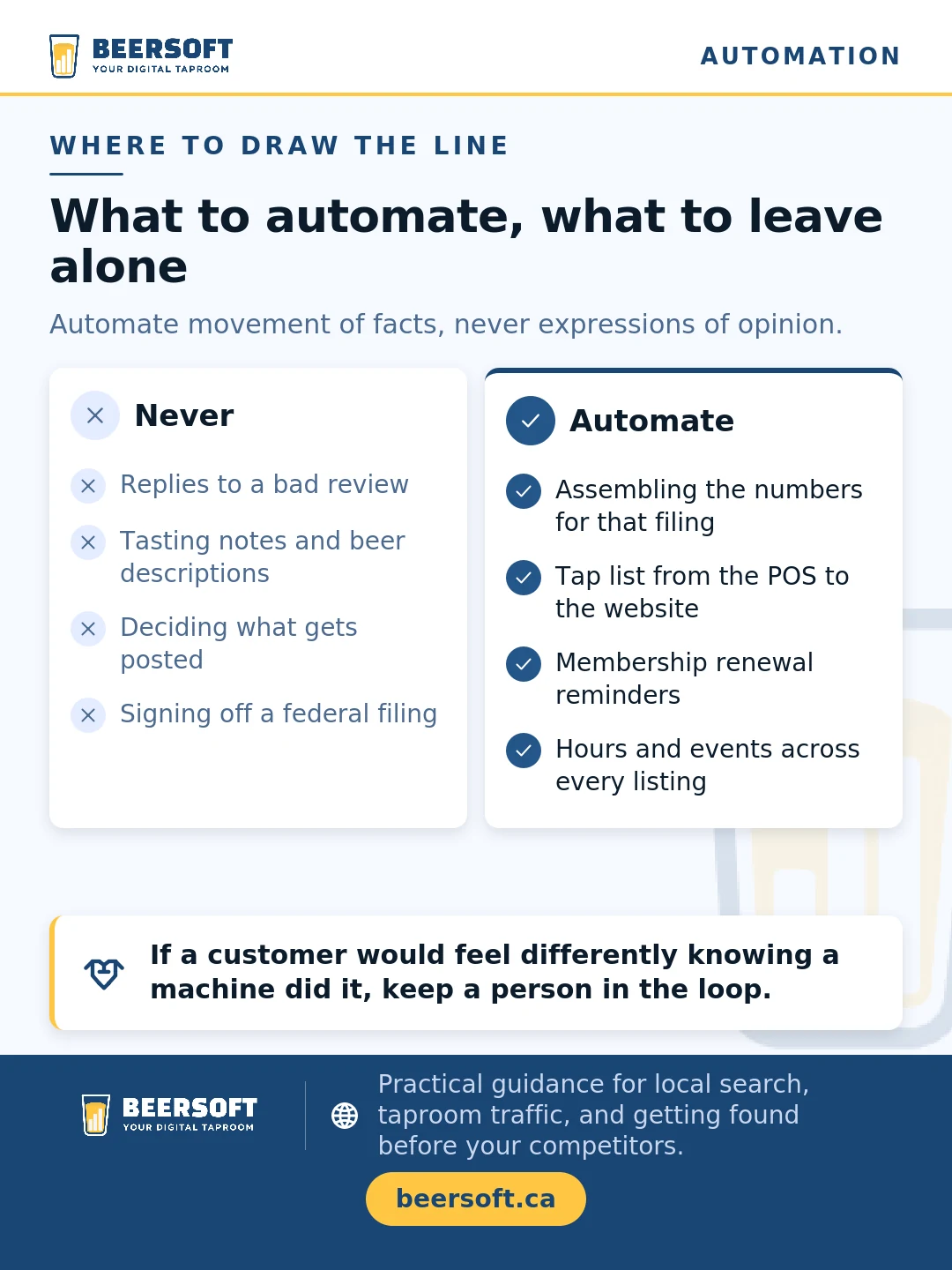
Key Takeaway: Automate movement of facts. Do not automate expressions of opinion, apology or taste.
How Should You Sequence the Work?
Smallest useful connection first, and never more than one at a time.
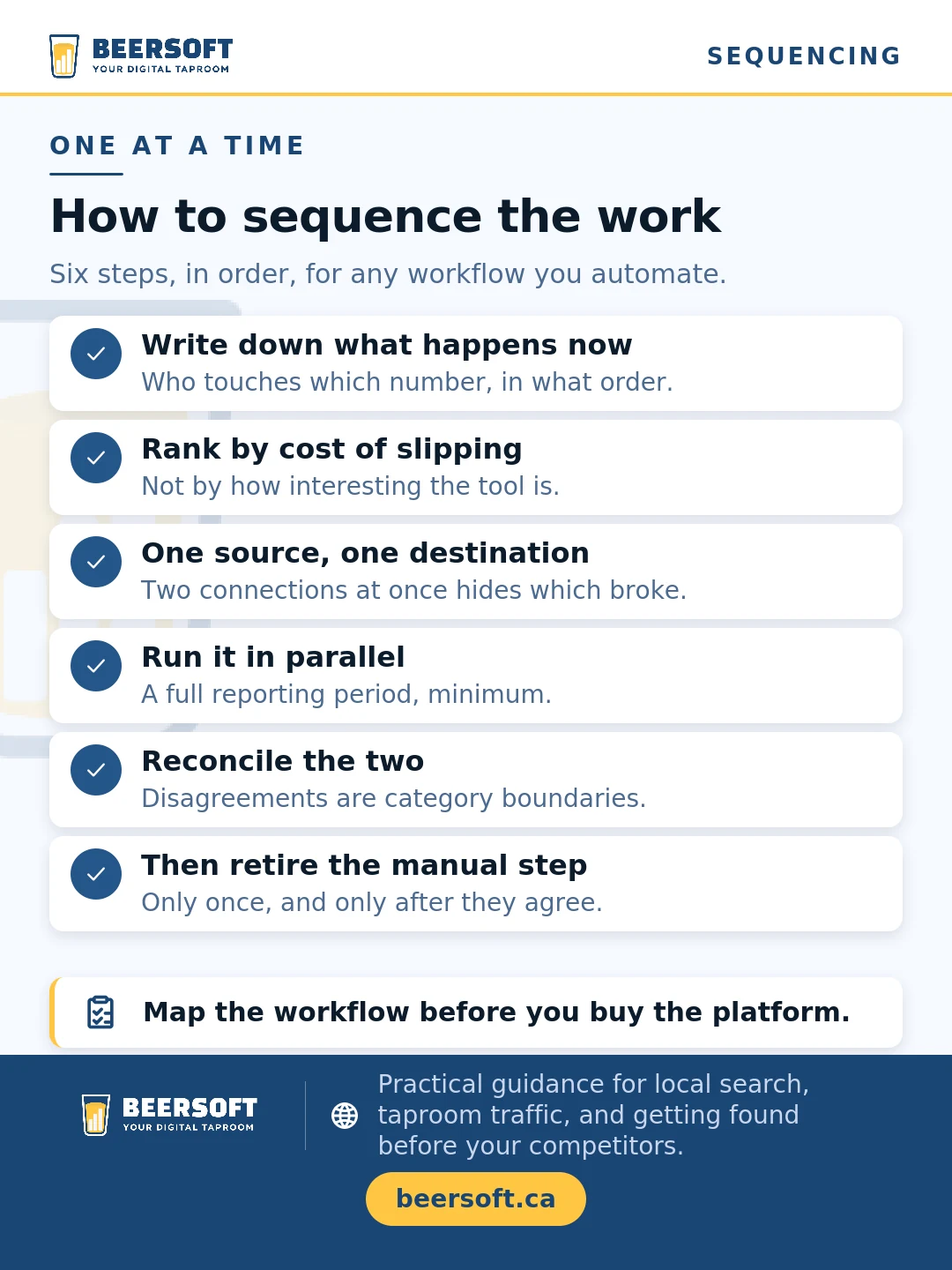
The failure mode is buying a platform before mapping a workflow. Automation tools are sold as capability, and capability is easy to buy and hard to apply. What determines whether any of it works is whether somebody has written down, in order, what currently happens and who does it.
Start with the workflow that costs the most when it slips, connect one source to one destination, run it for a full cycle in parallel with the manual process, and only then turn the manual one off. A compliance workflow should be run alongside for at least one complete reporting period before anybody trusts it. For a quarterly filer that means three months of keeping two sets of numbers and comparing them at the end, which feels wasteful right up until the first quarter they disagree. When they do disagree, the answer is almost never that the automation is broken in an obvious way. It is that a category boundary was drawn differently by the software than by the person who used to do it, and that is exactly the thing a parallel run exists to surface.
Key Takeaway: One connection, one full cycle in parallel, then retire the manual step. Automating two things at once means you cannot tell which one broke.
Frequently Asked Questions
What should a brewery automate first?
Federal compliance reporting, because it is mandatory, frequent and built entirely on data your brewing software already holds. A brewery over the $50,000 excise threshold files thirty-six times a year between monthly operations reports and semi-monthly tax returns. Automate the assembly of those figures, keep a person on the submission, and you have removed the largest block of recurring transcription in the business.
How often does a brewery have to file with the TTB?
It depends on excise tax liability in the preceding calendar year. At $50,000 or less you may file the Brewer's Report of Operations quarterly with quarterly tax returns, which is eight filings a year. Above $50,000 the report is monthly and tax returns become semi-monthly, which is thirty-six. Brewers liable for $1,000 or less may file annual tax returns. Reports are generally due within fourteen days of the period closing.
Is Zapier enough for a brewery, or do I need custom integration?
For most single-location taprooms, a connector tool handles the common cases: pushing a tap list, syncing a mailing list, creating calendar entries. Custom work becomes worthwhile when the data has to be transformed rather than moved, when compliance figures are involved, or when a platform has no public integration. Start with the simpler option and let a real limitation justify the upgrade.
Should I automate my brewery's social media posting?
Scheduling is fine. Generating is not. Scheduling moves work you already decided to do into a better time slot. Automated content generation tends to produce volume that nobody is accountable for, and a taproom feed with nothing worth reading performs worse than an irregular one with something in it. Keep a person deciding what gets posted.
What is the risk of automating compliance data?
The risk is not the automation, it is the assumption that it is correct. An integration that quietly misclassifies a removal will do so consistently, which is worse than a human doing it wrong once. Run any compliance automation in parallel with the manual process for at least one full reporting period, reconcile the two, and keep a named person signing off on every submission.
Conclusion: Map It Before You Buy Anything
Write down what actually happens now. Who touches which number, in what order, and how often. One page, done honestly, and most of the decisions make themselves.
Then take the workflow with the highest cost of slipping, which for almost every brewery is federal reporting, and connect one source to one destination. Run it in parallel for a full period. Retire the manual step only when the two agree.
Mapping the workflows and building the connections that hold up under a deadline is the part that gets skipped, and it is the part BeerSoft picks up: automation and workflow integration is where that work lives. Contact us with a list of the systems you run and we will tell you which ones already talk to each other.
If you take nothing else from this: the welcome email can wait. The filing cannot.
Sources
- Alcohol and Tobacco Tax and Trade Bureau. Requirements for Brewery Operations.
- Alcohol and Tobacco Tax and Trade Bureau. Maintaining Compliance in a Beverage Alcohol Related Business.
- Alcohol and Tobacco Tax and Trade Bureau. TTB F 5130.9, Brewer's Report of Operations.
- Electronic Code of Federal Regulations. 27 CFR Part 25, Beer.
- Brewers Association. 2026 Midyear Report. July 22, 2026.
Stay Ahead - Subscribe Now!
You may also be interested
Brewery Website Migration: How to Move Platforms Without Losing Your Rankings
When a brewery actually needs to change platforms, what a migration genuinely puts at risk, the URL map that has to exist before anything moves, and the checks that close it out

Brewery Email Marketing: The Four Sends That Earn Their Keep
Why the newsletter is the weakest thing you can do with a brewery list, the four sends that replace it, where the names actually come from, and the two numbers worth reporting
Should Your Taproom Run a Chatbot?
What a taproom chatbot would actually be asked, what the 2026 data says about how chatbots perform, why the tap list is the worst thing to put in one, the narrow cases where it does pay, and what to fix instead
Beer Photography for Small Breweries: What to Shoot and When
What a small brewery actually needs photographs of, why a beer shot takes longer than it looks, what a half-day and a full day cost and deliver, which images have a window that closes, and how to write a brief
What a Brewery Website Costs, and What Drives the Number
Why quotes for the same brewery website vary by three times, what makes a taproom site structurally different from a brochure site, which decisions actually move the price, what you pay after launch, and how to compare quotes fairly

Choosing a Taproom POS: What to Ask Before You Sign
What a brewery POS has to do that a restaurant POS does not, why the processing rate matters more than the subscription, what is actually in the contract, who owns your data when you leave, and the questions to ask before signing
Beer Label Design: What the Regulator Requires Before the Designer Starts
What the TTB requires on every beer label, how long approval actually takes in 2026, which rules constrain the artwork itself, what really delays a launch, and the brief a designer needs before starting
How to Start a Brewery: The Digital Foundations to Get Right First
What the federal and state approval timeline actually looks like in 2026, why your brewery name is a digital decision before it is a branding one, what to build during the approval window, and what has to be live before your first pour

The Three-Tier System, Explained for Brewery Marketers
Why the three-tier system exists, which marketing activities it forbids outright, exactly what a brewery may legally give a retailer and up to what value, why beer is treated differently from wine and spirits, and which channel you fully control
What Is a Mug Club? How Taprooms Build Recurring Revenue from Members
What a mug club is, how it differs from a points program, what the membership fee actually buys a taproom, the liquor-law rules that decide how you structure it, and how to publish the club so it can be found

ABV, IBU and SRM Explained: The Numbers on Your Tap List
What ABV, IBU and SRM actually measure, why the IBU number misleads drinkers, what the TTB requires you to print, and how to publish the specs so search engines and AI assistants can read them

Craft Beer Consumer Behavior in 2026: What the Data Means for Your Marketing Budget
How the major craft beer consumer behavior shifts of 2024 to 2026 translate into practical marketing budget decisions for taproom breweries, brewpubs, and microbreweries

Brewery Tourism Marketing: How to Attract Out-of-Town Visitors and Drive Weekend Traffic
How taproom breweries can attract out-of-town visitors, rank in tourism discovery platforms, and build the partnerships that drive consistent weekend traffic from the tourist segment in 2026
Brewery Loyalty Programs: Do Points and Perks Actually Drive Repeat Visits?
An evidence-based guide to brewery loyalty program mechanics, platform options, and ROI measurement for taproom operators considering whether and how to launch a customer loyalty program in 2026

Brewery Events as a Revenue Engine: How to Promote, Price, and Measure
How taproom breweries and brewpubs can promote, price, and measure events as a primary revenue engine rather than a secondary marketing activity in 2026
Brewery Merchandise and Secondary Revenue: How to Market Beyond the Pint
How taproom breweries and brewpubs can market merchandise, crowler programs, and beer club memberships as both a revenue diversification tool and a customer loyalty driver in 2026
12 Things Killing Your Local Search Rankings Right Now
A 12-point self-audit guide for brewery operators to identify and fix the website issues most commonly responsible for poor local search rankings and limited AI search visibility in 2026

Marketing Non-Alcoholic Beer: How Craft Breweries Can Capture the Sober Curious Consumer
How craft breweries can market non-alcoholic beer lines to sober-curious consumers, health-conscious drinkers, and younger demographics to capture the fastest-growing segment in the craft beer market in 2026
.webp)
Brewpub Marketing Strategy: How to Fill Both the Bar and the Dining Room
How brewpubs can use digital marketing to fill both the dining room and the bar by marketing the food and beer experience as a unified destination rather than two separate offerings
Microbrewery Marketing in a Shrinking Distribution Market: What to Do When Shelf Space Disappears
How microbreweries facing shrinking distributor interest and tightening shelf space can use digital marketing to differentiate their brand and pivot toward direct-to-consumer channels in 2026

Brewery Social Media Strategy for 2026: Instagram, Facebook, and When to Bother with TikTok
A platform-by-platform social media strategy for taproom breweries and brewpubs in 2026, covering Instagram, Facebook, and TikTok with content mix ratios and posting cadence

Brewery Content Marketing in 2026: What to Publish, When, and Why It Works
What to publish, when to publish it, and why a structured content marketing program is the highest-ROI long-term investment available to brewery operators in 2026
Meta Ads for Breweries: A Geo-Targeted Playbook for Taprooms and Brewpubs
A geo-targeted Meta advertising playbook for taproom breweries and brewpubs covering campaign structure, audience targeting, ad formats, and budget guidance for 2026

Multi-Location Brewery SEO: How Regional Craft Breweries Rank in Every Market
How regional craft breweries operating multiple taprooms can build an SEO architecture that ranks independently in every local market without cannibalizing results.
Brewery Review Marketing: How to Turn Guest Feedback into Local Search Fuel
Google reviews are the number two local ranking factor for breweries. Learn how to generate, respond to, and optimize reviews for local search and AI search visibility.
Google Business Profile for Breweries: The Complete 2026 Optimization Guide
How to set up, optimize, and maintain your brewery's Google Business Profile to dominate local search and drive foot traffic in 2026.

How to Make Your Brewery Visible in AI Search: A GEO Guide for Craft Breweries
How craft breweries can use Generative Engine Optimization (GEO) to stay visible in AI-powered search results in 2026