What a Brewery Website Costs, and What Drives the Number

Share the page:
Most professionally built small business websites land between about $3,000 and $15,000, with freelancers lower and agencies higher, plus ongoing costs of roughly $50 to $200 a month. But a brewery site is not a brochure site, and that is where the quotes start diverging. Your beers are a collection that changes weekly, your events are another, and both need a content system rather than static pages. That structural requirement is what lifts a taproom site out of the cheapest band, and understanding it is what lets you tell a fair quote from an expensive one.
Introduction: Two Sites Can Cost Ten Times as Much and Look Identical
A brewery owner asks three people what a website costs and gets $4,000, $12,000 and $30,000. Nobody explains the gap, so it reads as three opinions about the same thing.
It is not. Those are quotes for three different projects that happen to share a name.
The word "website" covers a five-page brochure you fill in yourself and a content-managed system with a beer collection, an events calendar, original photography and a merch store. A visitor might not be able to tell them apart on the homepage. The difference shows up in the second month, when you add four beers and either update them in ninety seconds or email someone.
Website conversations in BeerSoft onboarding almost always start with the number and end somewhere else, because the number was never the disagreement. The scope was.
Here is what the market actually charges, what a brewery specifically needs, and which decisions move the price.
Why Do Two Quotes for the Same Site Differ by Three Times?
Because scope varies more than quality does, and scope is invisible in a total.
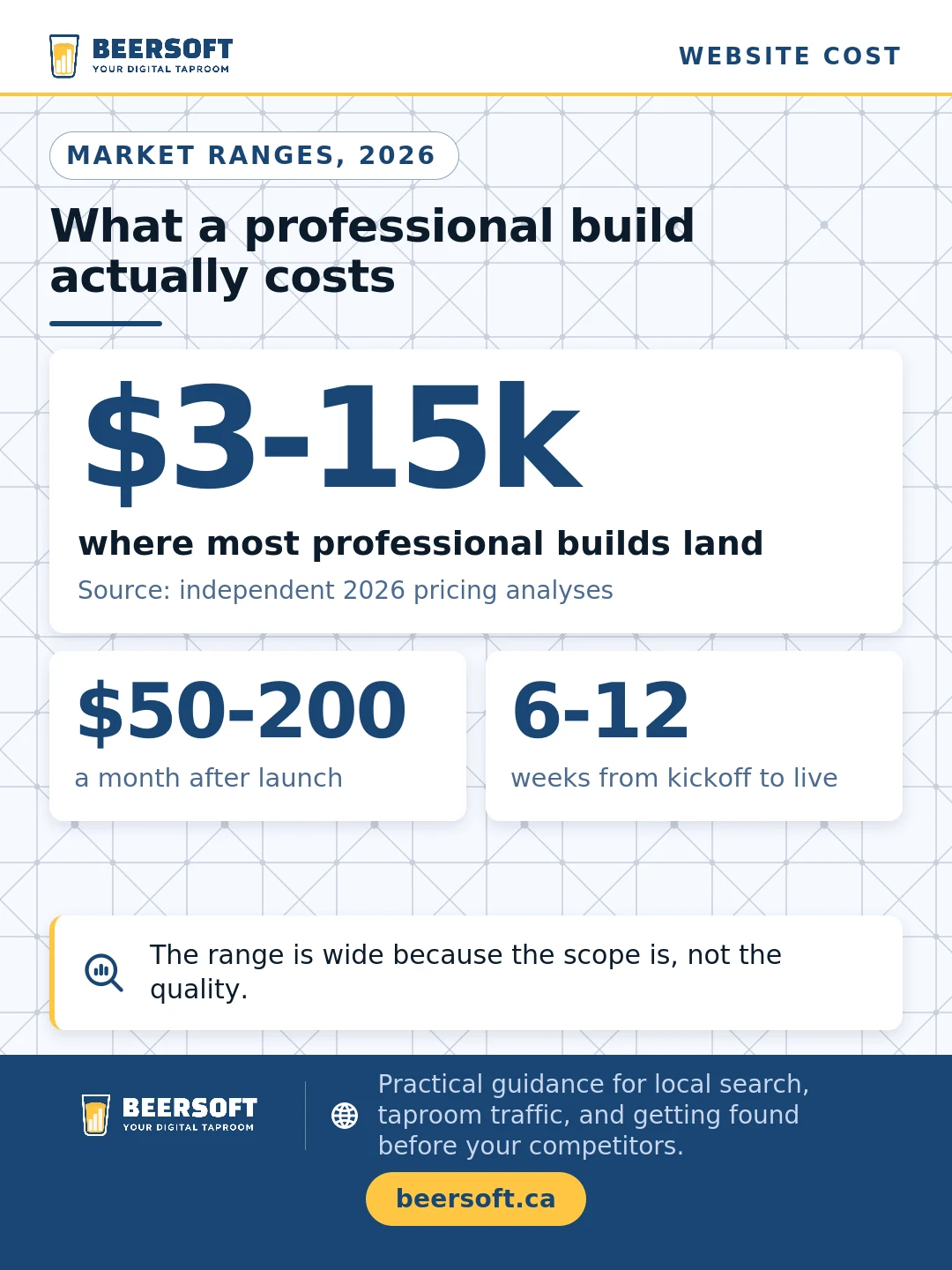
Those bands are wide on purpose, because the same range covers a dentist and a brewery. Two proposals at similar prices can still deliver very different things, which is why the useful comparison is scope against scope rather than total against total.
Key Takeaway: A quote is a number attached to a scope. Without the scope beside it, the number tells you nothing at all.
Comparing proposals right now? Talk to us about photography and content, which is usually the line item quotes differ on most and describe least.
What Makes a Brewery Site Different from a Brochure Site?
Your beers are not pages. They are a collection, and that one fact restructures the whole build.
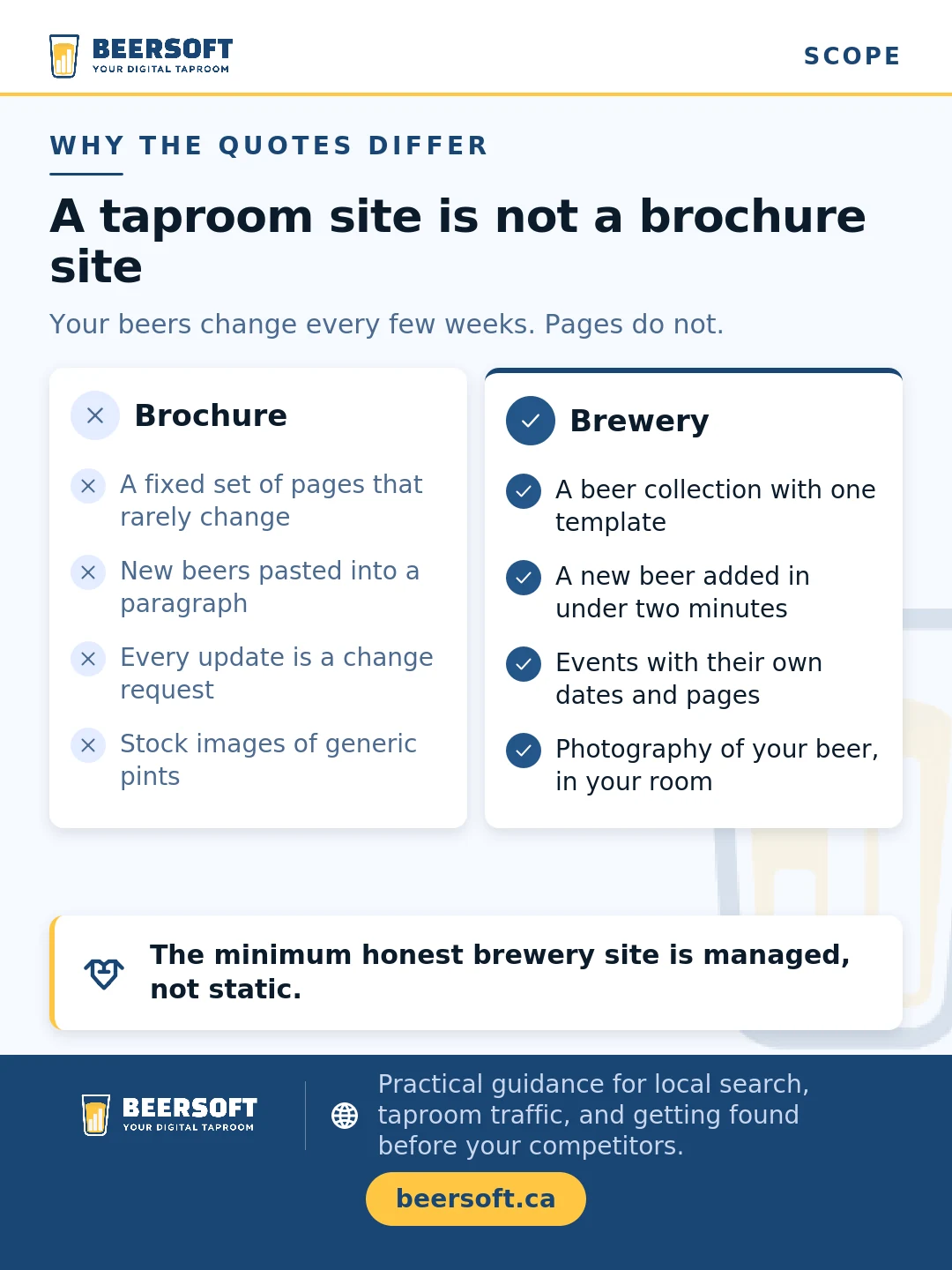
A five-page brochure site has a fixed set of pages that rarely change: home, about, services, contact. That is what the cheapest professional band is priced around, and it is a perfectly good product for a business that fits it.
A brewery does not fit it. You have a set of beers that changes every few weeks, each needing its own page with name, style, ABV, description and an image. You have events that recur. Those are content collections, which means the site needs a content management structure rather than a set of static pages, and somebody has to design a template that works for a beer that does not exist yet.
This is the thing most brewery owners discover after buying the wrong tier. The site looks right on launch day and becomes unmaintainable in month three, when adding a new beer means paying for a change request or pasting it into a paragraph where nothing can find it.
The practical test is a stopwatch. Ask any bidder to show you, live, how a new beer gets added: name, style, strength, description, photograph, published. On a site built around a collection that is under two minutes and a member of your staff can do it. On a brochure build it is an email, a queue and an invoice. Over three years that difference costs more than the gap between the two quotes, and it is the reason a tap list goes stale.
Key Takeaway: The minimum honest brewery site is a content-managed site with two collections. Anything priced as a brochure is priced for a different business.
What Actually Moves the Number?
Four things, in rough order of impact.
Content production. Photography and copywriting are routinely the largest variable in a quote and the least specified. Independent 2026 figures put copywriting around $50 to $150 an hour and a photo shoot at roughly $500 to $2,500. A proposal that includes original photography and one that says "client to supply images" are not comparable, and the second one quietly transfers a real cost to you.
Design approach. A template you fill in costs far less than a design built around your brand. Neither is wrong. What matters is that the difference is thousands of dollars and it is often invisible in the proposal.
Photography deserves separating out, because it is the one line where a brewery genuinely cannot substitute. Stock images of generic pints read as stock images of generic pints, and they undercut the one claim a taproom site is making, which is that this place is specific and worth the drive. A shoot is a real cost with a real range attached, but it is also an asset that outlives the website and feeds every other channel you run.
Structure. Page count still matters, but for a brewery the collections matter more. Two collections with well-built templates will serve you better than twenty hand-built pages.
Commerce. Adding a store is not a feature, it is a project. Tax, shipping, inventory and the compliance questions around shipping alcohol all arrive with it.
Key Takeaway: Ask every quote to separate design, build, content and commerce into four numbers. Most of the variance you are trying to understand lives in the third one.
What Do You Pay After Launch?
Between roughly $50 and $200 a month for a custom site, and it is rarely in the proposal.
That covers hosting, the CMS subscription, SSL, backups, security updates and small changes. Independent analyses put the annual total that owners overlook at somewhere between $1,100 and $5,000 depending on the stack and the support arrangement.
The number worth asking about specifically is change requests. Some arrangements include a monthly allowance, some bill hourly, and the difference decides whether you keep the site current or let it drift. A brewery that cannot update its own tap list will stop updating its tap list.
Key Takeaway: Ask what a typical month of small changes costs before you sign, not after your first invoice for one.
How Do You Compare Quotes Fairly?
By normalizing the scope before you look at the totals.
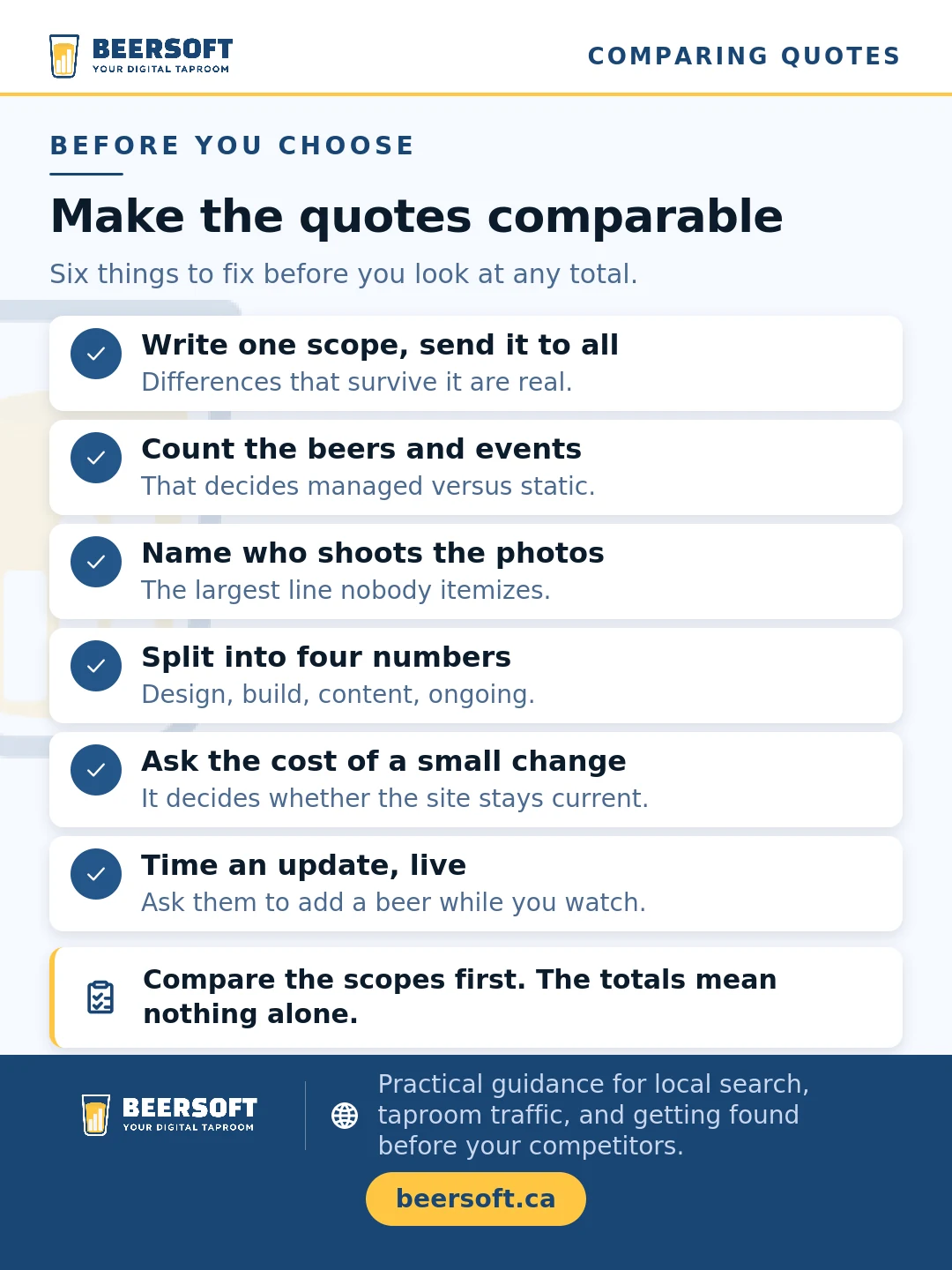
The version BeerSoft sees most often is an owner comparing three proposals that describe different projects, picking the middle one because it feels safe, and discovering the missing pieces at month two. The fix is not negotiating harder. It is making all three quotes describe the same thing first.
One practical note. If a proposal will not break down into design, build, content and ongoing, that is information. A firm that cannot separate those has not scoped the work, and the number at the bottom is an estimate of its own comfort rather than of your project.
One more thing worth saying, because most agency writing on this subject will not. Sometimes the cheapest option is the right one. A brewery that is pre-revenue, or that genuinely has four beers and no events, does not need a managed build yet, and buying one early ties up money that belongs in the brewhouse. The failure to avoid is not spending too little. It is buying a structure that cannot grow into what you already know you will need within a year.
Key Takeaway: Send every bidder the same one-page scope. Differences that survive that are real differences in approach, and those are worth paying for.
Frequently Asked Questions
How much does a brewery website cost?
Most professionally built small business sites land between about $3,000 and $15,000, with freelancers typically $1,500 to $8,000 and agencies $5,000 to $35,000 or more. A brewery usually sits above the bottom of that range, because a taproom site needs content collections for beers and events rather than a fixed set of pages. Ongoing costs add roughly $50 to $200 a month.
Why are website quotes so different for the same project?
Because they are usually not the same project. Page count, template versus custom design, whether original photography and copywriting are included, and whether commerce is in scope each move the price by thousands independently. Two proposals with similar totals can deliver very different things, so compare the scope first and the number second.
Does a brewery need a custom website or will a template do?
A template is fine as long as it supports content collections, because your beers and events change and static pages do not handle that. What a brewery should avoid is a five-page brochure build, which looks right at launch and becomes unmaintainable once the tap list moves. The question is less custom versus template than managed versus static.
What are the ongoing costs of a brewery website?
Hosting, the CMS subscription, SSL, backups, security updates and small content changes, commonly $50 to $200 a month for a custom site. Independent 2026 analyses put the annual figure owners tend to overlook at $1,100 to $5,000. Ask specifically how change requests are billed, because that determines whether the site stays current.
How long does a brewery website take to build?
Most small business projects run six to twelve weeks from kickoff to launch. Template-based builds move faster; anything involving original photography, branding work or commerce takes longer. If you are opening a brewery, that timeline fits comfortably inside the federal and state approval window, which is the argument for starting it early rather than late.
Conclusion: Normalize the Scope, Then Look at the Price
Write a one-page scope before you ask anybody for a number. How many beers, whether events need their own pages, whether you are selling anything, who is taking the photographs, and who updates the tap list on a Tuesday. Send the same page to everyone.
Then ask each proposal to split into four numbers: design, build, content, and ongoing. The spread you are trying to understand is almost always in content, and it is almost always the line nobody itemizes.
Scoping a brewery site so the quotes are comparable, and building one that an owner can actually maintain, is the part that decides whether the investment holds up. It is the part BeerSoft picks up: website design and build is where that work lives. Contact us with the proposals you are weighing and we will tell you what they are not comparing.
If you have not opened yet, the sequencing matters more than the price, and that version is here.
Sources
- Leadpages. How Much Does a Website Cost? 2026 Design Price Guide. July 13, 2026.
- GruffyGoat. Small Business Website Costs 2026: Calculator and Breakdown.
- Jim.com. Small Business Website Cost: How to Budget.
- Elementor. How Much Does a Small Business Website Cost? A 2026 Breakdown. June 29, 2026.
- Ziel Creative. How Much Does a Custom Website Cost in 2026? July 21, 2026.
Stay Ahead - Subscribe Now!
You may also be interested

Brewery Website Migration: How to Move Platforms Without Losing Your Rankings
When a brewery actually needs to change platforms, what a migration genuinely puts at risk, the URL map that has to exist before anything moves, and the checks that close it out

Brewery Email Marketing: The Four Sends That Earn Their Keep
Why the newsletter is the weakest thing you can do with a brewery list, the four sends that replace it, where the names actually come from, and the two numbers worth reporting
Should Your Taproom Run a Chatbot?
What a taproom chatbot would actually be asked, what the 2026 data says about how chatbots perform, why the tap list is the worst thing to put in one, the narrow cases where it does pay, and what to fix instead
Beer Photography for Small Breweries: What to Shoot and When
What a small brewery actually needs photographs of, why a beer shot takes longer than it looks, what a half-day and a full day cost and deliver, which images have a window that closes, and how to write a brief

Choosing a Taproom POS: What to Ask Before You Sign
What a brewery POS has to do that a restaurant POS does not, why the processing rate matters more than the subscription, what is actually in the contract, who owns your data when you leave, and the questions to ask before signing

Which Taproom Workflows to Automate First
Which taproom workflows actually repeat often enough to justify automating, why federal compliance reporting is the highest-value target, what to connect after that, what to leave alone, and the order to do it in

Beer Label Design: What the Regulator Requires Before the Designer Starts
What the TTB requires on every beer label, how long approval actually takes in 2026, which rules constrain the artwork itself, what really delays a launch, and the brief a designer needs before starting
How to Start a Brewery: The Digital Foundations to Get Right First
What the federal and state approval timeline actually looks like in 2026, why your brewery name is a digital decision before it is a branding one, what to build during the approval window, and what has to be live before your first pour

The Three-Tier System, Explained for Brewery Marketers
Why the three-tier system exists, which marketing activities it forbids outright, exactly what a brewery may legally give a retailer and up to what value, why beer is treated differently from wine and spirits, and which channel you fully control
What Is a Mug Club? How Taprooms Build Recurring Revenue from Members
What a mug club is, how it differs from a points program, what the membership fee actually buys a taproom, the liquor-law rules that decide how you structure it, and how to publish the club so it can be found

ABV, IBU and SRM Explained: The Numbers on Your Tap List
What ABV, IBU and SRM actually measure, why the IBU number misleads drinkers, what the TTB requires you to print, and how to publish the specs so search engines and AI assistants can read them

Craft Beer Consumer Behavior in 2026: What the Data Means for Your Marketing Budget
How the major craft beer consumer behavior shifts of 2024 to 2026 translate into practical marketing budget decisions for taproom breweries, brewpubs, and microbreweries

Brewery Tourism Marketing: How to Attract Out-of-Town Visitors and Drive Weekend Traffic
How taproom breweries can attract out-of-town visitors, rank in tourism discovery platforms, and build the partnerships that drive consistent weekend traffic from the tourist segment in 2026
Brewery Loyalty Programs: Do Points and Perks Actually Drive Repeat Visits?
An evidence-based guide to brewery loyalty program mechanics, platform options, and ROI measurement for taproom operators considering whether and how to launch a customer loyalty program in 2026
Brewery Events as a Revenue Engine: How to Promote, Price, and Measure
How taproom breweries and brewpubs can promote, price, and measure events as a primary revenue engine rather than a secondary marketing activity in 2026
Brewery Merchandise and Secondary Revenue: How to Market Beyond the Pint
How taproom breweries and brewpubs can market merchandise, crowler programs, and beer club memberships as both a revenue diversification tool and a customer loyalty driver in 2026
12 Things Killing Your Local Search Rankings Right Now
A 12-point self-audit guide for brewery operators to identify and fix the website issues most commonly responsible for poor local search rankings and limited AI search visibility in 2026

Marketing Non-Alcoholic Beer: How Craft Breweries Can Capture the Sober Curious Consumer
How craft breweries can market non-alcoholic beer lines to sober-curious consumers, health-conscious drinkers, and younger demographics to capture the fastest-growing segment in the craft beer market in 2026
.webp)
Brewpub Marketing Strategy: How to Fill Both the Bar and the Dining Room
How brewpubs can use digital marketing to fill both the dining room and the bar by marketing the food and beer experience as a unified destination rather than two separate offerings
Microbrewery Marketing in a Shrinking Distribution Market: What to Do When Shelf Space Disappears
How microbreweries facing shrinking distributor interest and tightening shelf space can use digital marketing to differentiate their brand and pivot toward direct-to-consumer channels in 2026

Brewery Social Media Strategy for 2026: Instagram, Facebook, and When to Bother with TikTok
A platform-by-platform social media strategy for taproom breweries and brewpubs in 2026, covering Instagram, Facebook, and TikTok with content mix ratios and posting cadence

Brewery Content Marketing in 2026: What to Publish, When, and Why It Works
What to publish, when to publish it, and why a structured content marketing program is the highest-ROI long-term investment available to brewery operators in 2026
Meta Ads for Breweries: A Geo-Targeted Playbook for Taprooms and Brewpubs
A geo-targeted Meta advertising playbook for taproom breweries and brewpubs covering campaign structure, audience targeting, ad formats, and budget guidance for 2026
Multi-Location Brewery SEO: How Regional Craft Breweries Rank in Every Market
How regional craft breweries operating multiple taprooms can build an SEO architecture that ranks independently in every local market without cannibalizing results.
Brewery Review Marketing: How to Turn Guest Feedback into Local Search Fuel
Google reviews are the number two local ranking factor for breweries. Learn how to generate, respond to, and optimize reviews for local search and AI search visibility.

Google Business Profile for Breweries: The Complete 2026 Optimization Guide
How to set up, optimize, and maintain your brewery's Google Business Profile to dominate local search and drive foot traffic in 2026.

How to Make Your Brewery Visible in AI Search: A GEO Guide for Craft Breweries
How craft breweries can use Generative Engine Optimization (GEO) to stay visible in AI-powered search results in 2026