Beer Can Design That Sells: Shelf Impact for Craft Packaging

Share the page:
A can does not get one heroic moment on the shelf. Field eye-tracking in real stores found shoppers average 26 separate glances at products before a purchase, totalling about 16 seconds, while only one purchase in seven involved looking at price at all. That is a design brief for recognition across repeated short looks, not for a poster. The practical decisions that follow are which elements stay constant across your whole range, and which decoration method you can afford: direct printing onto cans starts at roughly a truckload, about 150,000 units, while sleeves and labels can be bought by the reel.
Introduction: The Can Is Not the Artwork. It Is the Shelf Talker.
Most craft can design goes wrong in a specific and expensive way: every beer gets its own beautiful, unrelated illustration. Four releases in, the brewery has four pieces of artwork and no brand. A customer who liked the hazy pale last month cannot find the same brewery this month, because nothing on the shelf tells them it is the same brewery.
That is not a taste failure. The artwork is usually excellent. It is a systems failure, and it happens because the design was commissioned one can at a time by people looking at a screen, then judged at arm's length on a desk rather than at six feet in a cold aisle beside forty competitors. It is the most common packaging finding in BeerSoft brand reviews, and it is almost never the designer's fault.
The regulator's half of this is already written up in the piece on what the TTB requires before the designer starts. That one ends by telling you to brief the designer rather than the regulator. This is the brief.
What follows is what a can is actually competing against, what should never change across your range, and the printing decision that quietly caps everything else.
What Is the Can Actually Competing Against?
Not the other cans. Your own customer's memory, under time pressure, at a distance, on a cold shelf.
The best evidence on this is not from packaging agencies, it is from academic field research. Aleksandra Kovacheva and J. Jeffrey Inman ran mobile eye-tracking on shoppers in real grocery and mass merchandise stores. Across 63 shoppers making 220 purchases in 32 categories, product glances averaged 26.42 per purchase against 5.09 glances at price, with about 16 seconds spent looking at products in total. Only 14% of those purchases involved looking at price at all.
Two things follow, and they are both unintuitive.
First, the can is not getting one decisive look. It is getting a couple of dozen brief ones, often while the shopper is scanning past. Design that rewards a long study, fine linework, dense back-of-can storytelling, a clever illustration that resolves after a few seconds, is designed for the wrong viewing condition.
Second, price is a much smaller part of the decision at the shelf than brewery owners assume. That does not mean price does not matter. It means the shelf is where recognition happens and price gets checked later or not at all, which argues for spending the design budget on being findable rather than on looking expensive.
Key Takeaway: print a can flat at actual size, pin it six feet away, and look at it for one second. Whatever you can still name from there is your design. Everything else is decoration.
If your labels are strong but the rest of the brand does not match them, our graphic design and branding work for breweries covers the system rather than the individual can.
What Should Stay the Same Across Every Release?
A brand block, a position and a treatment. Those three are the range. Everything else can move, and probably should.
This is the single most valuable decision in craft packaging and it is usually never made explicitly. The brewery commissions can one, likes it, commissions can two from the same designer, and assumes consistency will emerge. It does not emerge. It has to be specified, because each new brief arrives with its own creative energy and nothing in the process defends the constant.
What "constant" means in practice is narrow and boring, which is why it works. The brewery mark appears at the same size, in the same place, on every can, in the same one or two colors. The style name sits in the same position with the same typeface at the same weight. The illustration, the palette and the mood are free to change completely.
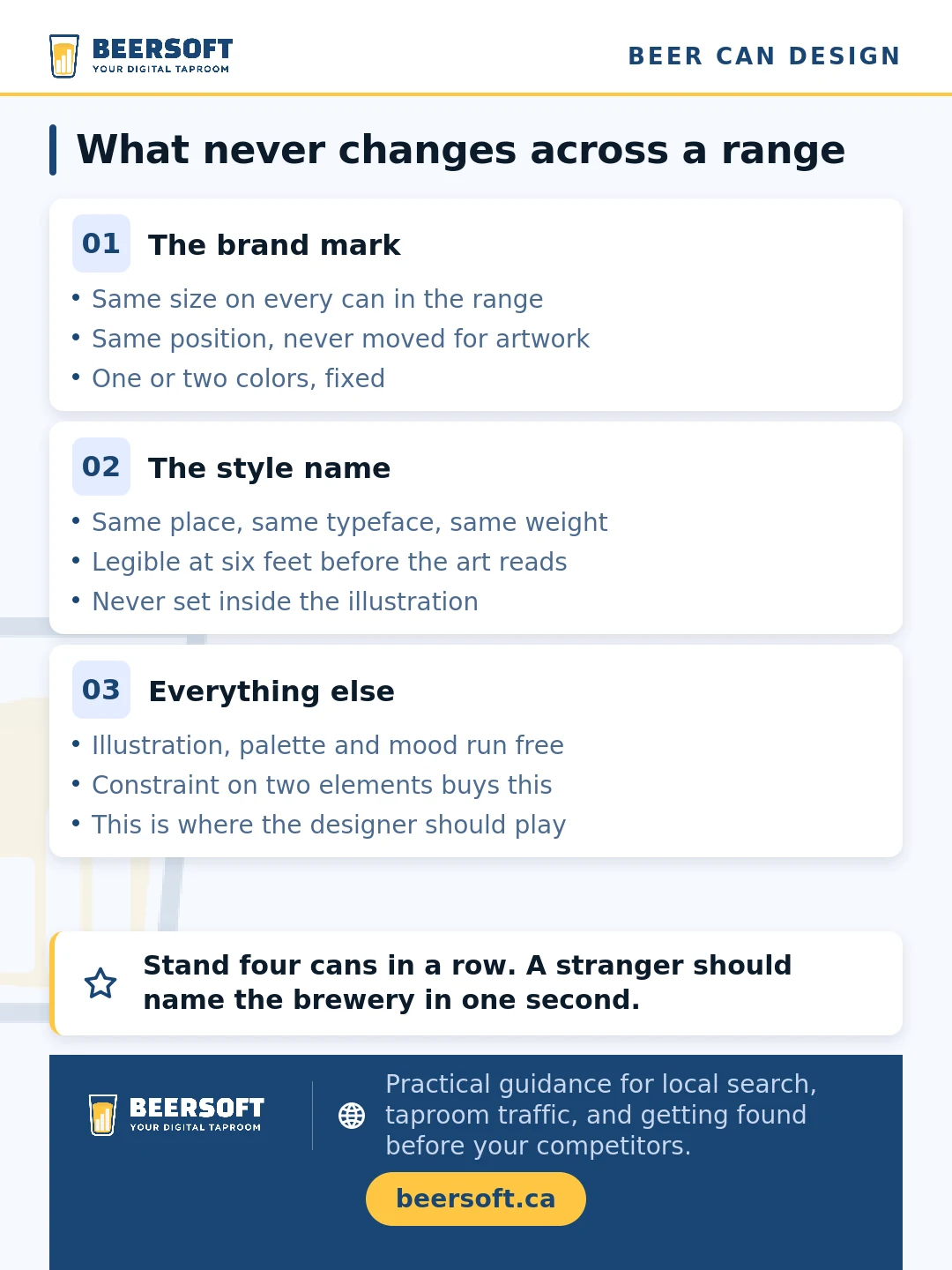
The test of whether you have this is simple. Stand four of your cans in a row. If a stranger cannot tell within a second that they come from the same brewery, you have four designs rather than a range, and every launch is starting your recognition from zero.
There is one common objection worth answering. Breweries worry that a constant makes the range boring or limits the designer. In practice the opposite happens: once the brand block is fixed and protected, the illustration can go much further, because it is no longer carrying the job of identifying you. Constraint on one element buys freedom on the others.
Key Takeaway: write down the three constants, with measurements, in a one-page document, and give it to every designer before they start. If it is not written down, it will drift by the third release.
How Does the Print Method Decide What You Can Do?
More than the design brief does. This is the decision that quietly caps everything else, and small breweries often discover it after falling in love with an approach they cannot order.
There are three ways to decorate a can, and the difference that matters is not the finish, it is the minimum quantity. Direct printing onto the can body gives the best result and the lowest per-unit cost at volume, but according to labelling-systems specialists CTM it typically requires a minimum order of one truckload, around 150,000 cans. For a brewery releasing a seasonal in 4,000 units, that is not a slow option, it is an unavailable one.
Sleeves and pressure-sensitive labels can be bought by the reel, which is what makes small and frequent releases possible at all. Shrink sleeves wrap the whole can including the curved top and base, so they give the most design area, and cost at least 25% more than a pressure-sensitive label. Pressure-sensitive labels cover the flat wall only, cost less, and behave better in some conditions and worse in others.
That last row deserves attention because it is a brewery-specific failure. Your cans end up in ice buckets, cold rooms and coolers, which is a moisture environment most label specifications are not written for. If the label lifts at the edge in a bucket of ice at a festival, the design does not matter. Specify a wet-strength adhesive and ask the printer directly what happens after two hours submerged.
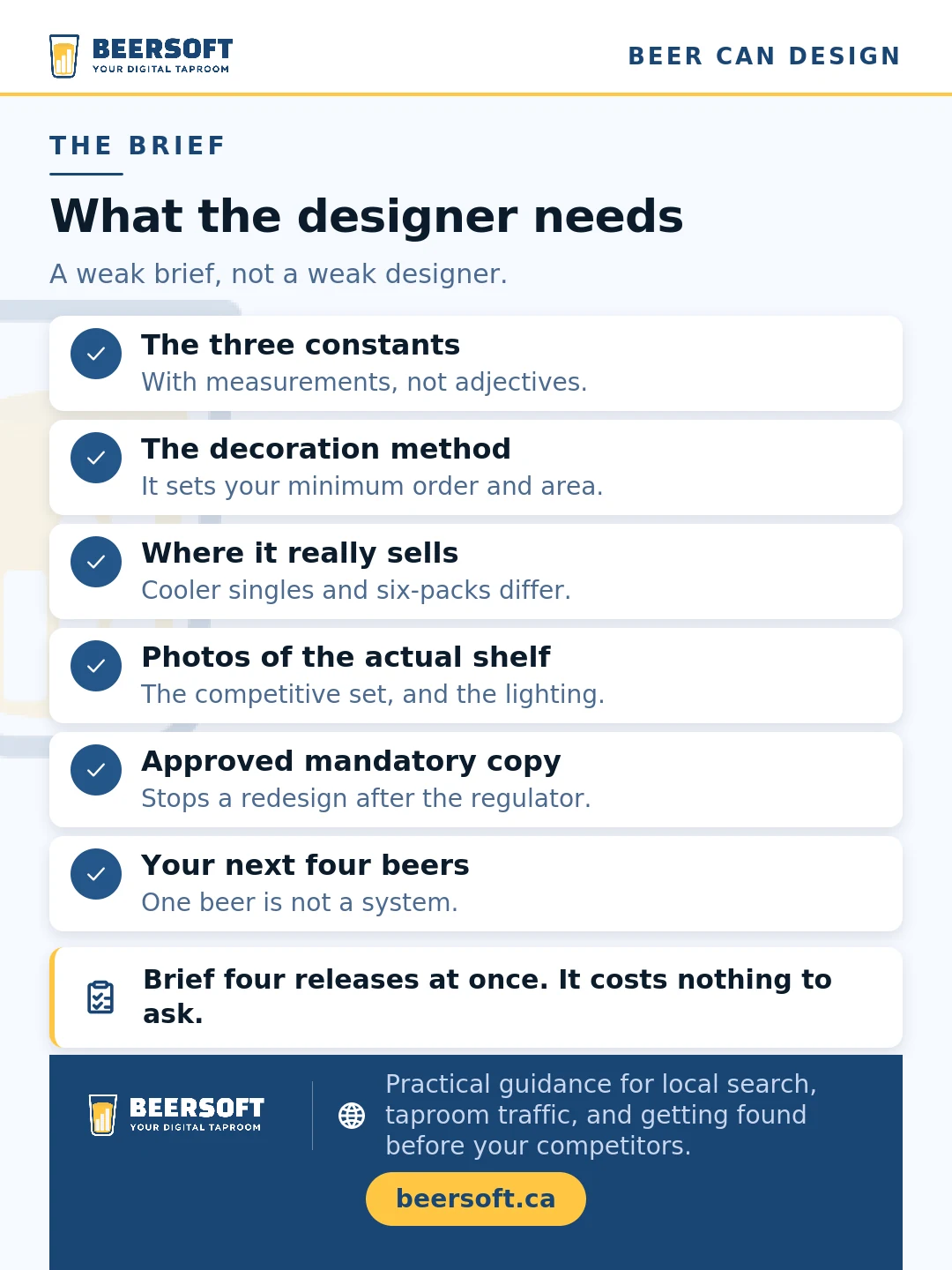
Key Takeaway: decide the decoration method before the design brief, not after. It sets your minimum order, your design area and your ability to change your mind, and every one of those changes what is worth designing.
Does It Change If the Can Is Sold on Its Own?
Yes, and the format mix is moving in the direction that makes it matter more.
The Brewers Association's 2025 packaging figures put aluminum cans at 78% of packaged craft volume, up two points on the year. Underneath that, the pack sizes are shifting. Six-packs remain the largest share at 45% of volume and dollars, down from 47% in 2022. Twelve-packs are 31%, up a point. Four-packs, the craft default for higher-ABV releases, are 11% and down a point. Singles are 8% and up a point, and 24-packs, at 2%, were the only pack size to grow in volume at all last year.
The design consequence is specific. In a four-pack or a six-pack, the carrier does a lot of the identifying work, and an individual can can afford to be more decorative. Sold as a single, in a cooler, standing next to a competitor's single, the can is the entire argument. Every one of the three constants has to survive on its own, with no carrier behind it.
A brewery selling mostly through its own taproom cooler is effectively a singles business, whatever the distribution mix says, and should design accordingly.
Key Takeaway: decide which format is your real volume before briefing, and design the can to work as a single even if most of it ships in fours. The reverse does not hold.
What Should You Actually Hand the Designer?
A short written document, not a mood board and a phone call. The label post makes this point for the regulatory side; this is the commercial side of the same brief.
Most weak can design traces back to a weak brief rather than a weak designer. When BeerSoft is asked to fix a range, the fix is usually written before anything is redrawn. A designer given "something bold for a hazy IPA, here are some cans we like" will produce something bold for a hazy IPA. They will not invent your brand system, protect your constants across a range they have not seen, or know that you sell 70% through the taproom cooler as singles.
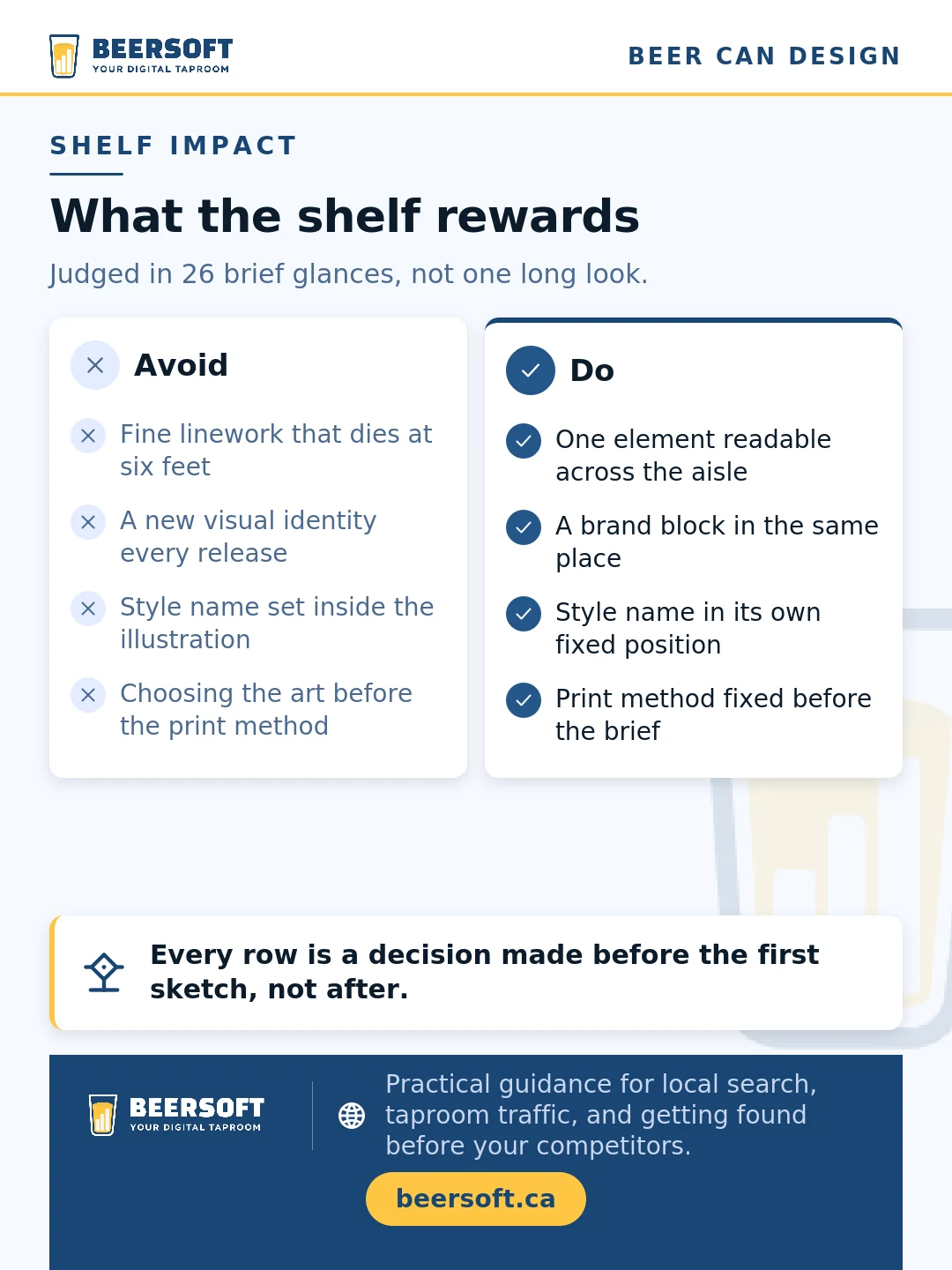
The last row is the one that separates a good outcome from an expensive one. Designing the fourth can is when a brewery discovers whether the first three were a range or three separate jobs, and by then the artwork is printed.
Key Takeaway: brief for the next four releases at once, even if you only commission one. The designer will build a system rather than an image, and it costs nothing extra to ask.
Frequently Asked Questions
How much does beer can design cost?
It varies too widely to quote a useful single figure, because "can design" covers everything from a one-off label using an existing brand system to building the system itself from scratch. The more useful budgeting question is whether you are buying one artwork or a range framework, since the second is more expensive once and cheaper on every release afterwards. Ask any designer to quote both separately.
Should I use shrink sleeves or pressure-sensitive labels?
Sleeves if you need the full can including the curves, and you accept at least 25% more cost per unit plus a risk of peeling in transit or warping in heat. Labels if cost matters more than coverage and you specify an adhesive that survives ice and condensation. Both can be bought by the reel, which is what makes small runs possible. Direct printing is a different category: it starts at roughly 150,000 cans.
What makes a beer can stand out on a crowded shelf?
Recognition rather than novelty. Field eye-tracking research found shoppers average around 26 brief glances at products before buying, so a can is judged in repeated short looks, not one long study. One element readable at six feet, and a brand block in the same place on every release, outperform intricate artwork that only resolves close up.
How many colors should a beer can design use?
Fewer than the design looks like it needs, and the number should be agreed with the printer before the artwork is finished rather than after. The color count interacts with the decoration method and the print process, so a palette that is cheap on one is expensive on another. The practical rule is to fix the method first, then ask what a given palette adds per unit at your run size.
Do I need a different design for cans sold as singles?
Not a different design, but you should design for the single first. In a four-pack or six-pack the carrier does part of the identifying work; a single standing in a cooler does all of it alone. Singles are 8% of craft packaged volume and rising, and a taproom cooler is effectively a singles business regardless of what the distribution mix says.
Conclusion: Design the Range, Then the Can
The expensive mistake in craft packaging is not ugly artwork. It is four good cans that do not add up to a brewery, ordered one at a time, each one restarting the recognition the last one built.
So do the boring part first. Write down the three things that never change, pick the decoration method before the brief rather than after, and design the can to survive as a single in a cooler at six feet. Then let the illustration go wherever it wants, because it is no longer doing the job of telling anyone who you are.
If you want the system built rather than described, BeerSoft does this work: graphic design and branding for breweries covers can and label design, the palette and typography behind it, and the brand guidelines that keep the fourth release looking like the first. If you have artwork you like and are not sure it holds up as a range, contact us and we will look at it beside your next three.
Sources
- Marketing Science Institute. Understanding In-Store Decisions with Eye-Tracking Data, by Aleksandra Kovacheva and J. Jeffrey Inman, report 24-116. Mobile eye-tracking field studies in US grocery and mass merchandise stores
- Brewers Association. Value Quest: 2025 Packaging Trends. Can and bottle share of packaged craft volume, and pack size mix.
- CTM Labeling Systems. Complete Guide to Craft Beer Can Wrap Labeling: Shrink Sleeve vs Pressure Sensitive. Minimum order quantities, relative cost and failure modes by decoration method.
- Brewers Association. National Beer Sales and Production Data. 2025 figures for market context.
Stay Ahead - Subscribe Now!
You may also be interested

Can a Brewery Deliver or Ship Beer? What the Rules Allow
Delivery and shipping are different things and the law treats them differently. Where a brewery may ship, what a compliant shipment requires, why the post office is never the answer, and what the nine-province Canadian agreement does and does not do yet.

How to Rank a Brewery on Google Maps
Google names three factors behind every map pack result. Two of them a brewery can move, one it never can, and the highest-leverage setting on the whole profile takes about two minutes to change.
Google Ads for Breweries: When Paid Search Beats Paid Social
A practical guide to paid search for taproom breweries: real category benchmarks, the alcohol policy rules that decide which campaign types you can run, and the intent split that tells you when to spend on Google instead of Meta.
What Actually Breaks on a Brewery Website, and What Maintenance Covers
The honest inventory of what decays on a brewery website, why plugins carry the risk on WordPress, what breaks on hosted builders instead, what a plan costs, and what you can do yourself
Brewery Website Migration: How to Move Platforms Without Losing Your Rankings
When a brewery actually needs to change platforms, what a migration genuinely puts at risk, the URL map that has to exist before anything moves, and the checks that close it out

Brewery Email Marketing: The Four Sends That Earn Their Keep
Why the newsletter is the weakest thing you can do with a brewery list, the four sends that replace it, where the names actually come from, and the two numbers worth reporting
Should Your Taproom Run a Chatbot?
What a taproom chatbot would actually be asked, what the 2026 data says about how chatbots perform, why the tap list is the worst thing to put in one, the narrow cases where it does pay, and what to fix instead
Beer Photography for Small Breweries: What to Shoot and When
What a small brewery actually needs photographs of, why a beer shot takes longer than it looks, what a half-day and a full day cost and deliver, which images have a window that closes, and how to write a brief
What a Brewery Website Costs, and What Drives the Number
Why quotes for the same brewery website vary by three times, what makes a taproom site structurally different from a brochure site, which decisions actually move the price, what you pay after launch, and how to compare quotes fairly

Choosing a Taproom POS: What to Ask Before You Sign
What a brewery POS has to do that a restaurant POS does not, why the processing rate matters more than the subscription, what is actually in the contract, who owns your data when you leave, and the questions to ask before signing
Which Taproom Workflows to Automate First
Which taproom workflows actually repeat often enough to justify automating, why federal compliance reporting is the highest-value target, what to connect after that, what to leave alone, and the order to do it in

Beer Label Design: What the Regulator Requires Before the Designer Starts
What the TTB requires on every beer label, how long approval actually takes in 2026, which rules constrain the artwork itself, what really delays a launch, and the brief a designer needs before starting
How to Start a Brewery: The Digital Foundations to Get Right First
What the federal and state approval timeline actually looks like in 2026, why your brewery name is a digital decision before it is a branding one, what to build during the approval window, and what has to be live before your first pour

The Three-Tier System, Explained for Brewery Marketers
Why the three-tier system exists, which marketing activities it forbids outright, exactly what a brewery may legally give a retailer and up to what value, why beer is treated differently from wine and spirits, and which channel you fully control
What Is a Mug Club? How Taprooms Build Recurring Revenue from Members
What a mug club is, how it differs from a points program, what the membership fee actually buys a taproom, the liquor-law rules that decide how you structure it, and how to publish the club so it can be found

ABV, IBU and SRM Explained: The Numbers on Your Tap List
What ABV, IBU and SRM actually measure, why the IBU number misleads drinkers, what the TTB requires you to print, and how to publish the specs so search engines and AI assistants can read them

Craft Beer Consumer Behavior in 2026: What the Data Means for Your Marketing Budget
How the major craft beer consumer behavior shifts of 2024 to 2026 translate into practical marketing budget decisions for taproom breweries, brewpubs, and microbreweries
Brewery Tourism Marketing: How to Attract Out-of-Town Visitors and Drive Weekend Traffic
How taproom breweries can attract out-of-town visitors, rank in tourism discovery platforms, and build the partnerships that drive consistent weekend traffic from the tourist segment in 2026
Brewery Loyalty Programs: Do Points and Perks Actually Drive Repeat Visits?
An evidence-based guide to brewery loyalty program mechanics, platform options, and ROI measurement for taproom operators considering whether and how to launch a customer loyalty program in 2026
Brewery Events as a Revenue Engine: How to Promote, Price, and Measure
How taproom breweries and brewpubs can promote, price, and measure events as a primary revenue engine rather than a secondary marketing activity in 2026
Brewery Merchandise and Secondary Revenue: How to Market Beyond the Pint
How taproom breweries and brewpubs can market merchandise, crowler programs, and beer club memberships as both a revenue diversification tool and a customer loyalty driver in 2026
12 Things Killing Your Local Search Rankings Right Now
A 12-point self-audit guide for brewery operators to identify and fix the website issues most commonly responsible for poor local search rankings and limited AI search visibility in 2026

Marketing Non-Alcoholic Beer: How Craft Breweries Can Capture the Sober Curious Consumer
How craft breweries can market non-alcoholic beer lines to sober-curious consumers, health-conscious drinkers, and younger demographics to capture the fastest-growing segment in the craft beer market in 2026
.webp)
Brewpub Marketing Strategy: How to Fill Both the Bar and the Dining Room
How brewpubs can use digital marketing to fill both the dining room and the bar by marketing the food and beer experience as a unified destination rather than two separate offerings
Microbrewery Marketing in a Shrinking Distribution Market: What to Do When Shelf Space Disappears
How microbreweries facing shrinking distributor interest and tightening shelf space can use digital marketing to differentiate their brand and pivot toward direct-to-consumer channels in 2026

Brewery Social Media Strategy for 2026: Instagram, Facebook, and When to Bother with TikTok
A platform-by-platform social media strategy for taproom breweries and brewpubs in 2026, covering Instagram, Facebook, and TikTok with content mix ratios and posting cadence

Brewery Content Marketing in 2026: What to Publish, When, and Why It Works
What to publish, when to publish it, and why a structured content marketing program is the highest-ROI long-term investment available to brewery operators in 2026
Meta Ads for Breweries: A Geo-Targeted Playbook for Taprooms and Brewpubs
A geo-targeted Meta advertising playbook for taproom breweries and brewpubs covering campaign structure, audience targeting, ad formats, and budget guidance for 2026
Multi-Location Brewery SEO: How Regional Craft Breweries Rank in Every Market
How regional craft breweries operating multiple taprooms can build an SEO architecture that ranks independently in every local market without cannibalizing results.
Brewery Review Marketing: How to Turn Guest Feedback into Local Search Fuel
Google reviews are the number two local ranking factor for breweries. Learn how to generate, respond to, and optimize reviews for local search and AI search visibility.
Google Business Profile for Breweries: The Complete 2026 Optimization Guide
How to set up, optimize, and maintain your brewery's Google Business Profile to dominate local search and drive foot traffic in 2026.
How to Make Your Brewery Visible in AI Search: A GEO Guide for Craft Breweries
How craft breweries can use Generative Engine Optimization (GEO) to stay visible in AI-powered search results in 2026