Can a Brewery Deliver or Ship Beer? What the Rules Allow

Share the page:
Delivery and shipping are different activities under the law, and confusing them is how breweries get into trouble. Delivery is local, usually under your own license, inside one jurisdiction. Shipping crosses lines, needs a license in the destination state, and is permitted in far fewer places than most operators assume: eleven states plus Washington D.C. allow direct-to-consumer beer shipping, against forty-eight states plus D.C. for wine. The post office is never an option for either, in any state, by federal rule. Canada signed a nine-province direct-to-consumer agreement in July 2026, but almost none of it is live yet. This guide covers what each activity requires, and how to tell which one you are actually able to do.
Introduction: The Law Does Not Think These Are the Same Thing
"Can we deliver?" and "can we ship?" get asked in the same breath and answered as though they were one question. They are two questions with different answers, different licenses and different failure modes, and the gap between them is where breweries accidentally commit a regulatory offense while believing they are running a promotion.
The short version is that local delivery is often available to you and shipping across state lines usually is not. Most operators assume the reverse, because wine shipping is so normalized that people extrapolate from it. That extrapolation is wrong by thirty-seven states.
This comes up in BeerSoft discovery calls more than almost anything else in the ecommerce conversation: a brewery wants an online store, the store is easy, and then the question of what may legally leave the building turns out to decide the entire build. It is worth answering before anyone designs a checkout.
What Is the Difference Between Delivering Beer and Shipping It?
Delivery moves beer a short distance, usually within the same state or province, usually under a license you already hold or a straightforward endorsement on it, often in your own vehicle or through a local courier acting as your agent. The transaction is treated as an extension of your existing retail privilege.
Shipping hands the package to a common carrier and moves it toward somewhere you are not licensed. That crosses a regulatory boundary, and the destination state's rules govern what happens next. You are no longer operating under your own license. You need one where the customer lives.
The practical test is whether the beer leaves your licensing jurisdiction and whether a carrier takes custody of it. If either is true, you are shipping, whatever the marketing page calls it.
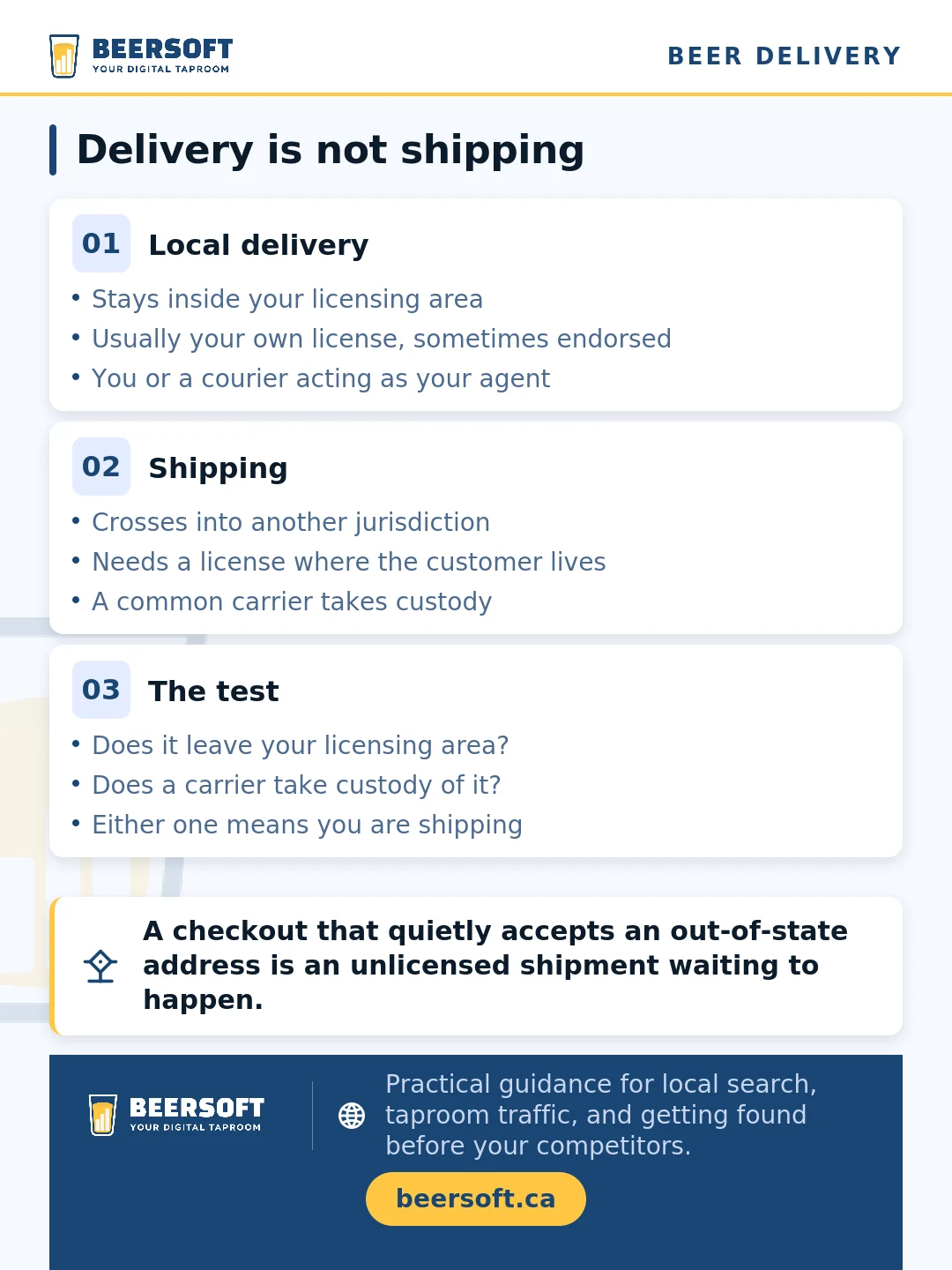
Key Takeaway: Before writing a word of website copy, decide which of the two you are building. A checkout that quietly accepts an out-of-state address is not an ecommerce feature, it is an unlicensed shipment waiting to happen.
Which States Actually Allow a Brewery to Ship Beer?
Far fewer than the wine comparison suggests, and this is the number that ends most DTC conversations early.
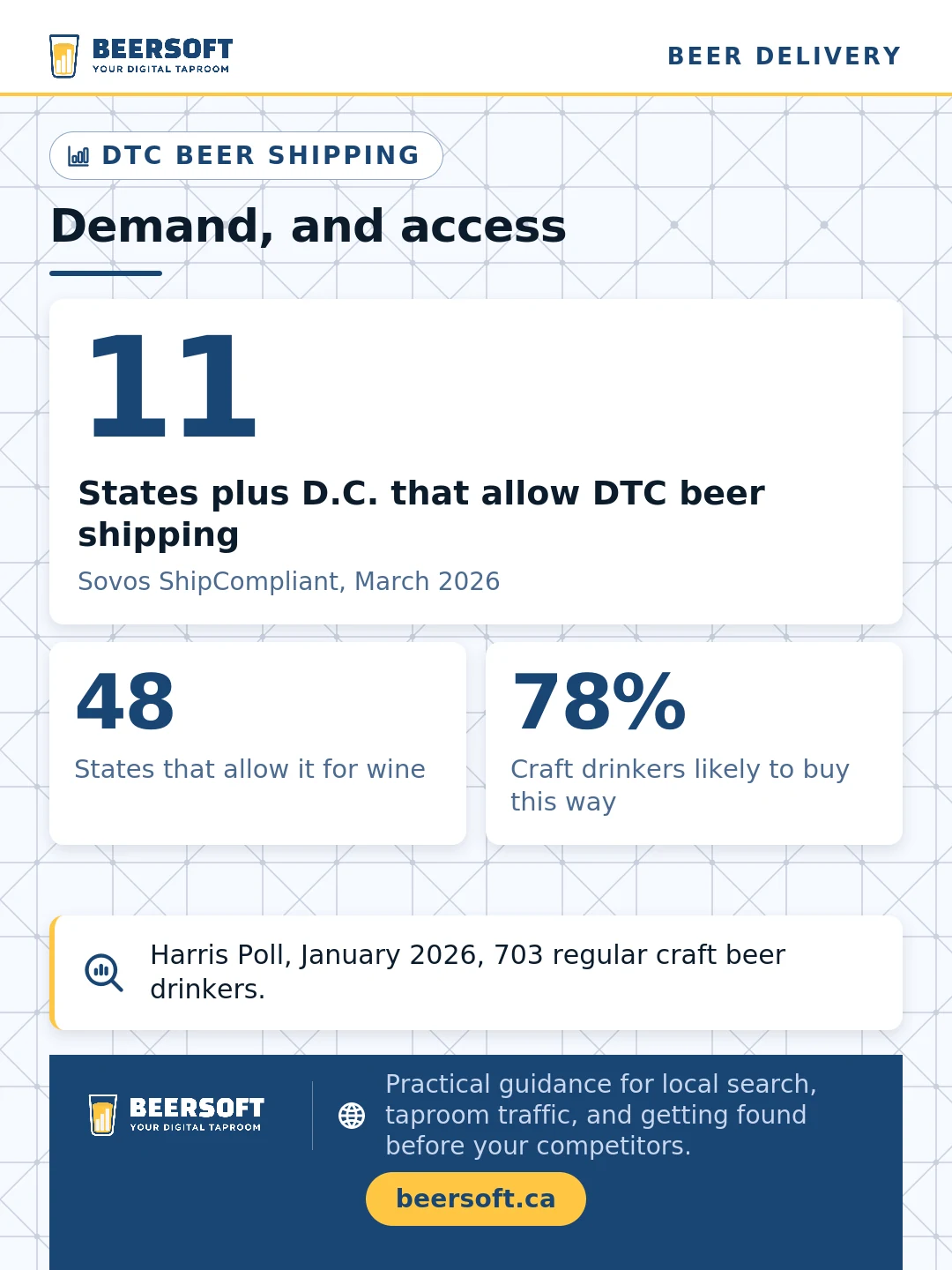
As of March 2026, eleven states plus Washington D.C. permit direct-to-consumer beer shipping: Alaska, Kentucky, Nebraska, New Hampshire, North Dakota, Ohio, Oregon, Vermont and Virginia, with Pennsylvania and Rhode Island allowing it under narrower parameters. Wine ships to forty-eight states plus D.C. That is a thirty-seven-state gap between two products sold side by side in the same store.
There is a useful warning buried in the sourcing here. Sovos publishes both the annual report and a running state-by-state guide, and the two do not agree: the report counts eleven states plus D.C., while the guide lists thirteen jurisdictions and includes Nevada. Neither is wrong so much as differently dated, because this area of law moves every legislative session. Treat any list, including the one above, as a starting point rather than an authority. Confirm the destination state before the first shipment, not after.
The reason for the gap is historical rather than logical. The Granholm line of cases that opened wine shipping dealt with wineries, and states have extended the principle to beer slowly and unevenly. There is no coherent public-health argument for why a bottle of wine may cross a state line and a can of beer may not. There is simply a different lobbying history.
Key Takeaway: Do not budget for a national DTC program. Budget for eleven states, check whether any of them contain enough of your customers to justify the compliance overhead, and be honest if the answer is no.
What Does a Compliant Shipment Actually Require?
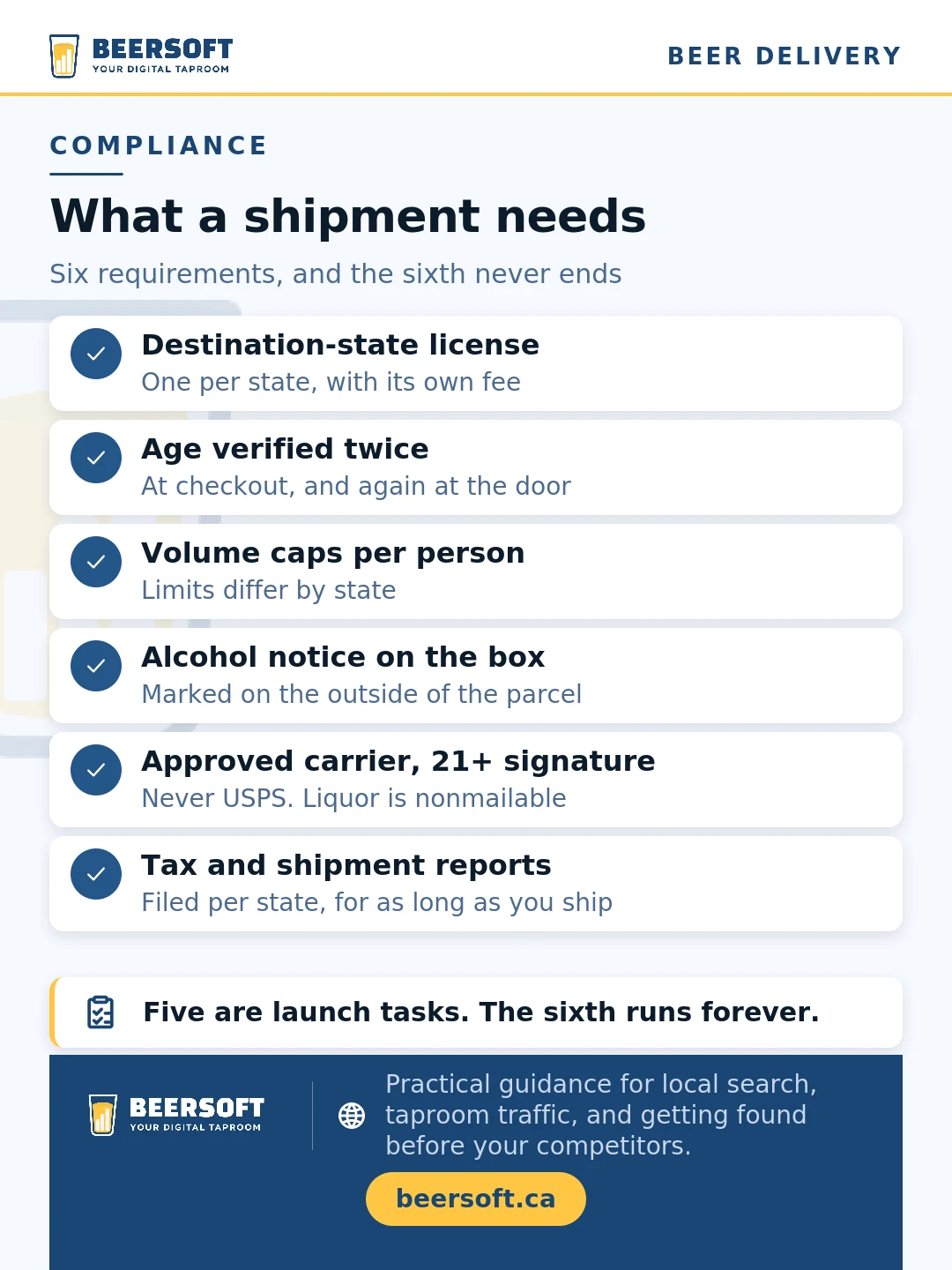
Six things, and the sixth is the one that surprises people.
You need a license issued by the destination state, not just your own. You must verify the age of the purchaser at checkout and again of the recipient at the door. You must stay inside per-person volume limits, which vary by state. You must label the outside of the box with notice that it contains alcohol. You must use an approved carrier operating under a licensed shipper agreement, and delivery requires the signature of someone twenty-one or older. And you must remit tax to each destination state and file regular reports detailing every shipment.
The post office is not an option, anywhere, ever. USPS Publication 52 makes intoxicating liquor nonmailable, and defines it as any beverage of 0.5 percent alcohol by weight or more. The single exception is for federal or state agency employees mailing between themselves for official purposes such as testing. There is no brewery version of that exception. Beer moves by private carrier or it does not move.
Four of those six live in your website rather than your warehouse: the age gate, the destination-aware cart, the volume logic and the records behind the reporting. That is a website build question long before it is a logistics one, and it is the part breweries usually discover last.
Key Takeaway: The compliance burden is ongoing, not a launch task. Per-state licensing, per-state tax and per-shipment reporting continue for as long as the program does, which is why most breweries that try this stop at two or three states rather than all eleven.
What Just Changed in Canada?
The door opened in July, and almost none of it is walkable yet.
On July 21, 2026, nine provinces signed a direct-to-consumer alcohol agreement: British Columbia, Alberta, Saskatchewan, Manitoba, Ontario, New Brunswick, Nova Scotia, Prince Edward Island, and Newfoundland and Labrador. Quebec and Yukon are working to join. Beer is specifically included, alongside wine, spirits and cider, which is a departure from the wine-first pattern that has shaped this file for a decade.
The caution is in the tense. The agreement enables consumers to order directly from licensed producers in participating provinces once implemented, and implementation is where it thins out. British Columbia has committed to a system covering all beverage alcohol categories by February 2027. No other province has set a date. BeerSoft's working answer for Canadian clients right now is to build the plumbing and hold the promise until a province publishes one.
So the honest Canadian position today is that interprovincial DTC is a commitment rather than a channel. It is worth building toward, worth watching, and not worth promising a customer this year outside of BC's stated timeline. Yukon is also consulting its dry communities before the program is introduced there, which is a reminder that a signed agreement is not a uniform rule.
Key Takeaway: If you are Canadian, put February 2027 in the calendar and build the age-verification and destination logic now, because the provinces that move will move faster than a website rebuild.
Is It Worth Building For?
The demand is real and the access is not, and you have to hold both facts at once.
In the 2026 Sovos report, drawn from a Harris Poll of 2,051 US adults over twenty-one including 703 regular craft beer drinkers, 78 percent of regular craft beer drinkers said they are likely to buy craft beer via direct shipping in future, 72 percent said they would buy more if they could, and 81 percent support expanding the laws. Those who do buy this way spend roughly $104 a month, about $1,249 a year.
That is a genuinely attractive customer. The problem is that you may only legally reach them in eleven states, and the compliance cost per state does not scale down for small programs.
For most breweries the honest sequence is: get local delivery right first, because it is available to you almost everywhere and the licensing is comparatively light. Add taproom pickup with online ordering, which has no shipping exposure at all. Then look at shipping only if you can name the specific states where your mailing list already lives, and only if that overlap is one of the eleven. Whether DTC deserves a place in your revenue mix at all is a strategy question, and we covered it separately in microbrewery distribution marketing.
Key Takeaway: Run the overlap before the build. Export your email list, sort by state, and check it against the eleven. If fewer than a few hundred subscribers sit inside them, the compliance overhead will cost more than the channel returns.
Frequently Asked Questions
Can I ship beer to a customer in another state?
Only if that state is one of the eleven plus Washington D.C. that permit direct-to-consumer beer shipping, and only once you hold a license issued by that state. Shipping into a state that does not allow it is not a gray area, and the fact that your checkout accepted the address is not a defense. Confirm the destination before you accept the order, not after.
Can I use USPS to ship beer?
No, and there is no version of this that works. USPS Publication 52 classifies intoxicating liquor as nonmailable, defining it as any beverage of 0.5 percent alcohol by weight or more. The only exception covers federal and state agency employees mailing between themselves for official purposes such as testing. Beer moves by private carrier under a licensed shipper agreement or it does not move.
What is the difference between beer delivery and beer shipping?
Delivery is local and stays inside your licensing jurisdiction, usually under your own license, carried by you or a courier acting as your agent. Shipping hands the package to a common carrier and crosses into a jurisdiction where you need a separate license. The test is whether the beer leaves your licensing area and whether a carrier takes custody. If either is true, it is shipping.
Do I need a license in the customer's state or my own?
Both. Your existing license permits you to produce and sell where you are. Shipping into another state requires a permit issued by that state, with its own application, fee and renewal cycle, plus tax remittance and regular shipment reporting to that state. This is the cost that makes small multi-state programs uneconomic.
Can Canadian breweries ship beer to another province?
Not generally, not yet. Nine provinces signed a direct-to-consumer agreement on July 21, 2026 that specifically includes beer, but it takes effect only as each province implements it. British Columbia has committed to February 2027 for all beverage alcohol categories. No other province has published a date. Treat it as a commitment to build toward rather than a channel you can sell into today.
Conclusion: Build for the Map You Actually Have
The instinct when an online store goes live is to switch shipping on everywhere and let the orders decide. In this category that instinct is a compliance incident with a shopping cart attached.
The sequence that works is unglamorous. Local delivery first, because you can almost certainly do it. Online ordering for taproom pickup next, because it carries no shipping exposure and captures the same convenience the customer actually wanted. Shipping last, into named states, once you have checked that your customers live in them.
Most of that sequence is website work rather than warehouse work: the age gate, the cart that knows where it is shipping, the volume rules, the records behind the reporting. That is the part BeerSoft gets called about, usually after a store has already been built without it. If you are planning an online store this year, our website design work starts with what may legally leave the building, and it is a much cheaper conversation before the build than after. Get in touch and bring your mailing list, sorted by state.
Sources
- Sovos ShipCompliant. 2026 Direct-to-Consumer Beer Shipping Report. Sixth annual edition; Harris Poll conducted January 2026 among 2,051 US adults aged 21 and over, including 703 regular craft beer drinkers. Jurisdiction count as of March 2026.
- Sovos ShipCompliant. What Are the DtC Beer Shipping Laws by State? Running jurisdiction list and the conditions a licensed shipper must meet.
- USPS. Publication 52, Section 42, Intoxicating Liquors. The nonmailability rule, the 0.5 percent definition, and the single agency-testing exception.
- Canadian Craft Brewers Association. Direct-to-Consumer Alcohol Sales Take Another Major Step Forward. The nine-province agreement of 21 July 2026 and British Columbia's February 2027 implementation commitment.
Stay Ahead - Subscribe Now!
You may also be interested

How to Rank a Brewery on Google Maps
Google names three factors behind every map pack result. Two of them a brewery can move, one it never can, and the highest-leverage setting on the whole profile takes about two minutes to change.

Google Ads for Breweries: When Paid Search Beats Paid Social
A practical guide to paid search for taproom breweries: real category benchmarks, the alcohol policy rules that decide which campaign types you can run, and the intent split that tells you when to spend on Google instead of Meta.

Beer Can Design That Sells: Shelf Impact for Craft Packaging
What a can is really competing against, the one thing that should stay constant across a range, how the decoration method sets your minimum order, and what to hand a designer
What Actually Breaks on a Brewery Website, and What Maintenance Covers
The honest inventory of what decays on a brewery website, why plugins carry the risk on WordPress, what breaks on hosted builders instead, what a plan costs, and what you can do yourself

Brewery Website Migration: How to Move Platforms Without Losing Your Rankings
When a brewery actually needs to change platforms, what a migration genuinely puts at risk, the URL map that has to exist before anything moves, and the checks that close it out
Brewery Email Marketing: The Four Sends That Earn Their Keep
Why the newsletter is the weakest thing you can do with a brewery list, the four sends that replace it, where the names actually come from, and the two numbers worth reporting
Should Your Taproom Run a Chatbot?
What a taproom chatbot would actually be asked, what the 2026 data says about how chatbots perform, why the tap list is the worst thing to put in one, the narrow cases where it does pay, and what to fix instead
Beer Photography for Small Breweries: What to Shoot and When
What a small brewery actually needs photographs of, why a beer shot takes longer than it looks, what a half-day and a full day cost and deliver, which images have a window that closes, and how to write a brief
What a Brewery Website Costs, and What Drives the Number
Why quotes for the same brewery website vary by three times, what makes a taproom site structurally different from a brochure site, which decisions actually move the price, what you pay after launch, and how to compare quotes fairly

Choosing a Taproom POS: What to Ask Before You Sign
What a brewery POS has to do that a restaurant POS does not, why the processing rate matters more than the subscription, what is actually in the contract, who owns your data when you leave, and the questions to ask before signing
Which Taproom Workflows to Automate First
Which taproom workflows actually repeat often enough to justify automating, why federal compliance reporting is the highest-value target, what to connect after that, what to leave alone, and the order to do it in

Beer Label Design: What the Regulator Requires Before the Designer Starts
What the TTB requires on every beer label, how long approval actually takes in 2026, which rules constrain the artwork itself, what really delays a launch, and the brief a designer needs before starting
How to Start a Brewery: The Digital Foundations to Get Right First
What the federal and state approval timeline actually looks like in 2026, why your brewery name is a digital decision before it is a branding one, what to build during the approval window, and what has to be live before your first pour

The Three-Tier System, Explained for Brewery Marketers
Why the three-tier system exists, which marketing activities it forbids outright, exactly what a brewery may legally give a retailer and up to what value, why beer is treated differently from wine and spirits, and which channel you fully control
What Is a Mug Club? How Taprooms Build Recurring Revenue from Members
What a mug club is, how it differs from a points program, what the membership fee actually buys a taproom, the liquor-law rules that decide how you structure it, and how to publish the club so it can be found

ABV, IBU and SRM Explained: The Numbers on Your Tap List
What ABV, IBU and SRM actually measure, why the IBU number misleads drinkers, what the TTB requires you to print, and how to publish the specs so search engines and AI assistants can read them

Craft Beer Consumer Behavior in 2026: What the Data Means for Your Marketing Budget
How the major craft beer consumer behavior shifts of 2024 to 2026 translate into practical marketing budget decisions for taproom breweries, brewpubs, and microbreweries
Brewery Tourism Marketing: How to Attract Out-of-Town Visitors and Drive Weekend Traffic
How taproom breweries can attract out-of-town visitors, rank in tourism discovery platforms, and build the partnerships that drive consistent weekend traffic from the tourist segment in 2026
Brewery Loyalty Programs: Do Points and Perks Actually Drive Repeat Visits?
An evidence-based guide to brewery loyalty program mechanics, platform options, and ROI measurement for taproom operators considering whether and how to launch a customer loyalty program in 2026
Brewery Events as a Revenue Engine: How to Promote, Price, and Measure
How taproom breweries and brewpubs can promote, price, and measure events as a primary revenue engine rather than a secondary marketing activity in 2026
Brewery Merchandise and Secondary Revenue: How to Market Beyond the Pint
How taproom breweries and brewpubs can market merchandise, crowler programs, and beer club memberships as both a revenue diversification tool and a customer loyalty driver in 2026
12 Things Killing Your Local Search Rankings Right Now
A 12-point self-audit guide for brewery operators to identify and fix the website issues most commonly responsible for poor local search rankings and limited AI search visibility in 2026

Marketing Non-Alcoholic Beer: How Craft Breweries Can Capture the Sober Curious Consumer
How craft breweries can market non-alcoholic beer lines to sober-curious consumers, health-conscious drinkers, and younger demographics to capture the fastest-growing segment in the craft beer market in 2026
.webp)
Brewpub Marketing Strategy: How to Fill Both the Bar and the Dining Room
How brewpubs can use digital marketing to fill both the dining room and the bar by marketing the food and beer experience as a unified destination rather than two separate offerings
Microbrewery Marketing in a Shrinking Distribution Market: What to Do When Shelf Space Disappears
How microbreweries facing shrinking distributor interest and tightening shelf space can use digital marketing to differentiate their brand and pivot toward direct-to-consumer channels in 2026

Brewery Social Media Strategy for 2026: Instagram, Facebook, and When to Bother with TikTok
A platform-by-platform social media strategy for taproom breweries and brewpubs in 2026, covering Instagram, Facebook, and TikTok with content mix ratios and posting cadence

Brewery Content Marketing in 2026: What to Publish, When, and Why It Works
What to publish, when to publish it, and why a structured content marketing program is the highest-ROI long-term investment available to brewery operators in 2026
Meta Ads for Breweries: A Geo-Targeted Playbook for Taprooms and Brewpubs
A geo-targeted Meta advertising playbook for taproom breweries and brewpubs covering campaign structure, audience targeting, ad formats, and budget guidance for 2026

Multi-Location Brewery SEO: How Regional Craft Breweries Rank in Every Market
How regional craft breweries operating multiple taprooms can build an SEO architecture that ranks independently in every local market without cannibalizing results.
Brewery Review Marketing: How to Turn Guest Feedback into Local Search Fuel
Google reviews are the number two local ranking factor for breweries. Learn how to generate, respond to, and optimize reviews for local search and AI search visibility.
Google Business Profile for Breweries: The Complete 2026 Optimization Guide
How to set up, optimize, and maintain your brewery's Google Business Profile to dominate local search and drive foot traffic in 2026.

How to Make Your Brewery Visible in AI Search: A GEO Guide for Craft Breweries
How craft breweries can use Generative Engine Optimization (GEO) to stay visible in AI-powered search results in 2026