How to Rank a Brewery on Google Maps

Share the page:
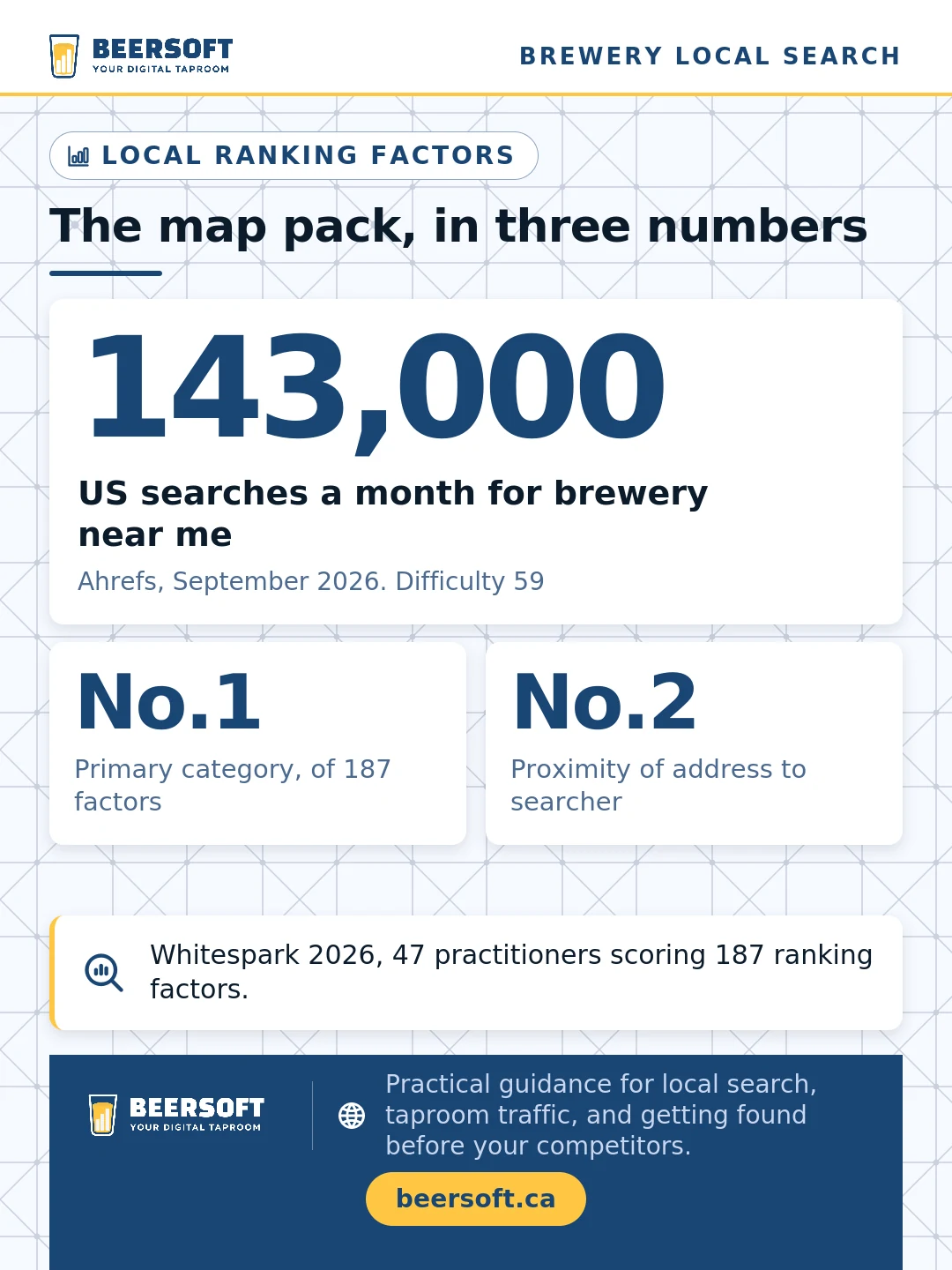
Google names three things behind every map pack result: relevance, distance and prominence. Relevance is what you tell Google you are. Distance is where you physically are. Prominence is how well known you are. In the 2026 Whitespark survey of 47 local SEO experts scoring 187 factors, the single most important factor was the primary category on your Business Profile, and the second was proximity of your address to wherever the person is standing. So the two most powerful levers in local search are the one you can change in about two minutes and the one you can never change at all. This guide covers which is which, and where a brewery's effort actually pays.
Introduction: The Second Most Powerful Ranking Factor Is Your Address
Ask most brewery owners why they are not in the map pack and you will hear that they need more reviews. Sometimes that is right. More often the profile has been sitting on the wrong primary category since the day it was claimed, and no volume of reviews will fix a category problem.
brewery near me runs about 143,000 US searches a month with a keyword difficulty of 59. That is the single largest pot of intent in this entire industry, and almost none of it is won on a website. It is won in a three-result block that Google assembles from profile data, distance and reputation signals, and then hands to someone who is already in their car.
The useful thing about Google's local ranking is that Google publishes the framework. It is not a secret, it is three named factors, and understanding which of the three you are actually able to influence is most of the work. The pattern we hit most often in BeerSoft profile reviews is not a brewery doing too little. It is a brewery doing a great deal of work against the one factor that was never going to move.
What Actually Decides Which Breweries Show in the Map Pack?
Google names three factors, and says so plainly in its own documentation: relevance, distance and prominence. Everything else you read about local search is a tactic aimed at one of those three.
Relevance is, in Google's words, "how well a Business Profile matches what someone is searching for." This is the one you control outright. It is built from the information on the profile: your primary category, your additional categories, your attributes, your description, your services. If Google cannot tell that you are a brewery, it will not return you for brewery searches, however good the beer is.
Distance is "how far each business is from the customer who's searching." Not from the city center, and not from your marketing target. From wherever that person is standing when they search, and Google will estimate their location if they have not shared it. This factor is set by your lease.
Prominence is "how well-known a business is," and Google says it draws on "how many websites link to your business and how many reviews you have." This is the slow one. It moves over months, not weeks, and it is the only one of the three that behaves like classic SEO.
Google is also explicit that none of it is purchasable: "There's no way to request or pay for a better local ranking on Google." Any agency suggesting otherwise is selling something that does not exist.
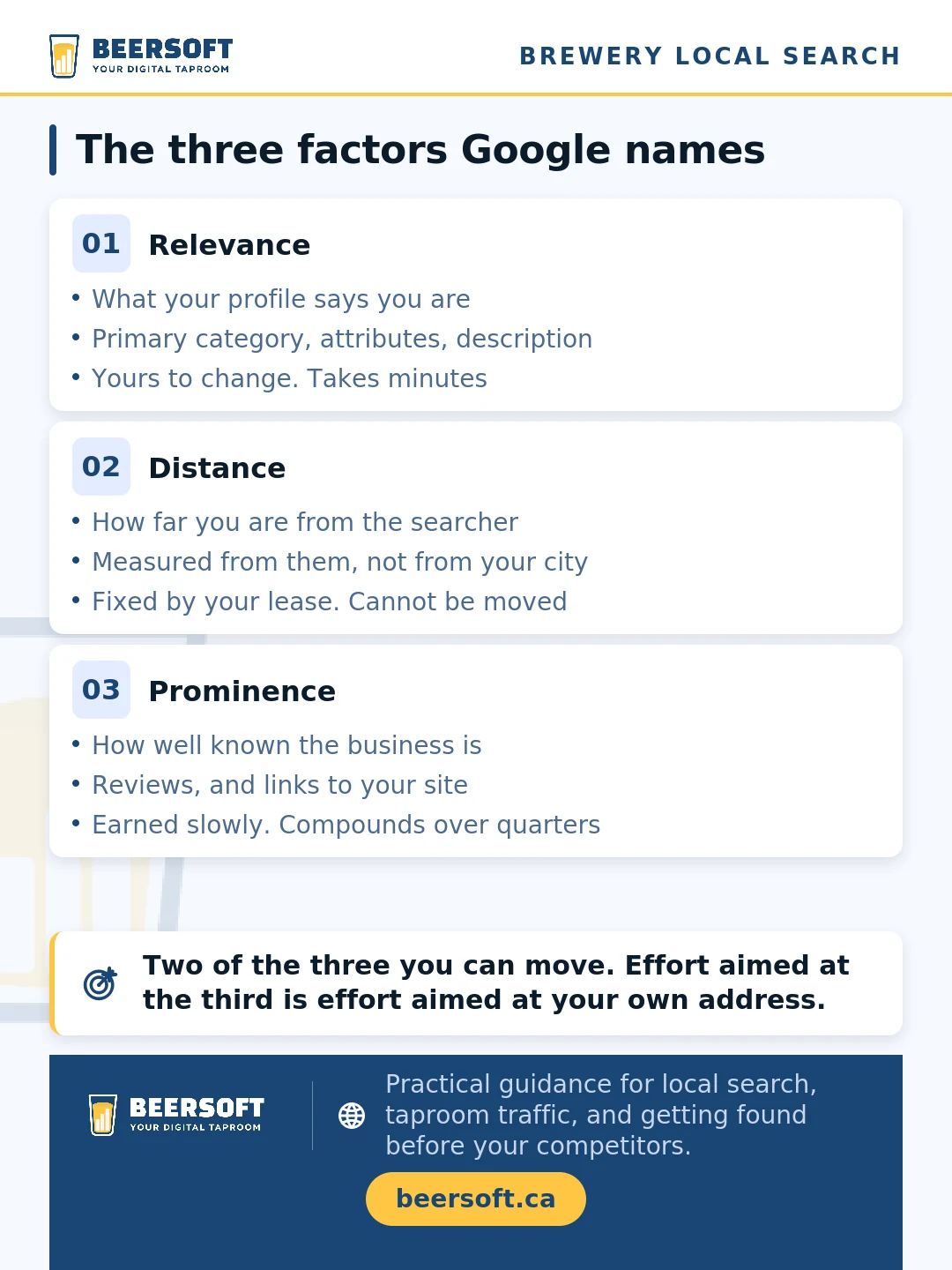
Key Takeaway: Before spending another hour on local search, sort your effort into these three buckets. Anything that does not land in relevance or prominence is not a ranking activity, whatever it is being sold as.
Why Is Your Primary Category the Highest-Leverage Change You Can Make?
Because it is the single most important factor in the whole system, and it takes about two minutes to fix.
Whitespark's 2026 Local Search Ranking Factors report surveyed 47 local SEO practitioners scoring 187 individual factors. Primary GBP Category came first, ahead of everything else. Not reviews, not links, not profile completeness. The dropdown you clicked once when you claimed the listing.
Google's guidance on how to pick it is unusually direct: "Select categories that complete the statement: 'This business IS a' rather than 'this business HAS a.'" And then the warning most people trip over: "Do not use categories solely as keywords or to describe attributes of your business."
For a brewery this is where the money is, because the honest answer is often uncomfortable. A brewpub that makes most of its revenue on food is a brewpub, and possibly a restaurant, and calling itself a Brewery because that is the identity the owners prefer costs it relevance on the searches that actually convert. The reverse happens too: a production brewery with a small taproom lists itself as a Bar, then wonders why it never appears for brewery searches.
Google also notes that more general categories are implicitly included, so stacking near-duplicates adds nothing. Use the most specific category that completes "this business IS a", then add secondary categories only for things you genuinely are, not things you have.
The rest of the profile matters too, and it is covered field by field in our Google Business Profile guide for breweries. The distinction worth holding onto is that completing the profile improves relevance, while the category decides which searches you are relevant to. One is filling in a form. The other is choosing which race you are running.
If you are not certain which category you are actually competing in, search your own main term from a phone two blocks away and look at who Google returns. The categories of the three businesses above you tell you what Google thinks the query means.
Key Takeaway: Open your Business Profile today and read the primary category aloud after the words "this business is a". If the sentence is false or strained, you have found a bigger ranking problem than your review count.
How Far Does a Brewery Actually Rank From Its Own Door?
Further than you would like in a rural county, and barely at all in a brewery district.
Distance ranked second out of 187 factors in the same Whitespark survey, described there as proximity of the address to the point of search. Second most important, and completely fixed. This is the part of local search that owners find hardest to accept, because every other channel rewards effort and this one rewards a lease signed years ago.
The practical consequence is that your realistic ranking radius is set by how many competitors sit between you and the searcher, not by how far you would like to reach. A brewery on a street with five others is competing inside a few hundred meters, and someone searching from the far side of town will simply not see it no matter how good the profile is. A brewery that is the only one for forty minutes effectively owns its whole catchment, and its ranking problem is usually relevance instead.
This is also why your own phone lies to you. Standing in your taproom, you are zero meters from your own address, so you rank first for everything and conclude the profile is fine. That test is worthless. Check from where your customers actually are: the hotel district, the residential streets, the other side of the river. Three points, screenshotted before anything is changed, is how a BeerSoft local audit opens. It usually settles the argument about whether the problem is the profile or the postcode.
What you can do about distance is narrow: open a second location, or stop competing for the parts of the map that were never available and spend that effort on the searches you can win. Breweries with more than one site have a genuinely different problem, which is covered in multi-location brewery SEO.
Key Takeaway: Never judge your map pack position from inside your own building. Test from at least three points your customers actually search from, and accept that anything beyond your competitive radius is not a ranking problem to solve.
What Moves Prominence for a Brewery, and How Long Does It Take?
Reviews and links, and months rather than weeks.
Google names both directly: prominence draws on "how many websites link to your business and how many reviews you have," and it states that "more reviews and positive ratings can help your business's local ranking." The 2026 survey adds a wrinkle that matters operationally: recency of reviews placed eleventh out of 187 factors, which means a steady trickle beats a burst. Forty reviews collected over a year is worth more than forty collected the week you ran a competition, and the burst carries risk besides.
Generating and responding to those reviews is a subject in its own right, and this site already covers it properly in brewery review marketing. Worth saying here only that it is a prominence activity, it is slow, and it is not a substitute for fixing relevance first.
The link half is where breweries are unusually lucky. Most small businesses have to earn local links the hard way. A brewery has guild directories, brewery trail programs, city tourism boards, festival listings and local press that covers new releases as a matter of routine. Those are prominence signals sitting in plain sight, and they are the part of this most often left undone.
If your profile is complete and you still are not showing, prominence is usually the bottleneck and it is the slowest to move. A digital audit will tell you which of the three factors is actually holding you back before you spend another quarter guessing.
Key Takeaway: Treat prominence as a compounding investment with a horizon of two to three quarters, and get the free local links first. A guild directory listing takes twenty minutes and outlives every campaign you will run this year.
Which Map Pack Tactics Are a Waste of a Brewery's Time?
The ones aimed at distance, and the ones aimed at gaming signals Google has spent fifteen years learning to discount.
Keyword stuffing the business name is the most common and the most damaging. Adding "Craft Brewery Taproom Downtown" to a name that is legally two words is a guidelines violation that invites suspension, and suspension costs you the listing entirely rather than a few positions.
Chasing review volume in bursts, buying citations in bulk, creating a second profile at a virtual address to reach a neighborhood you are not in: all of these attack the factor you cannot move, and the good ones are ineffective while the bad ones are dangerous.
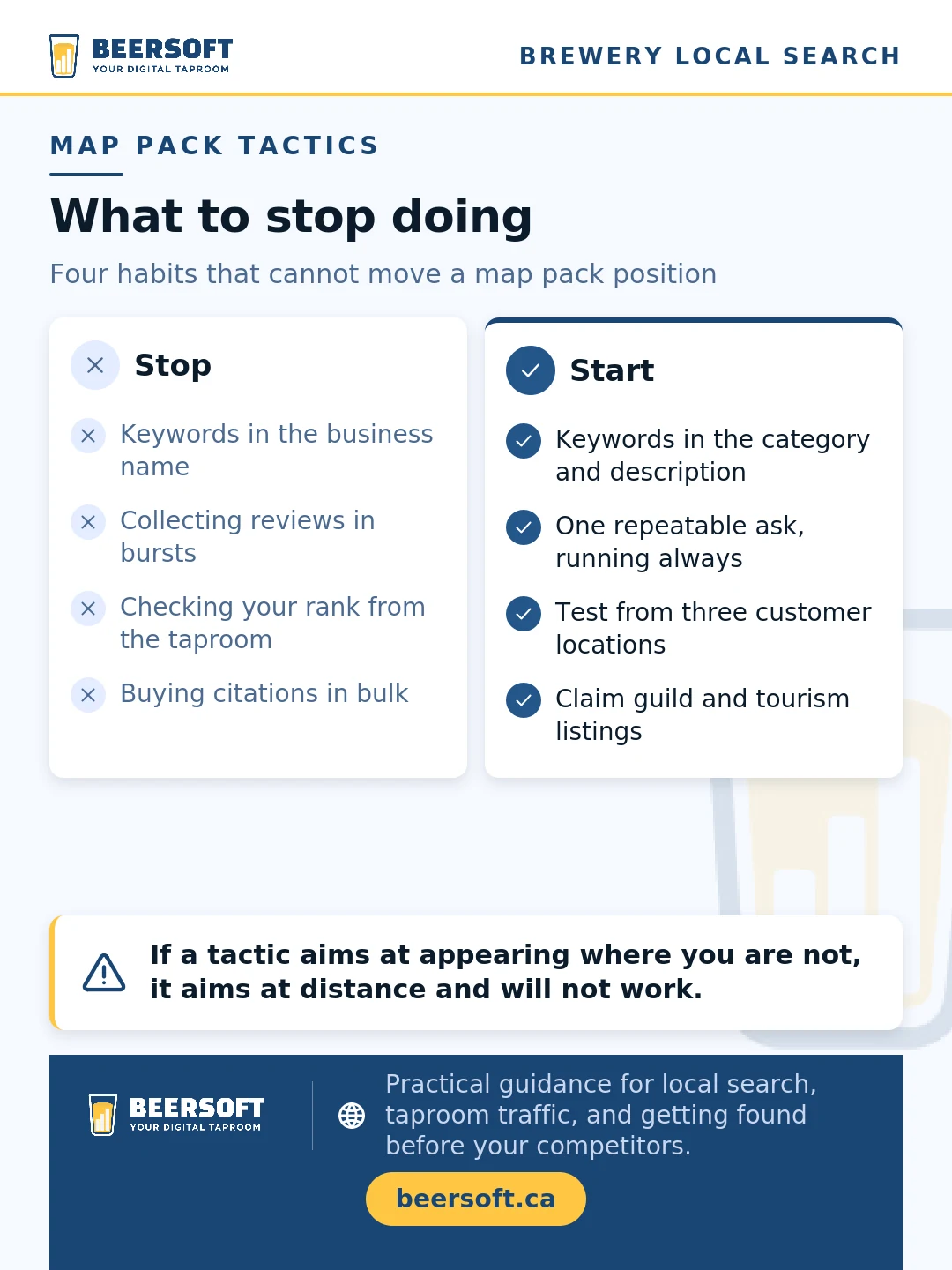
Key Takeaway: If a tactic is aimed at appearing somewhere you are not, it is aimed at distance and it will not work. Spend the same hour on the category, the attributes and one guild listing instead.
Frequently Asked Questions
How long does it take to rank higher on Google Maps?
It depends entirely on which factor was holding you back. A wrong primary category is a same-week fix, because relevance changes propagate in days. Prominence is the slow one: reviews and local links compound over two to three quarters, not weeks. If someone promises map pack movement in thirty days without having looked at your category first, they are guessing.
Can I pay Google to rank higher in the map pack?
No. Google states it directly: "There's no way to request or pay for a better local ranking on Google." You can pay for Local Services Ads or search ads that appear near the map pack, but those are advertising slots, clearly labeled and separate from the organic three results. Anyone offering paid placement in the map pack itself is describing a product that does not exist.
Should a brewpub choose Brewery or Brewpub as its primary category?
Answer Google's own test: does the business complete the sentence "this business IS a"? If food is a significant share of revenue and people come to eat, Brewpub is the honest answer and the one that matches dining intent. Choosing Brewery because it suits the brand identity costs relevance on the searches that fill tables. You can add the other as a secondary category.
Why does my brewery rank differently depending on where I search from?
Because distance is one of the three factors Google names, and it is measured from the person searching rather than from your city. The 2026 Whitespark survey put proximity of address to point of search second out of 187 factors. Ranking first from inside your taproom and fourth from across town is not a bug, it is the system working as documented.
Do I need a separate Google Business Profile for my taproom and my production facility?
Only if both are separately staffed and open to customers during stated hours. A production site the public cannot visit does not qualify for its own profile, and creating one to cover more of the map is the kind of shortcut that gets the real listing suspended. If you run genuinely separate public locations, each gets its own profile.
Conclusion: Fix the Category, Then Earn the Rest
Local search rewards two things and ignores a lot of effort aimed at a third. Relevance is free, immediate and almost entirely within your control, and it is the factor most breweries have never audited. Prominence is earned slowly and compounds. Distance is a fact about your building.
The sequence is therefore not complicated: read your primary category aloud after "this business is a" and fix it if the sentence is false, complete the attributes and the description, claim the guild and tourism listings you are already eligible for, then build a review habit that runs without anyone remembering to run it. That order matters, because doing the slow work first against a wrong category is how a year disappears.
If you want someone to tell you which of the three factors is actually costing you the map pack, that diagnosis is the first thing BeerSoft does in any SEO and AI optimization engagement, and it is usually a shorter conversation than owners expect. Get in touch and start with the category.
Sources
- Google. Improve your local ranking on Google. Business Profile Help, the definitions of relevance, distance and prominence and the statement that local ranking cannot be purchased.
- Google. Guidelines for representing your business on Google. Category selection, the "IS a" rather than "HAS a" test, and the warning against categories used as keywords.
- Whitespark. 2026 Local Search Ranking Factors. Published November 2025, 47 local SEO practitioners scoring 187 factors; primary category ranked first, proximity of address to point of search second, recency of reviews eleventh.
- Ahrefs. Keywords Explorer, United States. Search volume and keyword difficulty for "brewery near me", measured 28 September 2026.
Stay Ahead - Subscribe Now!
You may also be interested
Can a Brewery Deliver or Ship Beer? What the Rules Allow
Delivery and shipping are different things and the law treats them differently. Where a brewery may ship, what a compliant shipment requires, why the post office is never the answer, and what the nine-province Canadian agreement does and does not do yet.

Google Ads for Breweries: When Paid Search Beats Paid Social
A practical guide to paid search for taproom breweries: real category benchmarks, the alcohol policy rules that decide which campaign types you can run, and the intent split that tells you when to spend on Google instead of Meta.
Beer Can Design That Sells: Shelf Impact for Craft Packaging
What a can is really competing against, the one thing that should stay constant across a range, how the decoration method sets your minimum order, and what to hand a designer
What Actually Breaks on a Brewery Website, and What Maintenance Covers
The honest inventory of what decays on a brewery website, why plugins carry the risk on WordPress, what breaks on hosted builders instead, what a plan costs, and what you can do yourself
Brewery Website Migration: How to Move Platforms Without Losing Your Rankings
When a brewery actually needs to change platforms, what a migration genuinely puts at risk, the URL map that has to exist before anything moves, and the checks that close it out
Brewery Email Marketing: The Four Sends That Earn Their Keep
Why the newsletter is the weakest thing you can do with a brewery list, the four sends that replace it, where the names actually come from, and the two numbers worth reporting
Should Your Taproom Run a Chatbot?
What a taproom chatbot would actually be asked, what the 2026 data says about how chatbots perform, why the tap list is the worst thing to put in one, the narrow cases where it does pay, and what to fix instead
Beer Photography for Small Breweries: What to Shoot and When
What a small brewery actually needs photographs of, why a beer shot takes longer than it looks, what a half-day and a full day cost and deliver, which images have a window that closes, and how to write a brief
What a Brewery Website Costs, and What Drives the Number
Why quotes for the same brewery website vary by three times, what makes a taproom site structurally different from a brochure site, which decisions actually move the price, what you pay after launch, and how to compare quotes fairly

Choosing a Taproom POS: What to Ask Before You Sign
What a brewery POS has to do that a restaurant POS does not, why the processing rate matters more than the subscription, what is actually in the contract, who owns your data when you leave, and the questions to ask before signing
Which Taproom Workflows to Automate First
Which taproom workflows actually repeat often enough to justify automating, why federal compliance reporting is the highest-value target, what to connect after that, what to leave alone, and the order to do it in

Beer Label Design: What the Regulator Requires Before the Designer Starts
What the TTB requires on every beer label, how long approval actually takes in 2026, which rules constrain the artwork itself, what really delays a launch, and the brief a designer needs before starting
How to Start a Brewery: The Digital Foundations to Get Right First
What the federal and state approval timeline actually looks like in 2026, why your brewery name is a digital decision before it is a branding one, what to build during the approval window, and what has to be live before your first pour

The Three-Tier System, Explained for Brewery Marketers
Why the three-tier system exists, which marketing activities it forbids outright, exactly what a brewery may legally give a retailer and up to what value, why beer is treated differently from wine and spirits, and which channel you fully control
What Is a Mug Club? How Taprooms Build Recurring Revenue from Members
What a mug club is, how it differs from a points program, what the membership fee actually buys a taproom, the liquor-law rules that decide how you structure it, and how to publish the club so it can be found

ABV, IBU and SRM Explained: The Numbers on Your Tap List
What ABV, IBU and SRM actually measure, why the IBU number misleads drinkers, what the TTB requires you to print, and how to publish the specs so search engines and AI assistants can read them

Craft Beer Consumer Behavior in 2026: What the Data Means for Your Marketing Budget
How the major craft beer consumer behavior shifts of 2024 to 2026 translate into practical marketing budget decisions for taproom breweries, brewpubs, and microbreweries
Brewery Tourism Marketing: How to Attract Out-of-Town Visitors and Drive Weekend Traffic
How taproom breweries can attract out-of-town visitors, rank in tourism discovery platforms, and build the partnerships that drive consistent weekend traffic from the tourist segment in 2026
Brewery Loyalty Programs: Do Points and Perks Actually Drive Repeat Visits?
An evidence-based guide to brewery loyalty program mechanics, platform options, and ROI measurement for taproom operators considering whether and how to launch a customer loyalty program in 2026
Brewery Events as a Revenue Engine: How to Promote, Price, and Measure
How taproom breweries and brewpubs can promote, price, and measure events as a primary revenue engine rather than a secondary marketing activity in 2026
Brewery Merchandise and Secondary Revenue: How to Market Beyond the Pint
How taproom breweries and brewpubs can market merchandise, crowler programs, and beer club memberships as both a revenue diversification tool and a customer loyalty driver in 2026
12 Things Killing Your Local Search Rankings Right Now
A 12-point self-audit guide for brewery operators to identify and fix the website issues most commonly responsible for poor local search rankings and limited AI search visibility in 2026

Marketing Non-Alcoholic Beer: How Craft Breweries Can Capture the Sober Curious Consumer
How craft breweries can market non-alcoholic beer lines to sober-curious consumers, health-conscious drinkers, and younger demographics to capture the fastest-growing segment in the craft beer market in 2026
.webp)
Brewpub Marketing Strategy: How to Fill Both the Bar and the Dining Room
How brewpubs can use digital marketing to fill both the dining room and the bar by marketing the food and beer experience as a unified destination rather than two separate offerings
Microbrewery Marketing in a Shrinking Distribution Market: What to Do When Shelf Space Disappears
How microbreweries facing shrinking distributor interest and tightening shelf space can use digital marketing to differentiate their brand and pivot toward direct-to-consumer channels in 2026

Brewery Social Media Strategy for 2026: Instagram, Facebook, and When to Bother with TikTok
A platform-by-platform social media strategy for taproom breweries and brewpubs in 2026, covering Instagram, Facebook, and TikTok with content mix ratios and posting cadence

Brewery Content Marketing in 2026: What to Publish, When, and Why It Works
What to publish, when to publish it, and why a structured content marketing program is the highest-ROI long-term investment available to brewery operators in 2026
Meta Ads for Breweries: A Geo-Targeted Playbook for Taprooms and Brewpubs
A geo-targeted Meta advertising playbook for taproom breweries and brewpubs covering campaign structure, audience targeting, ad formats, and budget guidance for 2026

Multi-Location Brewery SEO: How Regional Craft Breweries Rank in Every Market
How regional craft breweries operating multiple taprooms can build an SEO architecture that ranks independently in every local market without cannibalizing results.
Brewery Review Marketing: How to Turn Guest Feedback into Local Search Fuel
Google reviews are the number two local ranking factor for breweries. Learn how to generate, respond to, and optimize reviews for local search and AI search visibility.
Google Business Profile for Breweries: The Complete 2026 Optimization Guide
How to set up, optimize, and maintain your brewery's Google Business Profile to dominate local search and drive foot traffic in 2026.

How to Make Your Brewery Visible in AI Search: A GEO Guide for Craft Breweries
How craft breweries can use Generative Engine Optimization (GEO) to stay visible in AI-powered search results in 2026