Google Ads for Breweries: When Paid Search Beats Paid Social

Share the page:
Paid search and paid social answer different questions, and breweries routinely fund the wrong one. Meta builds an audience that did not know you existed. Google intercepts someone who already decided they want a brewery tonight and is choosing between you and three competitors. The category is unusually cheap to buy: Restaurants and Food runs a median cost per click of $2.05 against an all-industry median of $5.42. The complication is that beer is not a normal advertising category. Google's alcohol policy blocks several campaign types outright, and the policy governing all of it changes on September 30, 2026. This guide covers what paid search costs a brewery, which campaign types you are allowed to run, how to structure the account, and how to tell whether any of it worked.
Introduction: Search Does Not Create Demand. It Intercepts It.
Most brewery paid-media budgets are built backwards. The taproom is quiet on a Tuesday, someone boosts a post, the post gets 4,000 impressions and eleven likes, and the Tuesday stays quiet. The money went to the channel that is good at telling people you exist, in service of a problem that was never about people not knowing you exist.
The people who filled your taproom last Saturday mostly did not discover you on Instagram that afternoon. They opened a phone, typed something with the word "brewery" in it, and picked from what came back. That is a search behavior, and it is purchasable. The account reviews that open most BeerSoft paid search engagements find the same shape every time: a Meta account with two years of history and a Google account that was either never opened or was opened once, set to automatic everything, and left to spend against the brewery's own name.
Paid search is not better than paid social. Our Meta ads playbook for taprooms covers the channel that creates demand; this is the one that intercepts it. Search is the correct answer to a narrower and more valuable question, and it is the answer breweries underfund. It is also the channel where the rules are genuinely different for alcohol, which is the part no general "Google Ads for restaurants" guide will tell you.
When Does Paid Search Beat Paid Social for a Brewery?
Paid search wins whenever the customer has already formed the intent and is choosing between options. Paid social wins whenever the intent has to be created first. That single split decides almost every budget question a brewery will ask.
The useful test is to write down the sentence the customer would have typed or thought. "Breweries near me open now" is a decision in progress and belongs to search. "I had no idea there was a new patio down the road" is a discovery and belongs to social. A brewery that runs only social spends its budget introducing itself to people who are not going out tonight. A brewery that runs only search collects the people already in motion and never grows the pool.
Seasonality sharpens this. In taproom peak, demand already exists and search is a way of taking a larger share of it. In a slow February, there is less demand to intercept and creating occasions matters more, which is social's job.
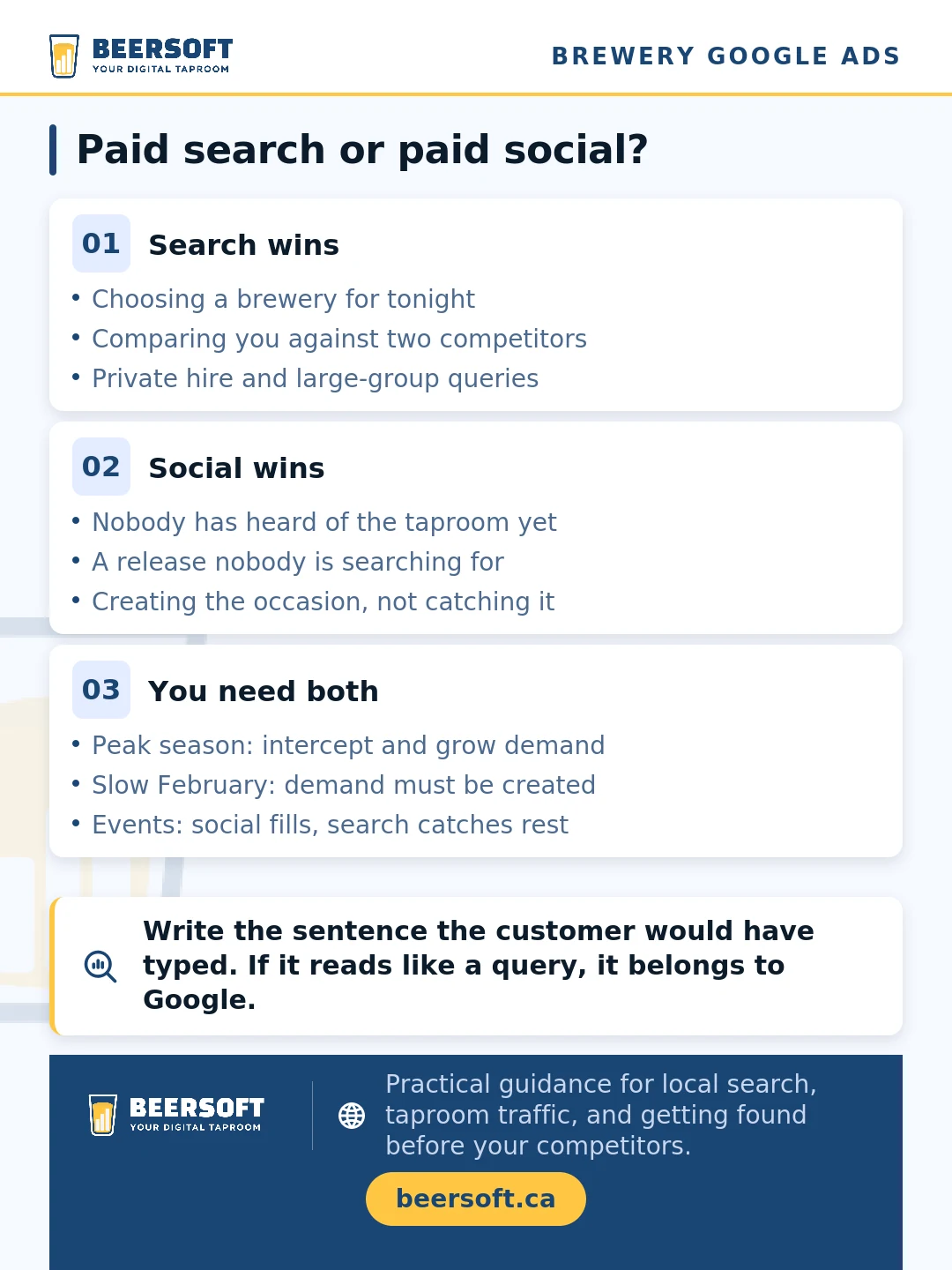
Key Takeaway: Write the customer's sentence before you pick the channel. If it reads like a query, it belongs to Google. If it reads like a realization, it belongs to Meta. Never let the platform with the better reporting dashboard make this decision for you.
What Do Google Ads Actually Cost a Brewery?
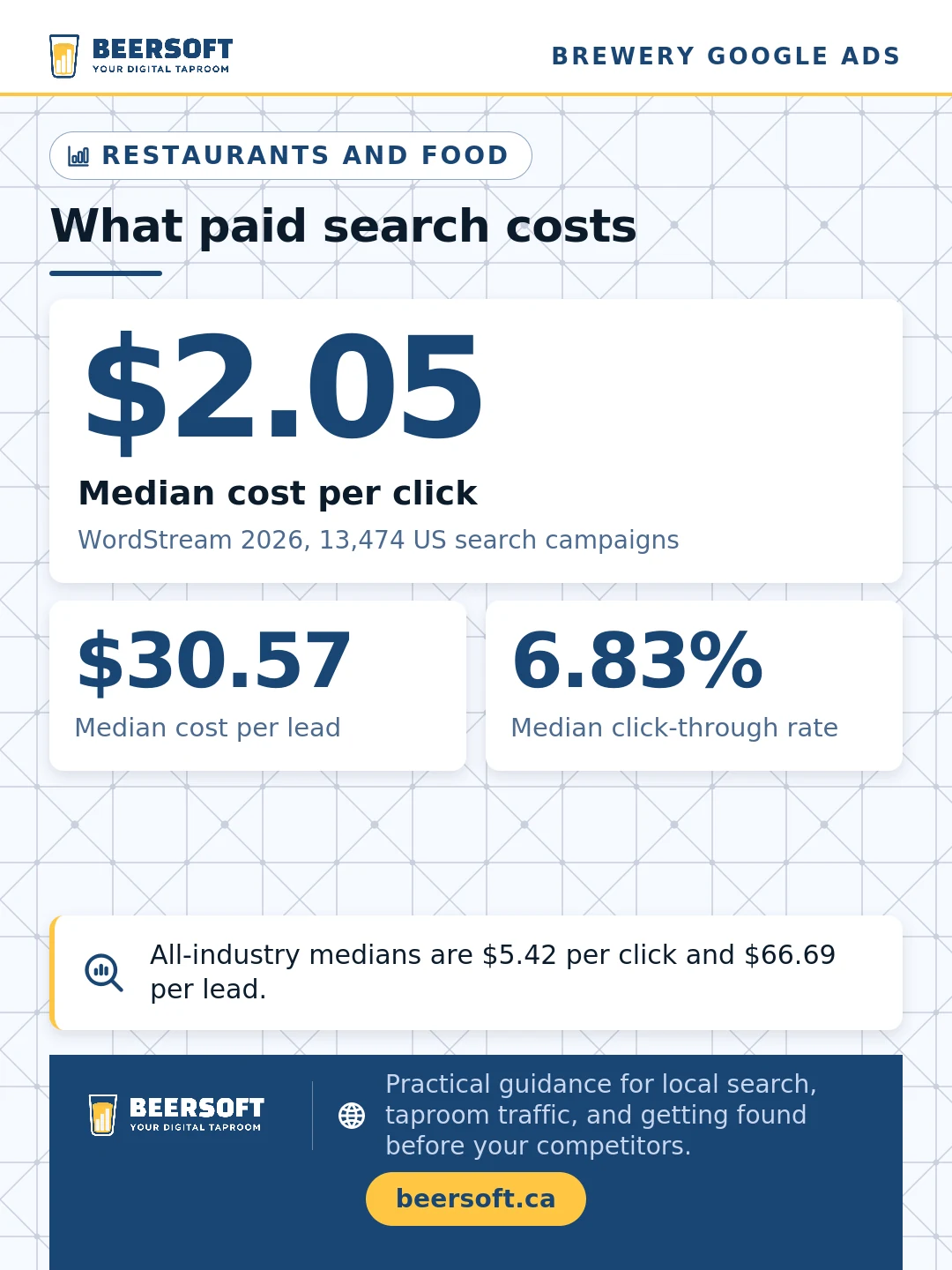
Less than almost anything else you could advertise. In the 2026 benchmark study of 13,474 US search campaigns, the Restaurants and Food category returned a median cost per click of $2.05, against an all-industry median of $5.42. Cost per lead came in at $30.57 against an all-industry $66.69. Click-through rate was 6.83% and conversion rate 8.05%, both close to the cross-industry figures.
Read that properly. The category converts at roughly the same rate as everything else while costing less than half as much to buy traffic for. That is the definition of an underpriced channel, and it is underpriced because the businesses in it are mostly too small and too busy to run paid search well.
The year-over-year movement is worth noting too, because it points in two directions at once. Category cost per lead fell 39.35%, one of the largest improvements recorded across all 23 industries. Click-through rate fell 9.89% over the same period. Cheaper leads, harder-won clicks: the auction got less expensive while the results page got more crowded with AI summaries, map packs and everything else competing for the same attention.
There is an irony buried in these numbers that is worth saying out loud. The keyword an agency bids on to reach a brewery owner, google ads for restaurants, carries a cost per click of around $14.00. The keyword a brewery bids on to reach a drinker costs $2.05. It costs seven times more to sell paid search to you than it costs you to run it. Bear that in mind the next time an agency explains how expensive Google Ads are.
Key Takeaway: Budget from cost per lead, not cost per click. At a $30.57 category median, a $1,000 month should be producing roughly 30 tracked actions. If it is producing five, the problem is the account structure or the landing page, not the channel.
Which Campaign Types Can a Brewery Legally Run?
This is where brewery paid search stops resembling restaurant paid search, and it is the section most guides skip because most guides were not written for an alcohol advertiser.
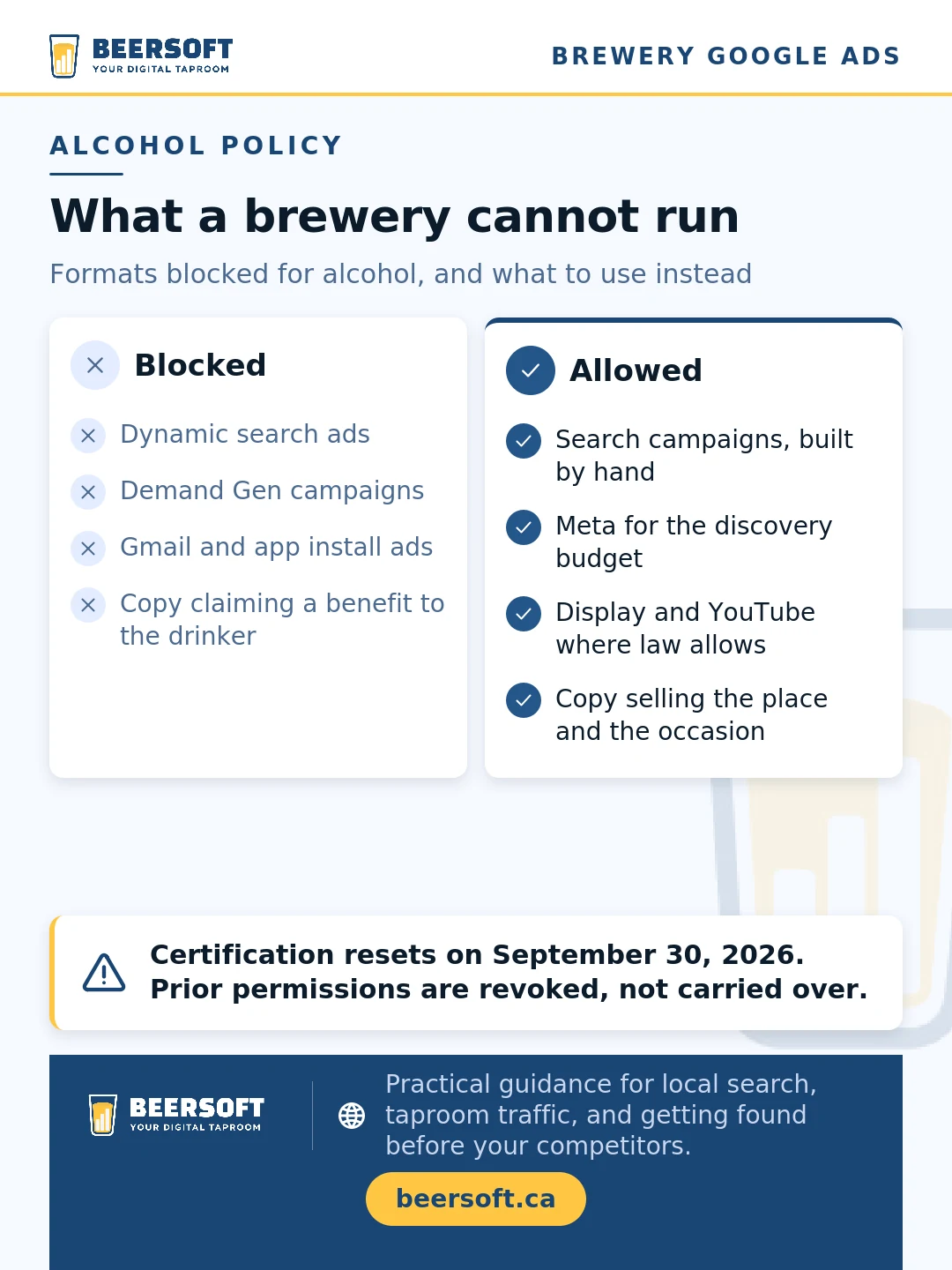
Google's alcohol policy prohibits specific campaign and ad formats outright. Demand Gen, dynamic search ads, Gmail ads and app install ads cannot carry alcohol content. Dynamic search ads matter most here, because they are the format a small advertiser reaches for first: point Google at the site, let it generate headlines from the pages, spend nothing on copywriting. A brewery cannot use it. Accounts built on that shortcut get disapproved, and the operator usually concludes that Google Ads "do not work for breweries."
Search, Display, YouTube, AdMob and Ad Exchange all permit alcohol advertising where local law allows it. Targeting is the other hard constraint: you may not target anyone below the legal drinking age in any location your ads reach, and campaigns aimed only at regions that disallow alcohol advertising are disapproved outright. Mixed-geography campaigns show as "Eligible (limited)" and run only where permitted, which is a status operators frequently misread as a technical fault.
The content rules bite on ad copy. Alcohol ads cannot suggest that drinking improves social, sexual, professional, intellectual or athletic standing, cannot claim health or therapeutic benefits, cannot show consumption while operating vehicles or machinery, and cannot depict binge or competition drinking favorably. If you sell a lower-alcohol or non-alcoholic line, the landing page has to state the highest ABV in the range.
One date to put in the calendar. Google's alcohol advertising policy moves to a unified global framework on September 30, 2026. Advertisers targeting regions that permit only 0% alcohol must apply for certification, and Google's notice states that all previous permissions are revoked on that date. Violations can lead to account suspension rather than a disapproved ad. If your brewery runs any non-alcoholic line into a restricted market, that is five days from this article's publication.
Five days is enough time to check a certification status and swap out a prohibited format. It is not enough time to rebuild an account from scratch after a suspension. If you are not sure which of those you are facing, ask before the thirtieth.
Key Takeaway: Before writing a single ad, confirm which formats you are allowed to use. A brewery that builds its first account on dynamic search ads has built an account that cannot run, and the disapproval will be read as proof the channel does not work.
How Should a Brewery Structure Its First Google Ads Account?
Three campaigns, separated by intent, is enough for almost any single-location taproom. Splitting further before you have conversion data just divides a small budget into portions too thin to learn from.
The first is branded defense, and it should usually be the smallest. If you already rank first organically for your own name and nobody else is bidding on it, you do not need it at all. If an aggregator, a delivery platform or a competitor is bidding on your name, a tightly capped branded campaign protects the click at a very low cost per acquisition. Check before you fund it.
The second is local non-branded, and it is the campaign that earns the money. This is where "brewery near me", "taproom [neighborhood]", "places with a patio [city]" and the qualifier searches live. Keep the radius genuinely local. The most common waste in brewery accounts is a radius set wide enough to include people who will never drive that far.
The third is occasion and event capture, and it is seasonal by design. Release weekends, holiday bookings, large-group and private-hire queries. Private hire deserves separate attention because the value per conversion is many times a single taproom visit, and the query volume is small enough that a modest budget can own it.
For budget, the published BeerSoft starter range for a managed brewery account is $1,000 to $3,000 a month. Take it as a starting point rather than a benchmark, because it describes a market we participate in. At the category median cost per lead of $30.57, the lower end of that range is roughly 30 tracked actions a month, which is enough signal to optimize against and not much more.
Running paid search against a taproom site that is slow, unclear about opening hours, or missing a booking path will burn the budget before it reaches the till. If you are not sure the site can carry the traffic, audit the site first.
Key Takeaway: Three campaigns, one of which you may not need. Check whether anyone is actually bidding on your brewery's name before you spend a cent defending it, because roughly half the time nobody is.
How Do You Know If Brewery Google Ads Are Working?
This is the honest difficulty with paid search for an on-premise business, and pretending otherwise is how agencies keep accounts they have not earned. The conversion you actually care about is a person standing at your bar, and that person did not fill in a form.
What you can measure reliably: direction requests, calls from the ad, booking and private-hire form submissions, menu views, and Google's own store visit estimates where your account qualifies for them. What you cannot measure reliably is the Saturday walk-in who searched on Thursday, told two friends, and arrived without clicking anything again.
The practical answer is to instrument the measurable conversions properly and then use a blunter instrument for the rest. Run a genuine holdout: turn the local non-branded campaign off for two comparable weeks and watch weekday covers, not weekend ones, because weekends are too demand-saturated to show a difference. It is a crude test and it is far better than an attribution model that quietly credits the last click for a decision made three days earlier.
Set the conversion values to something real while you are in there. A private-hire inquiry is not worth the same as a menu view, and an account that treats them equally will optimize toward the cheap one every time.
Key Takeaway: Instrument direction requests, calls and booking forms, then validate with a two-week holdout on weekday trade. If you cannot see a difference in covers when the campaign is off, you are buying clicks rather than customers.
Frequently Asked Questions
How much should a brewery spend on Google Ads per month?
Enough to generate learnable signal, which at the category median cost per lead of $30.57 means roughly $1,000 a month produces about 30 tracked actions. Below about $500 a month the data is too thin for the auction to optimize against and you are mostly paying for randomness. Our published managed range is $1,000 to $3,000 a month, which is a reasonable band for a single-location taproom.
Do I need special approval to advertise beer on Google?
In many markets, yes, and the rules change on September 30, 2026. Google's alcohol policy moves to a unified global framework on that date, and advertisers targeting regions that permit only 0% alcohol must apply for certification because all previous permissions are revoked. Everyone advertising alcohol must also comply with local law in every targeted country. Getting this wrong risks account suspension, not just a disapproved ad.
Should I run Google Ads or Meta ads first?
Whichever matches the problem you actually have. If people in your area do not know the taproom exists, start with Meta, because there is no search demand to intercept yet. If you are getting found but losing the comparison to two other breweries, start with Google. Most established taprooms have the second problem and fund the first.
Can I advertise my taproom events on Google Ads?
Yes, but understand what you are buying. Nobody searches for an event they have not heard of, so search will not create attendance on its own. Where it earns its place is capturing the people already looking, such as "things to do [city] this weekend" and private-hire queries, which convert at much higher value than a single visit.
Why were my brewery's ads disapproved under alcohol policy?
The three most common causes are a prohibited format, a targeting problem, and ad copy making a claim. Dynamic search ads, Demand Gen, Gmail and app install formats cannot carry alcohol content at all. Campaigns targeting only restricted regions are disapproved, while mixed geography shows as "Eligible (limited)", which is normal rather than broken. Copy suggesting beer improves social or professional standing, or offering any health benefit, will be rejected.
Conclusion: Bid on the Intent You Already Have
Most breweries are not short of people who would like them. They are short of the moment when someone with a free evening is deciding between three places, and that moment is purchasable for about two dollars.
What stops it working is rarely the budget. It is an account built on a format alcohol advertisers are not allowed to use, a radius drawn around a city instead of a neighborhood, conversions that count a menu view the same as a private-hire booking, and a policy deadline nobody noticed. Untangling that is what BeerSoft's Google Ads and PPC management work actually consists of, and it usually starts by finding out whether the account is legal to run before arguing about bids. If you want a second pair of eyes on an account that is spending without much to show for it, get in touch and we will start with the disapprovals.
And whatever else you do this week: if you run a non-alcoholic line into a restricted market, check your certification status before the thirtieth.
Sources
- Google. Alcohol advertising policy. Advertising Policies Help, prohibited practices, permitted platforms and formats, targeting and ABV disclosure requirements.
- Google. Update to the Alcohol Advertising Policy. August 2026 notice, effective September 30, 2026, unified global framework and certification requirement.
- WordStream. 2026 Google Ads Benchmarks. 13,474 US search campaigns across 23 industries, April 1 2025 to March 31 2026, minimum 52 campaigns per subcategory, median values.
- LocaliQ. Search Advertising Benchmarks for Every Industry. Same dataset, Restaurants and Food category detail.
- BeerSoft. Google Ads & PPC Advertising for Breweries & Taprooms. Published managed starter budget range.
Stay Ahead - Subscribe Now!
You may also be interested
Can a Brewery Deliver or Ship Beer? What the Rules Allow
Delivery and shipping are different things and the law treats them differently. Where a brewery may ship, what a compliant shipment requires, why the post office is never the answer, and what the nine-province Canadian agreement does and does not do yet.
How to Rank a Brewery on Google Maps
Google names three factors behind every map pack result. Two of them a brewery can move, one it never can, and the highest-leverage setting on the whole profile takes about two minutes to change.

Beer Can Design That Sells: Shelf Impact for Craft Packaging
What a can is really competing against, the one thing that should stay constant across a range, how the decoration method sets your minimum order, and what to hand a designer
What Actually Breaks on a Brewery Website, and What Maintenance Covers
The honest inventory of what decays on a brewery website, why plugins carry the risk on WordPress, what breaks on hosted builders instead, what a plan costs, and what you can do yourself
Brewery Website Migration: How to Move Platforms Without Losing Your Rankings
When a brewery actually needs to change platforms, what a migration genuinely puts at risk, the URL map that has to exist before anything moves, and the checks that close it out
Brewery Email Marketing: The Four Sends That Earn Their Keep
Why the newsletter is the weakest thing you can do with a brewery list, the four sends that replace it, where the names actually come from, and the two numbers worth reporting
Should Your Taproom Run a Chatbot?
What a taproom chatbot would actually be asked, what the 2026 data says about how chatbots perform, why the tap list is the worst thing to put in one, the narrow cases where it does pay, and what to fix instead
Beer Photography for Small Breweries: What to Shoot and When
What a small brewery actually needs photographs of, why a beer shot takes longer than it looks, what a half-day and a full day cost and deliver, which images have a window that closes, and how to write a brief
What a Brewery Website Costs, and What Drives the Number
Why quotes for the same brewery website vary by three times, what makes a taproom site structurally different from a brochure site, which decisions actually move the price, what you pay after launch, and how to compare quotes fairly

Choosing a Taproom POS: What to Ask Before You Sign
What a brewery POS has to do that a restaurant POS does not, why the processing rate matters more than the subscription, what is actually in the contract, who owns your data when you leave, and the questions to ask before signing
Which Taproom Workflows to Automate First
Which taproom workflows actually repeat often enough to justify automating, why federal compliance reporting is the highest-value target, what to connect after that, what to leave alone, and the order to do it in
Beer Label Design: What the Regulator Requires Before the Designer Starts
What the TTB requires on every beer label, how long approval actually takes in 2026, which rules constrain the artwork itself, what really delays a launch, and the brief a designer needs before starting
How to Start a Brewery: The Digital Foundations to Get Right First
What the federal and state approval timeline actually looks like in 2026, why your brewery name is a digital decision before it is a branding one, what to build during the approval window, and what has to be live before your first pour

The Three-Tier System, Explained for Brewery Marketers
Why the three-tier system exists, which marketing activities it forbids outright, exactly what a brewery may legally give a retailer and up to what value, why beer is treated differently from wine and spirits, and which channel you fully control
What Is a Mug Club? How Taprooms Build Recurring Revenue from Members
What a mug club is, how it differs from a points program, what the membership fee actually buys a taproom, the liquor-law rules that decide how you structure it, and how to publish the club so it can be found

ABV, IBU and SRM Explained: The Numbers on Your Tap List
What ABV, IBU and SRM actually measure, why the IBU number misleads drinkers, what the TTB requires you to print, and how to publish the specs so search engines and AI assistants can read them
Craft Beer Consumer Behavior in 2026: What the Data Means for Your Marketing Budget
How the major craft beer consumer behavior shifts of 2024 to 2026 translate into practical marketing budget decisions for taproom breweries, brewpubs, and microbreweries
Brewery Tourism Marketing: How to Attract Out-of-Town Visitors and Drive Weekend Traffic
How taproom breweries can attract out-of-town visitors, rank in tourism discovery platforms, and build the partnerships that drive consistent weekend traffic from the tourist segment in 2026
Brewery Loyalty Programs: Do Points and Perks Actually Drive Repeat Visits?
An evidence-based guide to brewery loyalty program mechanics, platform options, and ROI measurement for taproom operators considering whether and how to launch a customer loyalty program in 2026
Brewery Events as a Revenue Engine: How to Promote, Price, and Measure
How taproom breweries and brewpubs can promote, price, and measure events as a primary revenue engine rather than a secondary marketing activity in 2026
Brewery Merchandise and Secondary Revenue: How to Market Beyond the Pint
How taproom breweries and brewpubs can market merchandise, crowler programs, and beer club memberships as both a revenue diversification tool and a customer loyalty driver in 2026
12 Things Killing Your Local Search Rankings Right Now
A 12-point self-audit guide for brewery operators to identify and fix the website issues most commonly responsible for poor local search rankings and limited AI search visibility in 2026
Marketing Non-Alcoholic Beer: How Craft Breweries Can Capture the Sober Curious Consumer
How craft breweries can market non-alcoholic beer lines to sober-curious consumers, health-conscious drinkers, and younger demographics to capture the fastest-growing segment in the craft beer market in 2026
.webp)
Brewpub Marketing Strategy: How to Fill Both the Bar and the Dining Room
How brewpubs can use digital marketing to fill both the dining room and the bar by marketing the food and beer experience as a unified destination rather than two separate offerings
Microbrewery Marketing in a Shrinking Distribution Market: What to Do When Shelf Space Disappears
How microbreweries facing shrinking distributor interest and tightening shelf space can use digital marketing to differentiate their brand and pivot toward direct-to-consumer channels in 2026

Brewery Social Media Strategy for 2026: Instagram, Facebook, and When to Bother with TikTok
A platform-by-platform social media strategy for taproom breweries and brewpubs in 2026, covering Instagram, Facebook, and TikTok with content mix ratios and posting cadence

Brewery Content Marketing in 2026: What to Publish, When, and Why It Works
What to publish, when to publish it, and why a structured content marketing program is the highest-ROI long-term investment available to brewery operators in 2026
Meta Ads for Breweries: A Geo-Targeted Playbook for Taprooms and Brewpubs
A geo-targeted Meta advertising playbook for taproom breweries and brewpubs covering campaign structure, audience targeting, ad formats, and budget guidance for 2026
Multi-Location Brewery SEO: How Regional Craft Breweries Rank in Every Market
How regional craft breweries operating multiple taprooms can build an SEO architecture that ranks independently in every local market without cannibalizing results.
Brewery Review Marketing: How to Turn Guest Feedback into Local Search Fuel
Google reviews are the number two local ranking factor for breweries. Learn how to generate, respond to, and optimize reviews for local search and AI search visibility.
Google Business Profile for Breweries: The Complete 2026 Optimization Guide
How to set up, optimize, and maintain your brewery's Google Business Profile to dominate local search and drive foot traffic in 2026.
How to Make Your Brewery Visible in AI Search: A GEO Guide for Craft Breweries
How craft breweries can use Generative Engine Optimization (GEO) to stay visible in AI-powered search results in 2026