Beer Photography for Small Breweries: What to Shoot and When

Share the page:
Most breweries commission photography once, get twenty pictures of pints, and still have nothing to put on a beer page. The useful way to plan a shoot is by what each image has to do: a beer page needs one consistent treatment repeated per beer, a Google listing needs the room, and social needs people. A half-day runs roughly $800 to $2,000 and produces fifteen to thirty finished images; a full day is $1,500 to $4,000 for thirty to sixty. Some shots have a window that closes, and the build-out is the obvious one. Shoot those first, whatever else waits.
Introduction: Twenty Photographs of Pints Is Not a Photo Library
The usual sequence is that a brewery books a photographer, spends a day being photographed, receives a gallery, and uses about six of the images. The rest are variations of the same shot: a full glass, nicely lit, on the bar.
They are good photographs. They are not a library, because nobody decided in advance what the library was for.
A beer page needs a picture of every beer, framed identically, so the page looks like a set rather than a scrapbook. A Google Business Profile needs the room, the frontage and the parking, because that is what someone deciding whether to drive over is actually checking. Social needs people. A label needs something else again. Those are four different briefs, and a day spent shooting pints satisfies one of them.
Photography comes up in BeerSoft onboarding most often as a gap rather than a plan: a client with a beautiful homepage image and twelve beer pages sharing one stock photo of hops.
Here is what to shoot, what it costs, and which images you cannot go back for.
What Does a Brewery Actually Need Photographs Of?
Four categories, and they are not interchangeable.
The beer set is the one that pays for itself and the one most often skipped. A page per beer is the structure a brewery site needs anyway, and twelve beers photographed the same way look like a brand. Twelve beers photographed on twelve different days look like a folder.
Key Takeaway: Decide the four lists before you book anything. A shoot without a shot list produces variations of whatever was easiest to photograph that day.
Building the beer pages at the same time? Talk to us about content creation, because the photography and the page structure are the same decision made twice.
Why Does a Beer Shot Take Longer Than You'd Think?
Because the subject changes while you are photographing it.
A poured beer is on a clock. The head settles, the carbonation calms, and the condensation that makes a glass look cold under bright lights does not survive long. Photographers deal with this by pouring fresh for each setup rather than lighting one glass and working around it, which means a single beer shot can consume several pours and a lot of glassware.
Then there is the glass itself. Every fingerprint, every water spot and every scratch shows at the resolution a beer page needs, so glassware gets handled, polished and reset between frames.
None of this is a reason to worry about the quote. It is the reason a set of twelve beers is a half-day rather than an hour, and it is worth understanding before you look at a day rate and wonder what takes so long.
The practical consequence for you is preparation. Clean glassware in quantity, enough beer to pour repeatedly, and somebody who can pour consistently are all your side of the arrangement, and a shoot that stops while someone hunts for a clean glass is a shoot you are paying for by the hour.
Key Takeaway: Supply more clean glassware and more beer than feels necessary. The bottleneck on a beer shoot is almost never the camera.
What Does a Shoot Cost, and What Do You Get?
Somewhere between a few hundred and a few thousand, and the deliverable count matters as much as the rate.
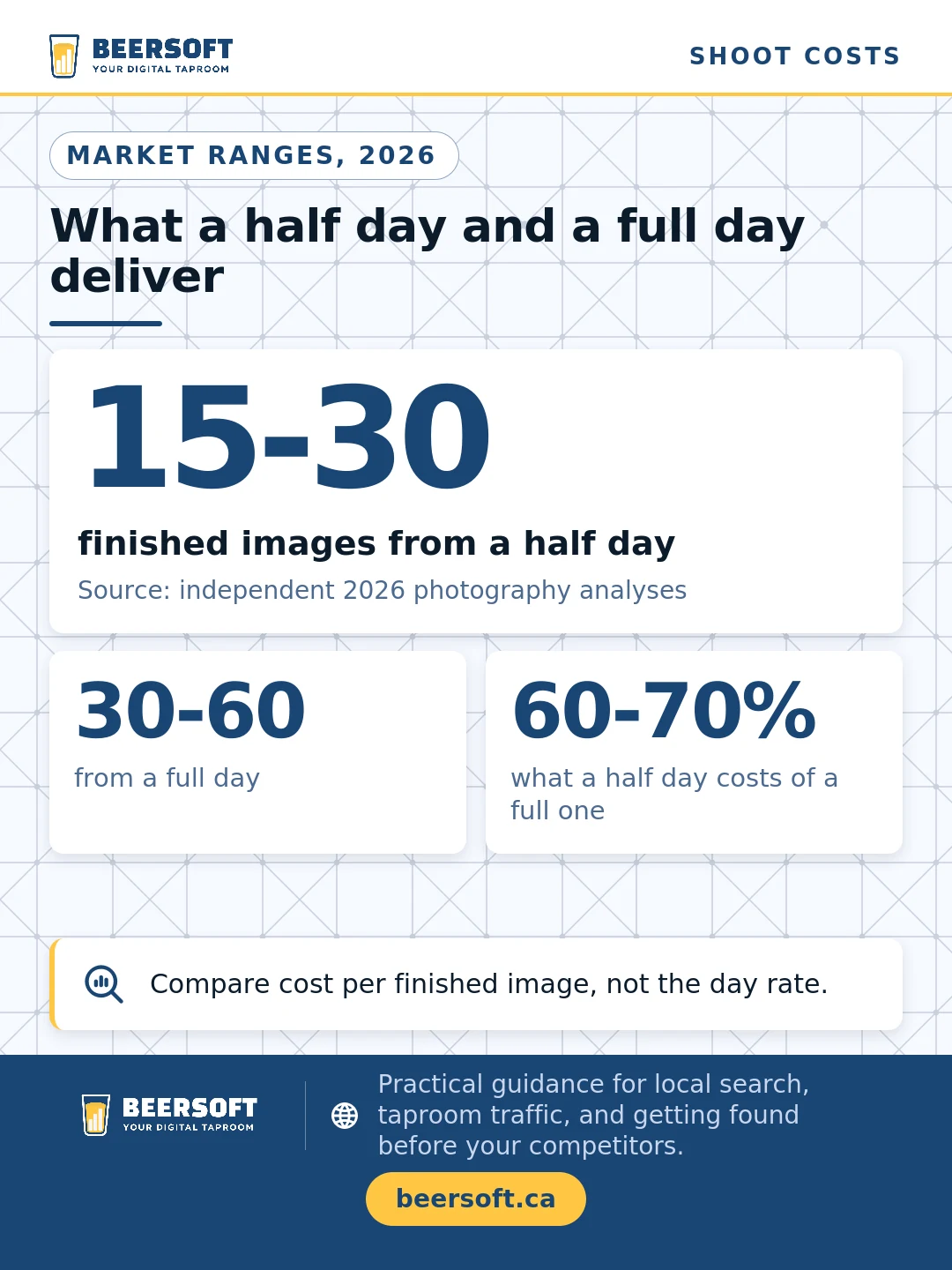
Independent 2026 pricing analyses put a half-day at roughly $800 to $2,000 for around four hours, typically producing fifteen to thirty finished images. A full day is commonly $1,500 to $4,000 for thirty to sixty or more. Per-image pricing exists too, usually $25 to $350 depending on complexity.
Two things surprise people. First, a half-day usually costs more than half a full day, often sixty to seventy percent, because the booking still blocks the photographer's diary. Second, the day rate frequently covers the photographer's time and a set number of edited images, while styling, props, extensive retouching and extended licensing sit on top. Analyses in this space put those additions at forty to sixty percent of the base on some projects.
Licensing is the line to read carefully. A standard commercial license normally covers your website, social and print. Large-scale use, billboards or paid campaigns at scale, is often priced separately. Say what the images are for before the shoot rather than after.
The way to judge whether any of it is worth it is reuse rather than the sticker. A beer set shot once appears on the beer pages, in the tap list, on the Google listing, across social, in press requests and on any menu you print, and it keeps appearing until the beer is retired. Divide the cost across the surfaces and the years and the arithmetic looks different from a day rate sitting on its own in an invoice. The images that age badly are the ones tied to a season, a person who left, or a room you have since refitted, which is another argument for shooting the standing set separately from the topical work.
Key Takeaway: Compare on cost per finished image and on what the license permits, not on the day rate alone.
Which Shots Have a Window That Closes?
More than you would expect, and they are the ones to book first.
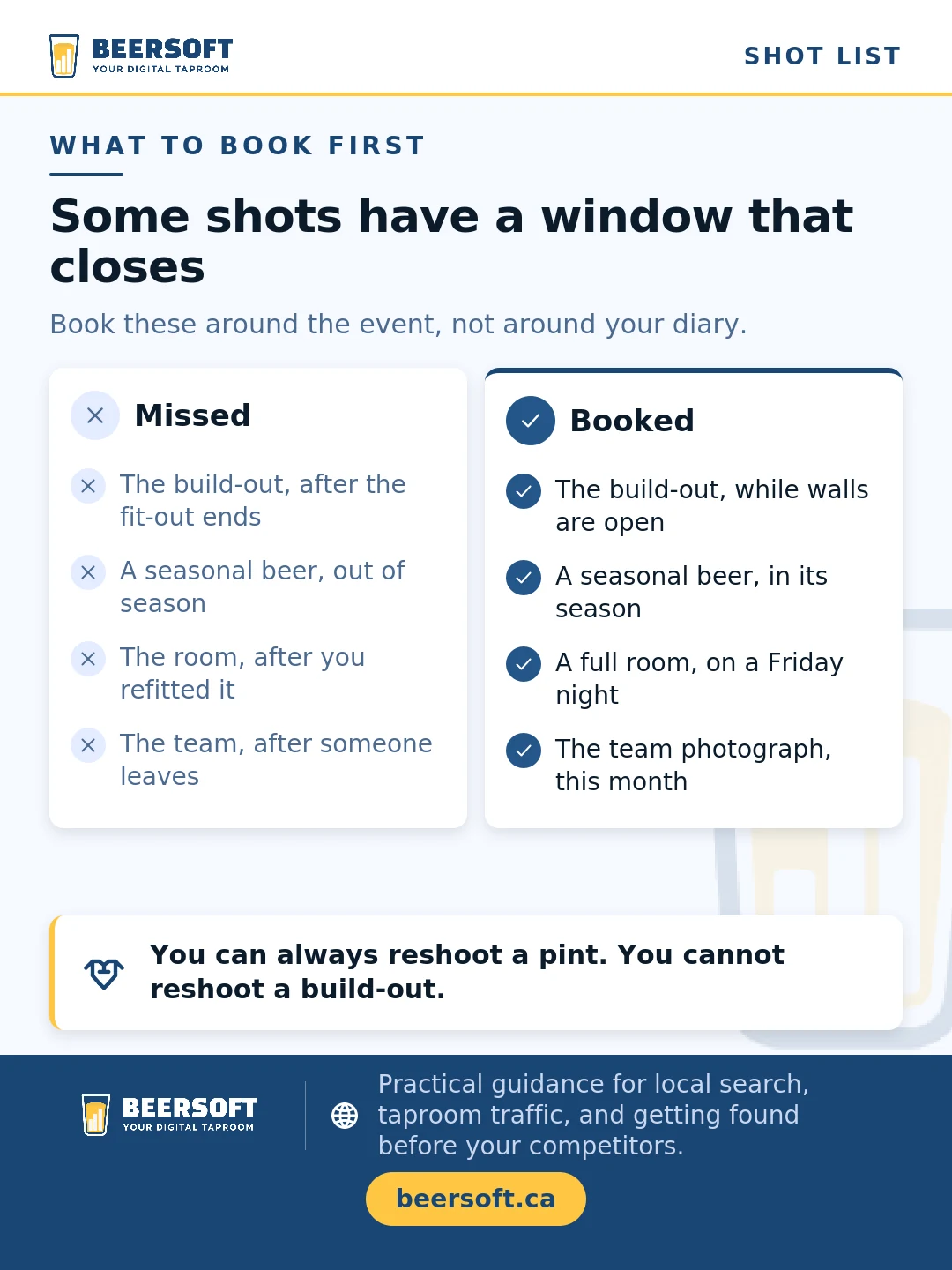
A tap list is evergreen in the sense that you can always photograph today's beers. A build-out is not. The brewery under construction exists for a few months and then never again, and it is the most interesting visual story a new brewery will ever have. The startup piece makes the same point in passing; it belongs here properly.
Seasonal releases are the same shape. A beer you make once a year has one shooting window a year, and missing it means the page carries nothing until next autumn.
A full room is a third. Photographing a busy taproom requires a busy taproom, which means shooting on a Friday evening rather than at the quiet Tuesday morning that suits everyone's diary. The alternative is an empty room, which reads to a first-time visitor as a warning rather than an invitation.
And staff leave. The team photograph that is on your about page in three years is the one you take now.
Key Takeaway: Sort the shot list into perishable and evergreen, then book the perishable items around the event rather than around the calendar.
How Do You Brief a Photographer?
In one page, with the deliverables and the constraints in it.
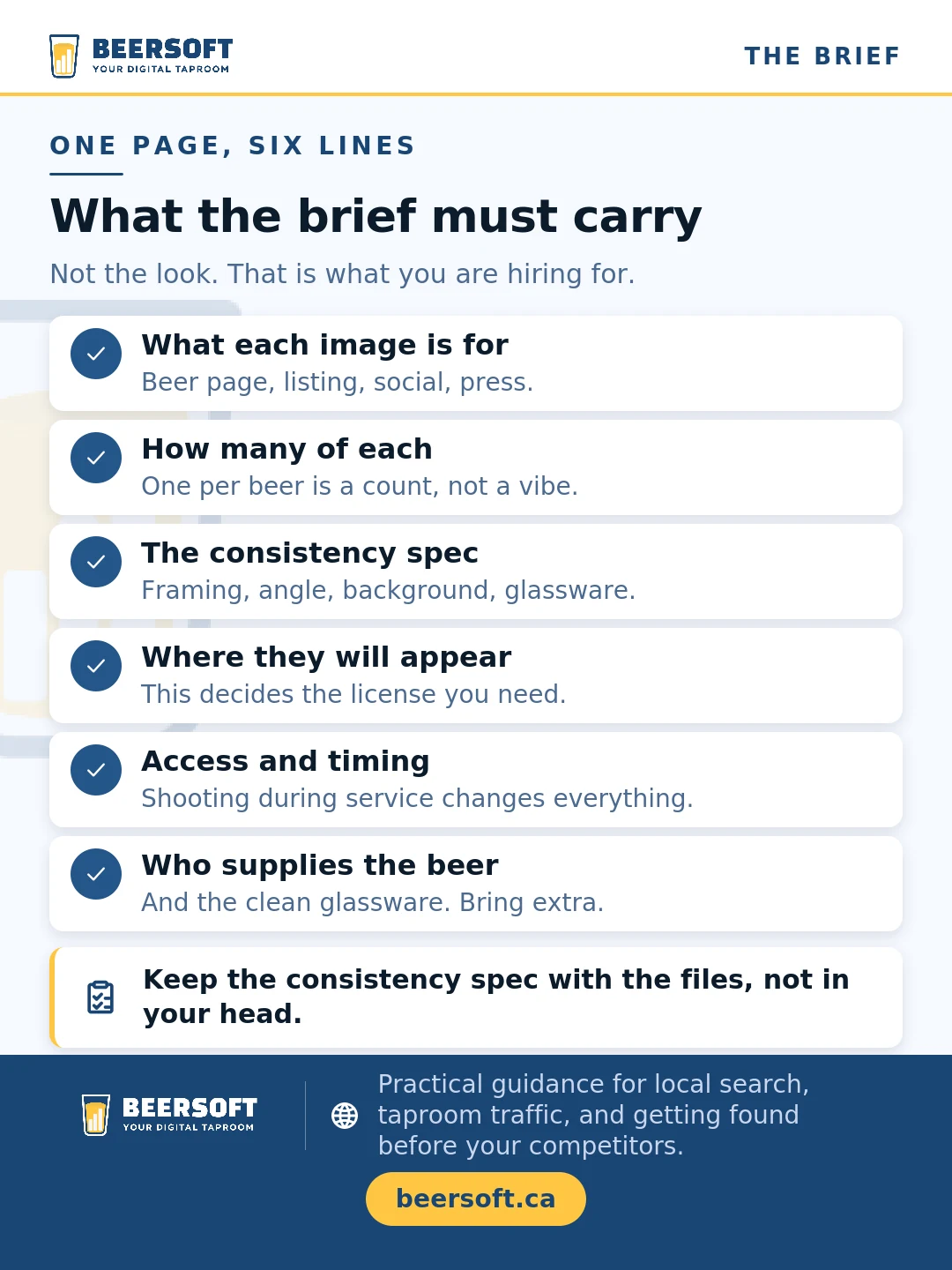
The brief does not need to describe the look. That is what you are hiring for, and a brewery owner describing lighting to a photographer is the same mistake as a photographer describing hop schedules to a brewer. What the brief needs to carry is what the images are for, how many of each, where they will appear, and what has to be consistent.
Consistency is the item most often left out and the one with the longest tail. If the beer set is shot at a specified framing, angle and background, a new beer can be added in two years by any competent photographer and it will match. Without that specification, every future addition either looks wrong or requires reshooting the set.
The version BeerSoft sees most often is a brewery on its third photographer, with three visually incompatible sets of beer images and no record of how any of them were shot.
Key Takeaway: Write the consistency spec down and keep it with the image files. It is the difference between a library that grows and one that gets replaced.
Frequently Asked Questions
How much does beer photography cost?
Independent 2026 analyses put a half-day at roughly $800 to $2,000 for about four hours, typically delivering fifteen to thirty finished images, and a full day at $1,500 to $4,000 for thirty to sixty or more. Per-image pricing runs $25 to $350 depending on complexity. Styling, props, heavy retouching and extended licensing are usually quoted on top of the day rate rather than included in it.
What should a brewery photograph first?
Anything with a window that closes. Build-out and brew day are scheduled events you cannot restage, seasonal releases have one shooting window a year, and a busy room requires a busy night. Everything else, including the standing beer set, can be shot on a quiet morning whenever it suits. Perishable first, evergreen second.
Why do beer photos take so long to shoot?
Because the subject changes while you work. Head settles, carbonation calms, and condensation does not last under lights, so photographers pour fresh for each setup rather than working around one glass. Glassware also has to be spotless, since fingerprints and water spots show clearly at the resolution a website needs. A set of twelve beers is a half-day rather than an hour for those reasons.
Can I photograph my own beers on a phone?
For social, often yes. For a beer page, the problem is not resolution but consistency: twelve beers shot on twelve days under different light will not look like a set. If budget is tight, the better compromise is to commission the beer set professionally with a documented specification, then shoot events and day-to-day content yourself against that standard.
What should be in a photography brief?
What the images are for, how many of each category, where they will appear, what must be consistent across the set, and any access constraints such as shooting during service. It does not need to describe the lighting or the look, which is what you are hiring the photographer to decide. Include the licensing you need before the shoot rather than after.
Conclusion: Shoot the Perishable Things First
Split the list before you book. Build-out, brew day, seasonal beers and a full room are events, not tasks, and they get scheduled around the thing happening rather than around your diary. Everything else can wait for a quiet morning.
Then write the consistency spec for the beer set and keep it with the files. Framing, angle, background, glassware. That one page is what lets the twelfth beer added in two years look like it belongs with the first eleven.
Planning a shoot around what the pages and listings actually need, and keeping the specification so the library survives a change of photographer, is the part that turns a day of photography into an asset. It is the part BeerSoft picks up: photography and videography is where that work lives. Contact us with your tap list and your opening hours and we will tell you what the shot list should be.
If you are still deciding what the site itself should cost, that piece is here, and photography is usually the line the quotes differ on most.
Sources
- Lars Miller Media. Commercial Photography Rates: What to Expect in 2026. April 17, 2026.
- Lars Miller Media. Product Photography Pricing: Complete Cost Guide 2026. June 11, 2026.
- FrameOnce. Product Photography Pricing: What to Expect in 2026. February 25, 2026.
- Ken Jones Photography. Product Photography Rates: What to Budget in 2026. June 27, 2026.
- Vision Balm. How Much Does a Product Photo Shoot Cost in 2026?
Stay Ahead - Subscribe Now!
You may also be interested
Brewery Website Migration: How to Move Platforms Without Losing Your Rankings
When a brewery actually needs to change platforms, what a migration genuinely puts at risk, the URL map that has to exist before anything moves, and the checks that close it out
Brewery Email Marketing: The Four Sends That Earn Their Keep
Why the newsletter is the weakest thing you can do with a brewery list, the four sends that replace it, where the names actually come from, and the two numbers worth reporting
Should Your Taproom Run a Chatbot?
What a taproom chatbot would actually be asked, what the 2026 data says about how chatbots perform, why the tap list is the worst thing to put in one, the narrow cases where it does pay, and what to fix instead
What a Brewery Website Costs, and What Drives the Number
Why quotes for the same brewery website vary by three times, what makes a taproom site structurally different from a brochure site, which decisions actually move the price, what you pay after launch, and how to compare quotes fairly
Choosing a Taproom POS: What to Ask Before You Sign
What a brewery POS has to do that a restaurant POS does not, why the processing rate matters more than the subscription, what is actually in the contract, who owns your data when you leave, and the questions to ask before signing
Which Taproom Workflows to Automate First
Which taproom workflows actually repeat often enough to justify automating, why federal compliance reporting is the highest-value target, what to connect after that, what to leave alone, and the order to do it in
Beer Label Design: What the Regulator Requires Before the Designer Starts
What the TTB requires on every beer label, how long approval actually takes in 2026, which rules constrain the artwork itself, what really delays a launch, and the brief a designer needs before starting
How to Start a Brewery: The Digital Foundations to Get Right First
What the federal and state approval timeline actually looks like in 2026, why your brewery name is a digital decision before it is a branding one, what to build during the approval window, and what has to be live before your first pour

The Three-Tier System, Explained for Brewery Marketers
Why the three-tier system exists, which marketing activities it forbids outright, exactly what a brewery may legally give a retailer and up to what value, why beer is treated differently from wine and spirits, and which channel you fully control
What Is a Mug Club? How Taprooms Build Recurring Revenue from Members
What a mug club is, how it differs from a points program, what the membership fee actually buys a taproom, the liquor-law rules that decide how you structure it, and how to publish the club so it can be found

ABV, IBU and SRM Explained: The Numbers on Your Tap List
What ABV, IBU and SRM actually measure, why the IBU number misleads drinkers, what the TTB requires you to print, and how to publish the specs so search engines and AI assistants can read them
Craft Beer Consumer Behavior in 2026: What the Data Means for Your Marketing Budget
How the major craft beer consumer behavior shifts of 2024 to 2026 translate into practical marketing budget decisions for taproom breweries, brewpubs, and microbreweries

Brewery Tourism Marketing: How to Attract Out-of-Town Visitors and Drive Weekend Traffic
How taproom breweries can attract out-of-town visitors, rank in tourism discovery platforms, and build the partnerships that drive consistent weekend traffic from the tourist segment in 2026
Brewery Loyalty Programs: Do Points and Perks Actually Drive Repeat Visits?
An evidence-based guide to brewery loyalty program mechanics, platform options, and ROI measurement for taproom operators considering whether and how to launch a customer loyalty program in 2026
Brewery Events as a Revenue Engine: How to Promote, Price, and Measure
How taproom breweries and brewpubs can promote, price, and measure events as a primary revenue engine rather than a secondary marketing activity in 2026
Brewery Merchandise and Secondary Revenue: How to Market Beyond the Pint
How taproom breweries and brewpubs can market merchandise, crowler programs, and beer club memberships as both a revenue diversification tool and a customer loyalty driver in 2026
12 Things Killing Your Local Search Rankings Right Now
A 12-point self-audit guide for brewery operators to identify and fix the website issues most commonly responsible for poor local search rankings and limited AI search visibility in 2026
Marketing Non-Alcoholic Beer: How Craft Breweries Can Capture the Sober Curious Consumer
How craft breweries can market non-alcoholic beer lines to sober-curious consumers, health-conscious drinkers, and younger demographics to capture the fastest-growing segment in the craft beer market in 2026
.webp)
Brewpub Marketing Strategy: How to Fill Both the Bar and the Dining Room
How brewpubs can use digital marketing to fill both the dining room and the bar by marketing the food and beer experience as a unified destination rather than two separate offerings
Microbrewery Marketing in a Shrinking Distribution Market: What to Do When Shelf Space Disappears
How microbreweries facing shrinking distributor interest and tightening shelf space can use digital marketing to differentiate their brand and pivot toward direct-to-consumer channels in 2026

Brewery Social Media Strategy for 2026: Instagram, Facebook, and When to Bother with TikTok
A platform-by-platform social media strategy for taproom breweries and brewpubs in 2026, covering Instagram, Facebook, and TikTok with content mix ratios and posting cadence

Brewery Content Marketing in 2026: What to Publish, When, and Why It Works
What to publish, when to publish it, and why a structured content marketing program is the highest-ROI long-term investment available to brewery operators in 2026
Meta Ads for Breweries: A Geo-Targeted Playbook for Taprooms and Brewpubs
A geo-targeted Meta advertising playbook for taproom breweries and brewpubs covering campaign structure, audience targeting, ad formats, and budget guidance for 2026
Multi-Location Brewery SEO: How Regional Craft Breweries Rank in Every Market
How regional craft breweries operating multiple taprooms can build an SEO architecture that ranks independently in every local market without cannibalizing results.
Brewery Review Marketing: How to Turn Guest Feedback into Local Search Fuel
Google reviews are the number two local ranking factor for breweries. Learn how to generate, respond to, and optimize reviews for local search and AI search visibility.
Google Business Profile for Breweries: The Complete 2026 Optimization Guide
How to set up, optimize, and maintain your brewery's Google Business Profile to dominate local search and drive foot traffic in 2026.
How to Make Your Brewery Visible in AI Search: A GEO Guide for Craft Breweries
How craft breweries can use Generative Engine Optimization (GEO) to stay visible in AI-powered search results in 2026