Should Your Taproom Run a Chatbot?

Share the page:
For most taprooms, no. Gartner's 2026 research puts customer satisfaction with chatbot-only interactions at 28% against 82% for a human, and 72% of users escalate to a person after one or two small mistakes. A taproom gets asked about five things, four of which a well-structured page and an accurate Google listing answer better and cheaper. The fifth is what is on tap, which changes weekly and is therefore the single thing a bot is most likely to get wrong. There are three situations where one earns its place, and they are narrower than the sales pitch suggests.
Introduction: Everything Written About This Is Written by Someone Selling One
Search for restaurant chatbots and every result concludes that you need one. That is not a conspiracy, it is just who writes about the topic. Companies that sell chatbots produce the content, and companies that sell chatbots do not publish articles explaining when a chatbot is the wrong purchase.
So here is the version from a firm that builds them and will tell you when not to.
The honest position is that conversational AI has genuine uses in hospitality, and that a single-location taproom is usually not one of them. Not because the technology is bad, but because the questions a taproom gets asked are almost all questions a properly built page already answers, and because the one question a bot could uniquely help with is the one it is structurally worst at.
Chatbots come up in BeerSoft onboarding fairly often, usually after somebody has seen a competitor add one. The conversation that follows is normally about what problem it is meant to solve, and it frequently turns out there isn't one.
Here is what the data says, and where the exceptions are.
What Would a Taproom Chatbot Actually Be Asked?
Five things, and you already know what they are, because your staff answer them every shift.
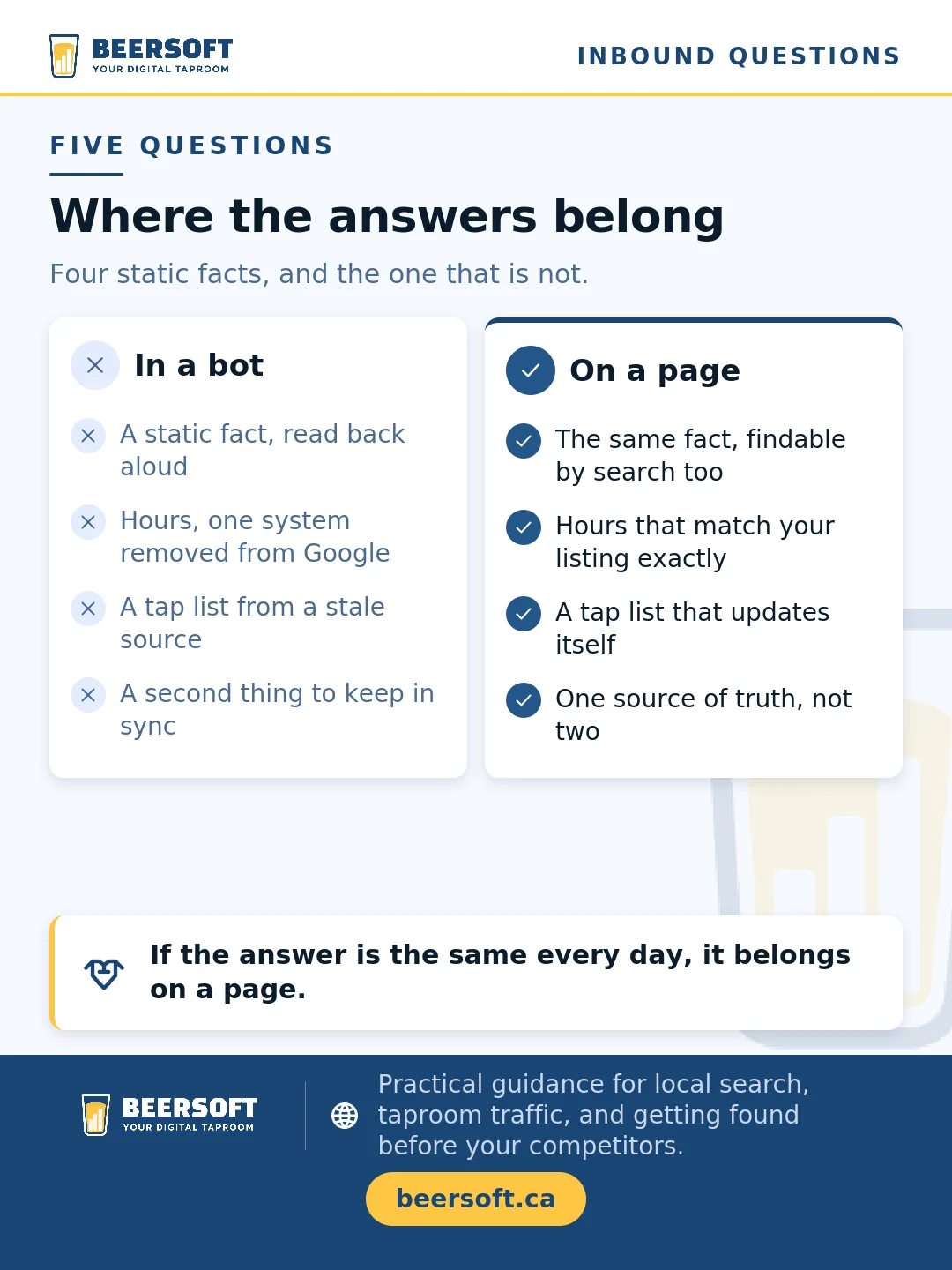
Four of those five are static facts. A bot that answers them is an expensive way to read a page aloud, and it is one more system to keep in sync with the page it is reading from.
Key Takeaway: If a question has the same answer every day, the answer belongs on a page, not in a conversation.
What Does the Data Actually Say?
That people tolerate chatbots and rarely like them, and that tolerance collapses fast on error.
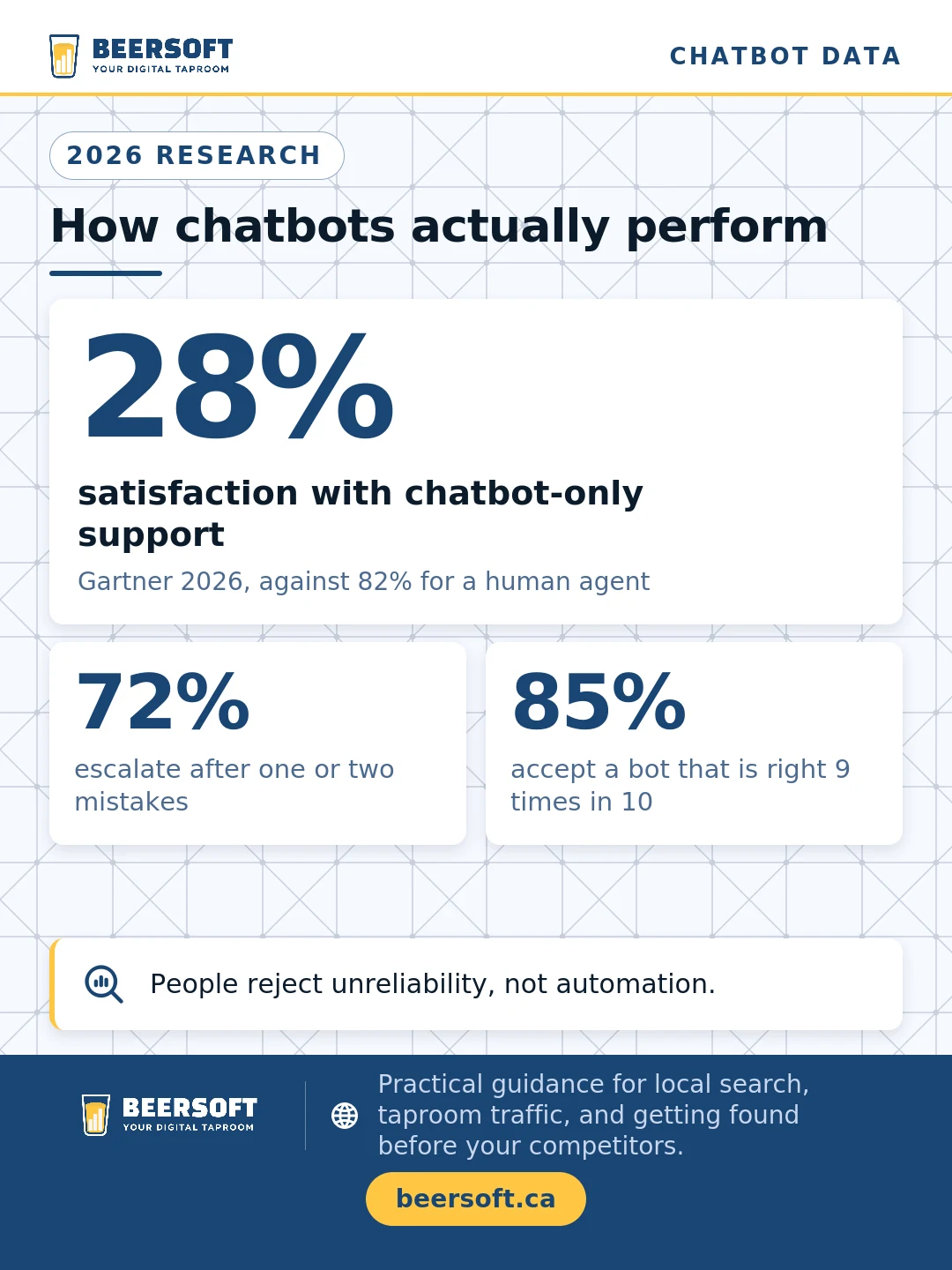
Gartner's 2026 customer service research puts satisfaction with chatbot-only interactions at 28%, against 82% for interactions with a human. Zendesk's 2026 CX Trends found 73% of customers would rather wait on hold for a person than use a chatbot. SurveyMonkey's 2026 tracking has preference for humans rising from 83% to 85% year on year while preference for AI fell from 7% to 5%.
The most useful number for a taproom is about error tolerance. A 2026 survey of around a thousand North American consumers found 72% escalate to a human after one or two small mistakes, and that 62% of escalations come from comprehension failures rather than slow responses. People are not leaving because the bot is slow. They are leaving because it did not understand them.
The counterweight, and it matters. A June 2026 survey of 1,001 US adults found 85% would happily use an automated system that resolves their issue nine times out of ten. So the rejection is not of automation. It is of automation that fails and traps you. That distinction is the whole decision: a bot that is reliably right about a small number of things is fine, and a bot that is occasionally wrong about the thing you asked is worse than no bot.
Key Takeaway: The bar is not "does it work most of the time." Two mistakes is the budget before most people give up on it entirely.
Wondering what your site already answers? Talk to us about AI marketing and we will look at what a visitor can find before adding anything new to the page.
Why Is the Tap List the Worst Thing to Put in a Bot?
Because it is the only question with real value and it changes every week.
The first four questions are stable. Your hours are your hours. But what is pouring right now is genuinely useful information, genuinely hard to find, and genuinely different from last Tuesday. It is the one thing a conversational interface could add value on.
It is also the thing most likely to be wrong, for a reason that has nothing to do with the bot's intelligence. The bot answers from a source. If that source is a page somebody updates manually when they remember, the bot is now a confident, friendly, always-available way of telling people you have a beer you kicked on Saturday.
That is worse than silence. A stale page is passive and people discount it. A bot that says "yes, we have the hazy IPA on right now" is an active assurance, and someone drives over on the strength of it.
We have made the argument twice that the tap list should push from wherever it is authoritative rather than being retyped, in the piece on publishing your beer specs and again in the one on which workflows to automate. A chatbot does not change that requirement. It raises the penalty for ignoring it.
Key Takeaway: Do not put the tap list in a bot until the tap list updates itself. Until then the bot is a faster way to be wrong.
When Is a Chatbot Actually Worth It?
Three situations, and they share a shape: real inbound volume, on questions that are not static.
Private hire and events. If you take a meaningful number of inquiries a week about buyouts, function space or large bookings, those conversations are genuinely variable and genuinely repetitive at the same time. Qualifying them, capacity, date, budget, catering, before a person picks up is real work being removed.
Multiple locations. The moment "are you open" has a different answer depending on which site someone means, a routing layer starts earning its keep. One taproom does not have that problem.
A second language. If a real share of your visitors do not read English comfortably, a conversational interface that handles the basics in their language is doing something a static page in one language cannot.
Notice what is not on that list: most single-site taprooms. If your inbound is a handful of Instagram DMs a week asking whether you do food, the honest answer is that you have a page problem, not a conversation problem.
Key Takeaway: Volume plus variability is the test. If either is missing, a bot is a solution looking for a question.
What Should You Fix Instead?
The things a bot would have been covering for.
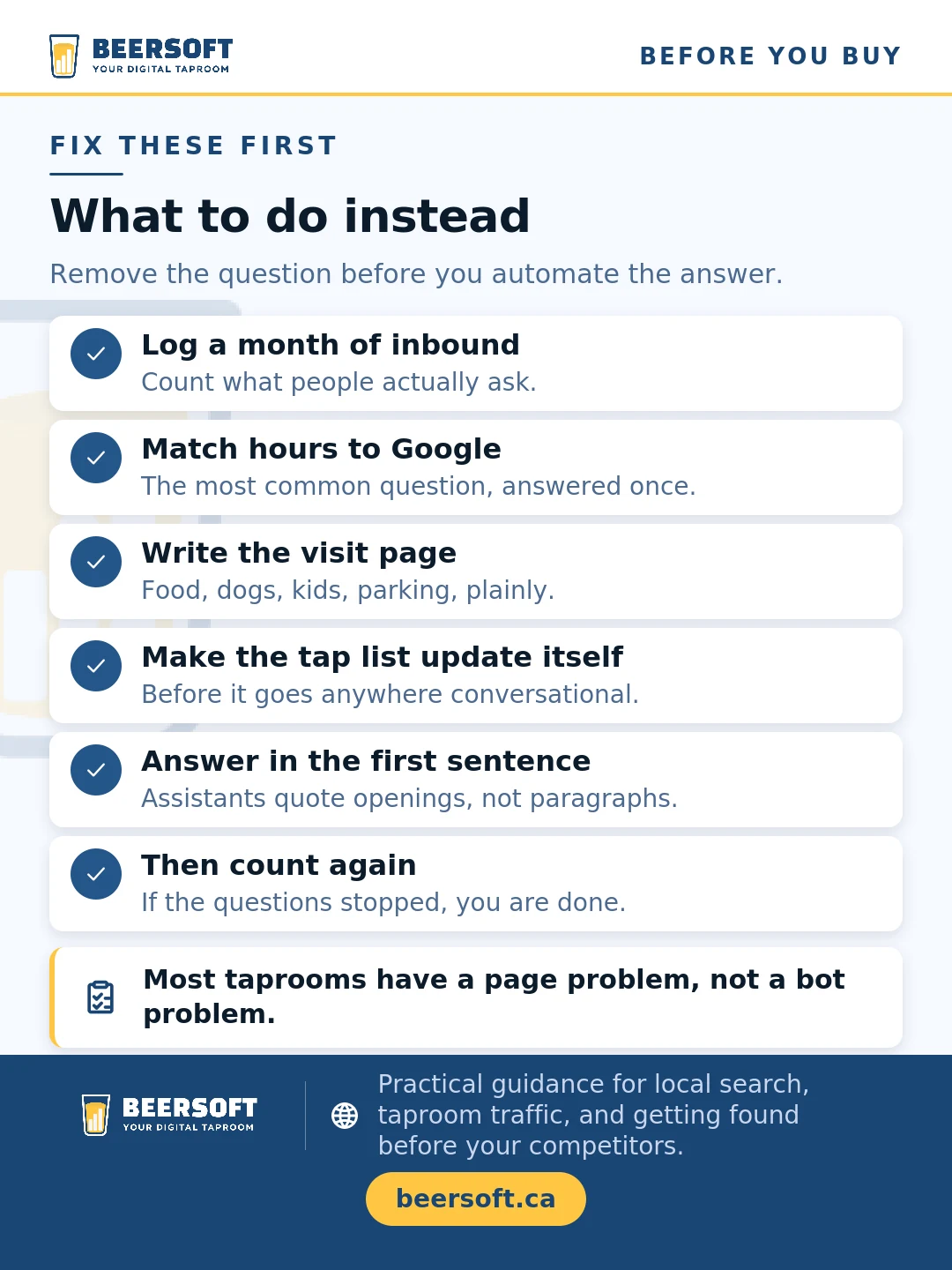
Most of what a taproom chatbot would answer is a symptom of information that is hard to find. Hours buried in a footer, a dog policy nobody wrote down, a tap list last updated in July. Fixing those removes the questions rather than automating the answers, and it costs less.
The version BeerSoft sees most often is a taproom that adds a chatbot, watches it answer the same four questions all month, and never changes the page those questions were about. The bot becomes a permanent patch over a five-minute fix.
There is also an argument from where the questions are going. A rising share of "is this place open, do they do food, what is on" never reaches your site at all now; it is answered by a search engine or an assistant reading your pages and your listing. Making those sources correct serves both the people who ask you directly and the far larger number who never do.
Key Takeaway: Every question your bot would answer twenty times a month is a question your page should have answered once.
Frequently Asked Questions
Do restaurant chatbots actually work?
They work for narrow, high-volume, repetitive tasks and perform poorly outside that. Gartner's 2026 research puts satisfaction with chatbot-only interactions at 28% against 82% for a human agent, and Zendesk found 73% of customers would rather wait on hold than use one. The nuance worth knowing is that 85% of consumers say they would happily use an automated system that resolves their issue nine times out of ten, so the objection is to unreliability rather than to automation.
Should a single-location taproom get a chatbot?
Usually not. A single taproom is asked roughly five recurring questions, four of which are static facts better handled by a clear page and an accurate Google Business Profile. Adding a bot creates a second system to keep in sync with the first. The cases where it does pay are high volumes of private-hire inquiries, multiple locations, or a significant non-English-speaking audience.
Can a chatbot tell customers what is on tap?
It can, and this is the riskiest thing to ask it to do. Your tap list changes weekly, and a bot answers from whatever source you point it at. If that source is updated manually, the bot becomes a confident way of telling people about a beer you no longer have. Fix the tap list so it updates from an authoritative source before putting it anywhere conversational.
What do customers dislike most about chatbots?
Not being understood. A 2026 survey of around a thousand North American consumers found 62% of escalations to a human stem from comprehension failures, against 22% from performance issues, and that 72% escalate after just one or two small mistakes. Accuracy matters far more than speed; only a small minority cite slow responses as their main frustration.
What is the alternative to a taproom chatbot?
Answer the questions once, publicly, where people and search engines can both find them. Hours that match your Google listing exactly, a visit page covering food, dogs, kids and parking in plain language, and a tap list that is genuinely current. That removes most of the inbound rather than automating a reply to it, and it also serves the growing share of people who never visit your site because an assistant answered for you.
Conclusion: Remove the Question Before You Automate the Answer
Start by counting. For one month, log what people actually ask you by DM, phone and email. Most taprooms find four or five questions covering nearly everything, and nearly all of them have a fixed answer.
Then fix the pages those questions are about, and make the tap list update itself rather than being retyped. If the questions keep coming after that, you have a genuine conversation problem and a bot is worth costing. If they stop, you have saved the subscription and the maintenance.
Working out which of those two situations you are actually in, and building the underlying data properly either way, is the part worth paying for. It is the part BeerSoft picks up: AI chatbots and assistants is where that work lives, including the conversations that end with us telling a client not to build one. Contact us with a month of your inbound messages and we will tell you whether you have a conversation problem or a page problem.
If you are in the minority with real inquiry volume, a bot is a reasonable purchase. Most taprooms are not, and nobody selling one is going to say so.
Sources
- GreetNow. Why Customers Hate Chatbots in 2026 (And What Actually Works), citing Gartner 2026 Customer Service and Support Research and Zendesk CX Trends 2026.
- Botpress. 50+ Customer Support Chatbot Statistics in North America, 2026. June 15, 2026.
- SurveyMonkey. Customer Service Statistics 2026: Humans vs AI Trends. February 19, 2026.
- ChatterMate. AI Customer Service Frustration Is Real, citing Parloa's Consumer Patience Index, June 2026.
- Avaya. 45 Customer Experience Statistics for 2026. February 17, 2026.
Stay Ahead - Subscribe Now!
You may also be interested
Brewery Website Migration: How to Move Platforms Without Losing Your Rankings
When a brewery actually needs to change platforms, what a migration genuinely puts at risk, the URL map that has to exist before anything moves, and the checks that close it out
Brewery Email Marketing: The Four Sends That Earn Their Keep
Why the newsletter is the weakest thing you can do with a brewery list, the four sends that replace it, where the names actually come from, and the two numbers worth reporting
Beer Photography for Small Breweries: What to Shoot and When
What a small brewery actually needs photographs of, why a beer shot takes longer than it looks, what a half-day and a full day cost and deliver, which images have a window that closes, and how to write a brief
What a Brewery Website Costs, and What Drives the Number
Why quotes for the same brewery website vary by three times, what makes a taproom site structurally different from a brochure site, which decisions actually move the price, what you pay after launch, and how to compare quotes fairly

Choosing a Taproom POS: What to Ask Before You Sign
What a brewery POS has to do that a restaurant POS does not, why the processing rate matters more than the subscription, what is actually in the contract, who owns your data when you leave, and the questions to ask before signing
Which Taproom Workflows to Automate First
Which taproom workflows actually repeat often enough to justify automating, why federal compliance reporting is the highest-value target, what to connect after that, what to leave alone, and the order to do it in
Beer Label Design: What the Regulator Requires Before the Designer Starts
What the TTB requires on every beer label, how long approval actually takes in 2026, which rules constrain the artwork itself, what really delays a launch, and the brief a designer needs before starting
How to Start a Brewery: The Digital Foundations to Get Right First
What the federal and state approval timeline actually looks like in 2026, why your brewery name is a digital decision before it is a branding one, what to build during the approval window, and what has to be live before your first pour

The Three-Tier System, Explained for Brewery Marketers
Why the three-tier system exists, which marketing activities it forbids outright, exactly what a brewery may legally give a retailer and up to what value, why beer is treated differently from wine and spirits, and which channel you fully control
What Is a Mug Club? How Taprooms Build Recurring Revenue from Members
What a mug club is, how it differs from a points program, what the membership fee actually buys a taproom, the liquor-law rules that decide how you structure it, and how to publish the club so it can be found

ABV, IBU and SRM Explained: The Numbers on Your Tap List
What ABV, IBU and SRM actually measure, why the IBU number misleads drinkers, what the TTB requires you to print, and how to publish the specs so search engines and AI assistants can read them
Craft Beer Consumer Behavior in 2026: What the Data Means for Your Marketing Budget
How the major craft beer consumer behavior shifts of 2024 to 2026 translate into practical marketing budget decisions for taproom breweries, brewpubs, and microbreweries

Brewery Tourism Marketing: How to Attract Out-of-Town Visitors and Drive Weekend Traffic
How taproom breweries can attract out-of-town visitors, rank in tourism discovery platforms, and build the partnerships that drive consistent weekend traffic from the tourist segment in 2026
Brewery Loyalty Programs: Do Points and Perks Actually Drive Repeat Visits?
An evidence-based guide to brewery loyalty program mechanics, platform options, and ROI measurement for taproom operators considering whether and how to launch a customer loyalty program in 2026
Brewery Events as a Revenue Engine: How to Promote, Price, and Measure
How taproom breweries and brewpubs can promote, price, and measure events as a primary revenue engine rather than a secondary marketing activity in 2026
Brewery Merchandise and Secondary Revenue: How to Market Beyond the Pint
How taproom breweries and brewpubs can market merchandise, crowler programs, and beer club memberships as both a revenue diversification tool and a customer loyalty driver in 2026
12 Things Killing Your Local Search Rankings Right Now
A 12-point self-audit guide for brewery operators to identify and fix the website issues most commonly responsible for poor local search rankings and limited AI search visibility in 2026

Marketing Non-Alcoholic Beer: How Craft Breweries Can Capture the Sober Curious Consumer
How craft breweries can market non-alcoholic beer lines to sober-curious consumers, health-conscious drinkers, and younger demographics to capture the fastest-growing segment in the craft beer market in 2026
.webp)
Brewpub Marketing Strategy: How to Fill Both the Bar and the Dining Room
How brewpubs can use digital marketing to fill both the dining room and the bar by marketing the food and beer experience as a unified destination rather than two separate offerings
Microbrewery Marketing in a Shrinking Distribution Market: What to Do When Shelf Space Disappears
How microbreweries facing shrinking distributor interest and tightening shelf space can use digital marketing to differentiate their brand and pivot toward direct-to-consumer channels in 2026

Brewery Social Media Strategy for 2026: Instagram, Facebook, and When to Bother with TikTok
A platform-by-platform social media strategy for taproom breweries and brewpubs in 2026, covering Instagram, Facebook, and TikTok with content mix ratios and posting cadence

Brewery Content Marketing in 2026: What to Publish, When, and Why It Works
What to publish, when to publish it, and why a structured content marketing program is the highest-ROI long-term investment available to brewery operators in 2026
Meta Ads for Breweries: A Geo-Targeted Playbook for Taprooms and Brewpubs
A geo-targeted Meta advertising playbook for taproom breweries and brewpubs covering campaign structure, audience targeting, ad formats, and budget guidance for 2026
Multi-Location Brewery SEO: How Regional Craft Breweries Rank in Every Market
How regional craft breweries operating multiple taprooms can build an SEO architecture that ranks independently in every local market without cannibalizing results.
Brewery Review Marketing: How to Turn Guest Feedback into Local Search Fuel
Google reviews are the number two local ranking factor for breweries. Learn how to generate, respond to, and optimize reviews for local search and AI search visibility.
Google Business Profile for Breweries: The Complete 2026 Optimization Guide
How to set up, optimize, and maintain your brewery's Google Business Profile to dominate local search and drive foot traffic in 2026.
How to Make Your Brewery Visible in AI Search: A GEO Guide for Craft Breweries
How craft breweries can use Generative Engine Optimization (GEO) to stay visible in AI-powered search results in 2026