Brewery Email Marketing: The Four Sends That Earn Their Keep


Share the page:
Most breweries treat email as a newsletter: one send, everyone gets it, nobody opens it. The newsletter is the weakest thing you can do with a list. Across 20 billion campaign emails and 470 million automated sends, triggered emails earned $3.41 per send against $0.155 for broadcasts, a 22-fold gap on the same lists. Four triggered sends cover almost everything a taproom needs: a welcome, a recurring what's-on, a lapsed-visitor nudge, and a membership renewal. Build those four before you write a fifth. Written for owners and taproom managers running their own marketing, with a list somewhere between 200 and 5,000 names.
Introduction: The List Is Yours. The Feed Is Rented.
A taproom with 2,000 Instagram followers reaches about 64 of them with a post. The same taproom emailing 2,000 people lands in nearly all 2,000 inboxes and gets opened by roughly 660.
Those two numbers come from different measurement systems and they are not a perfect like-for-like, but the gap is an order of magnitude and no amount of methodology argument closes it. Instagram's average reach rate across 872,075 brand posts between January 2025 and August 2026 was 3.20%, and Facebook's was 1.25%. Instagram's fell 14% year over year. Meanwhile automated email flows in food and beverage ran a 33% open rate and a 5.8% click rate across more than 205,000 brands.
The reason to care is not that email is a better channel in the abstract. It is that a brewery list is an asset on your side of the ledger. Nobody can throttle it, reprice it, or change its rules in a product update.
And yet most brewery lists underperform badly, which is a structural problem rather than a writing problem. The structure almost everyone starts with is one newsletter, sent to everybody, whenever there is news. That is the version of email marketing that does not work, and most operators conclude from it that email does not work.
Something worth saying early: the most common request that reaches BeerSoft on this topic is "can you write our newsletter". The more useful answer is usually that the newsletter is the fourth priority, behind three sends that fire without anyone writing anything that week.
Here is the case for that, and the four sends.
Why Does Email Still Beat Social for Filling a Taproom?
Because you own the list and you do not own the feed, and because a taproom is a local business with a finite addressable audience.
That second point gets missed. A national e-commerce brand can treat reach as a growth lever: more followers, more sales. A taproom cannot. Almost everyone who will ever drink your beer on premise lives within a twenty-minute drive. Once you have collected the email addresses of the people who already walk through the door, you have most of the audience that matters, permanently, and the job changes from acquisition to frequency.
The market backdrop makes frequency the more valuable job anyway. The Brewers Association counted 9,578 operating craft breweries in the United States in 2025, down 2.9% on the year, with craft volume down 4% and retail dollar sales down 2.8% to $28.0 billion. In that same year, onsite sales grew more strongly than distribution. The taproom is where the margin is, and the taproom is the thing email is good at filling.
The platform columns are not an argument against social. Social is how people find you. Email is how you get them back. Confusing the two is how a brewery ends up with 6,000 followers and 40 regulars.
Key Takeaway: if your list is smaller than your Instagram following, list growth is a higher-return project than content, because every name you add is worth roughly ten followers in reach.
If you want a second opinion on where your marketing spend is actually going, talk to us about brewery digital marketing.
Which Four Emails Should a Brewery Actually Send?
A welcome, a recurring what's-on, a lapsed-visitor nudge, and a membership renewal. Three of the four fire automatically, which is the entire point.
The numbers behind that split are stark. Comparing 20 billion broadcast campaigns against 470 million automated sends across more than 27,000 brands, campaigns produced a 0.74% click rate and $0.155 per email. Automations produced a 4.66% click rate and $3.41 per email. Same lists, same brands, 22 times the revenue per send. Welcome emails alone ran a 35.53% open rate, a 2.11% conversion rate and $6.16 per email, the highest of any automation type.
The reason is timing rather than copy. A broadcast arrives when it suits you. A trigger arrives when something just happened to the reader, which is when they are paying attention.
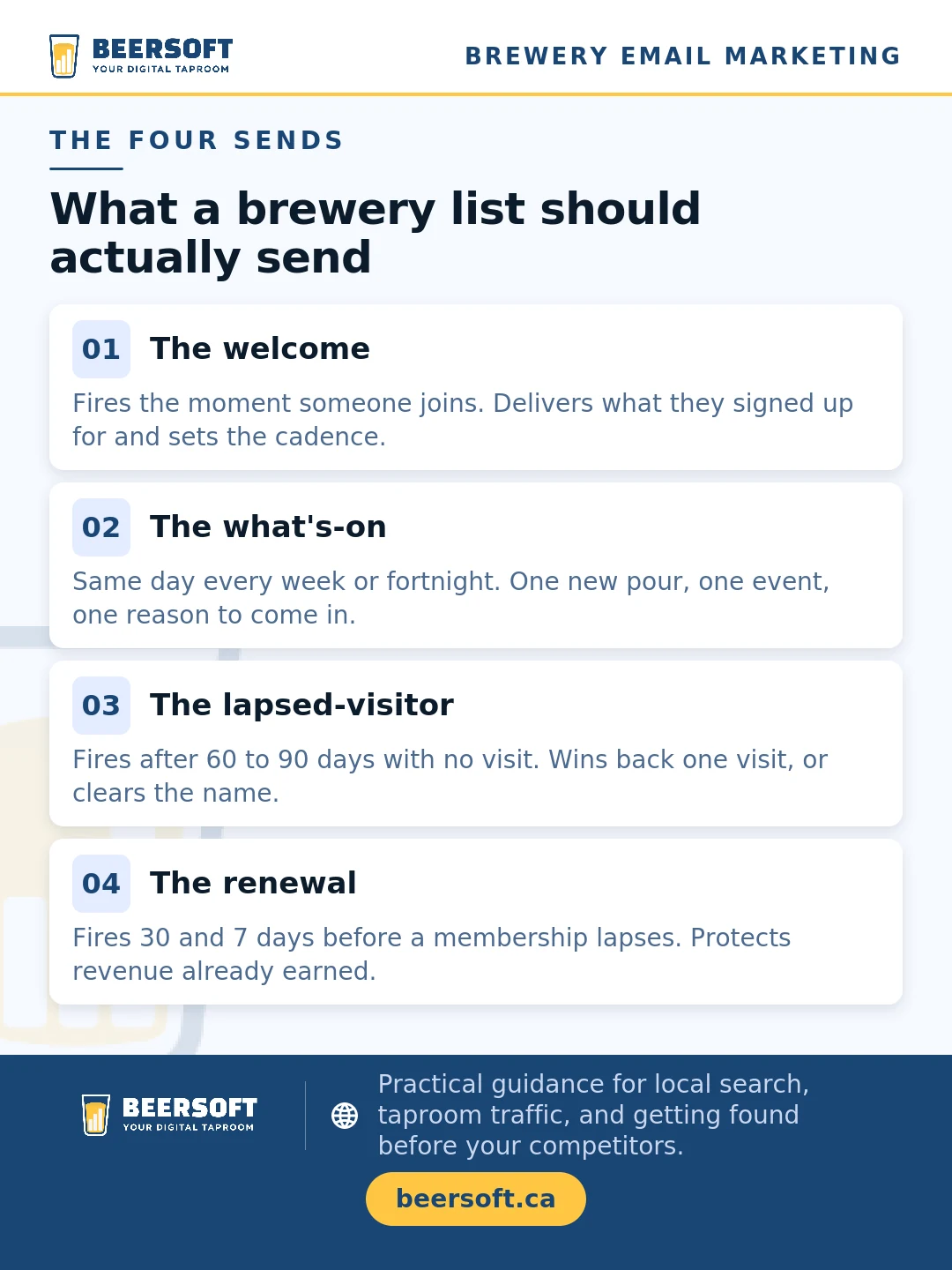
Send 1 is the one nobody builds and the one that pays best. Somebody hands you their address at the bar, and then hears nothing for eleven days until the next newsletter goes out, by which point they have forgotten signing up and the unsubscribe looks like the tidy option. A welcome that arrives within the minute, says what they will get and how often, and gives them one specific thing, is a single afternoon of work that keeps paying.
Send 3 is the one that feels rude and is not. A lapsed-visitor email does one of two useful things: it brings somebody back, or it establishes that they are gone, which lets you stop counting them. Both outcomes are worth more than a name sitting inert in a list you are paying to store. Note that automations carry a higher unsubscribe rate than broadcasts, 0.59% against 0.20%, and win-backs higher still. That is the mechanism working, not failing.
Send 4 is where the money is if you run any kind of membership. If you have a mug club or taproom membership, the renewal date is the single most valuable trigger you own, because a renewal costs nothing to acquire and a replacement member costs everything. The same logic sits under brewery loyalty programs generally: the program is the promise, email is the thing that actually delivers it.
Key Takeaway: build sends 1 and 4 first. Between them they take about a day, they run unattended, and they cover the two moments with the most money attached.
How Do You Build a Brewery Email List Without Buying One?
At the point of service, from people currently holding your beer. Every reliable brewery list is built in the room.
Bought lists are a dead end for a taproom for a practical reason before an ethical one: a purchased list is national and your business is not. You pay to reach 10,000 people, twelve of whom can drive to you. Beyond that, Canada's anti-spam legislation requires consent before commercial electronic messages are sent, and a purchased list does not carry it.
The tactics that work are unglamorous and they all involve asking at a moment when the answer is yes.
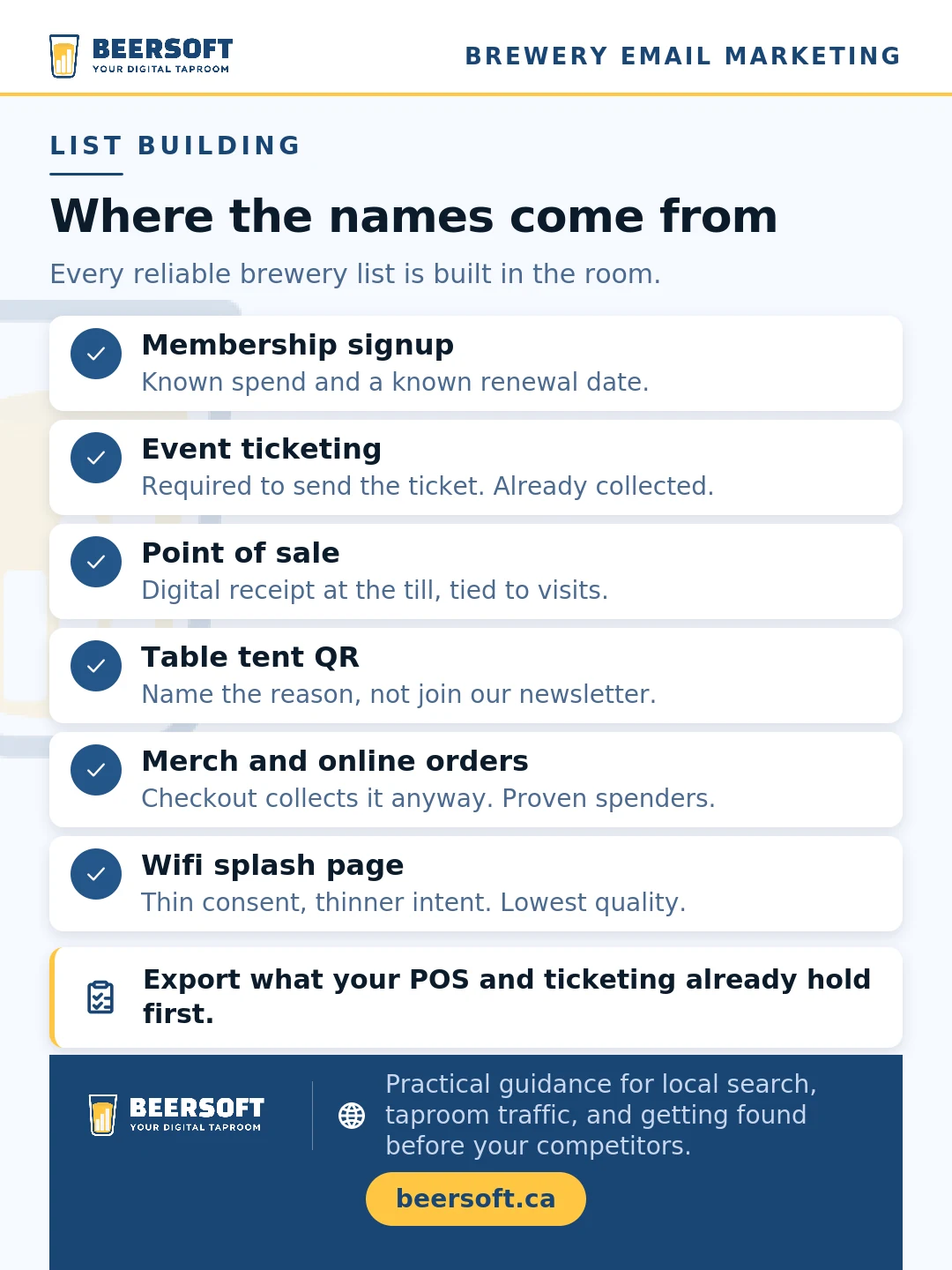
Two of those rows are usually already done and forgotten. Most breweries have a ticketing platform holding every attendee from three years of events, and a POS holding names attached to actual spend. Those are lists. In BeerSoft audits they are the most common thing a brewery already owns and has never once emailed. They are simply not in the email tool yet, which is a plumbing problem rather than a marketing one, and it is the same plumbing problem covered in the piece on which taproom workflows to automate first. If you are still choosing a taproom POS, whether it can export a customer list with visit dates is worth more to your marketing than any feature on the demo.
One rule that is worth more than the rest of this section combined: never ask for an email address without saying what will arrive and how often. "Join our mailing list" collects fewer names and worse ones than "one email most Thursdays, with what's pouring that weekend".
Key Takeaway: before running any new collection tactic, export whatever your ticketing platform and POS already hold. Most breweries find several hundred names they already had consent for.
How Often Should You Send, and What Goes in Each One?
One recurring send a week or every two weeks, plus triggers that run on their own clock. That is the whole cadence.
The instinct is to send less, on the theory that less is politer. In practice a list that hears from you monthly forgets who you are between sends, and monthly email carries the highest unsubscribe rate per send precisely because every one arrives as a surprise. Weekly, on the same day, from the same name, stops being an interruption and becomes a fixture. People start looking for it on Thursday.
The what's-on send should be short enough to read on a phone at a red light. One new pour, one event, one thing to do this week, and a link. Not a roundup. Not a letter from the founder. If you have something long to say, that is a blog post and the email is the thing that points at it.
Two specifics that matter more than they should. Send from a person's name at your domain rather than a generic address, because the sender name is most of the open decision. And put the useful information in the email itself rather than making people click through to find out what is on: the click is not the goal, the visit is.
Something worth flagging on events, since events are the most common reason breweries start emailing at all. A single announcement email for an event is a wasted asset. The pattern that works is an announcement, then a reminder 48 hours out to people who did not click the first one, which is a different email to a different segment for a different reason. That sits alongside the wider argument in the post on brewery events as a revenue engine.
Key Takeaway: pick a day, send weekly or fortnightly on that day, and keep the recurring send under 150 words. Consistency of arrival beats quality of writing at this list size.
What Should You Measure, and What Should You Ignore?
Measure what a send caused. Ignore what it looked like.
Start by demoting open rate, which is the number every platform puts first and the one that has been least trustworthy since 2021. Apple's Mail Privacy Protection downloads remote content "in the background when you receive a message (instead of when you view it)", which registers as an open whether or not a human ever looked. A meaningful share of your list is on Apple Mail. Your open rate is therefore a blend of real opens and machine opens, and it moves when Apple changes something rather than when your marketing changes something.
Open rate is still useful as a trend line against itself. It is useless as a target, and reporting it to an owner as the headline number is how email programs get judged on the wrong axis for a year.
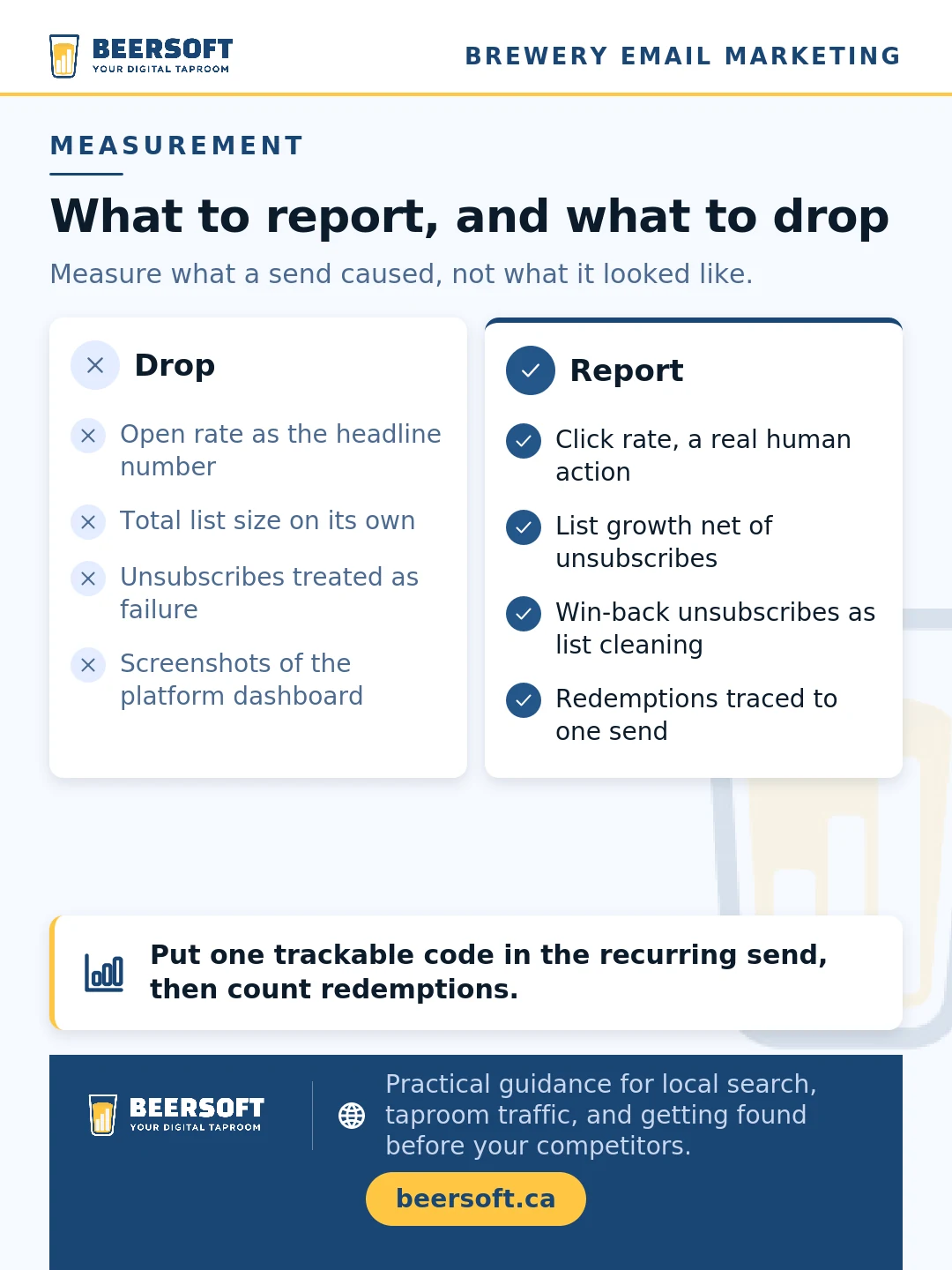
The measurement that matters most is also the hardest to wire up, and it is worth the afternoon: a code, a named drink, or a booking link unique to the email, so a redemption at the till traces back to a send. Once one recurring email has produced a countable number of covers, the argument about whether email is worth doing is over and never needs to be had again.
Key Takeaway: put one trackable thing in the recurring send, a code or a named pour, and count redemptions monthly. One measured send beats a year of open-rate screenshots.
Frequently Asked Questions
How often should a brewery send marketing emails?
One recurring send a week or every two weeks, on the same day, plus triggered emails that fire on their own. Monthly is too infrequent for a taproom: the list forgets you between sends and each one arrives as a surprise, which is what drives unsubscribes. Consistency of arrival matters more than length or polish, so a short weekly email outperforms a long monthly one at almost any brewery list size.
What is a good open rate for a brewery email list?
Automated flows in food and beverage average about a 33% open rate and a 5.8% click rate, so anything in the low thirties is normal. Treat it as a trend line rather than a target, because Apple's Mail Privacy Protection loads images before anyone reads the message and records that as an open. Click rate and redemptions are the numbers worth reporting.
Do breweries need consent before emailing customers in Canada?
Yes. Canada's anti-spam legislation requires businesses to obtain consent before sending commercial electronic messages, and purchased lists do not carry it. In practice this is rarely a constraint for a taproom, because the people worth emailing are the ones who handed you their address at the bar, on a membership form or at checkout. Keep a record of where and when each name was collected.
What is the best email platform for a small brewery?
The one that connects to where your customer data already lives. For a brewery, that usually means the POS and the ticketing platform, because sends 3 and 4 depend on visit dates and membership dates rather than on anything typed into the email tool. Mailchimp, Klaviyo and Constant Contact all work. Pick on integrations, not on templates.
How big does a brewery email list need to be to be worth it?
Around 200 names is enough to start seeing countable returns, because a taproom list is local and the recipients are people who have already paid you once. A 500-name list of past visitors is worth considerably more than 5,000 followers, since roughly a third of it opens and a measurable share walks in. Build the four sends at whatever size you are now rather than waiting for a threshold.
Conclusion: Build the Triggers Before You Write a Newsletter
Most brewery email programs stall because they begin with the hardest, lowest-yielding piece: a newsletter that somebody has to write from scratch every week, sent to everybody, measured on a number that Apple partly controls.
Invert it. Build the welcome and the renewal first, because they run unattended and they sit on the two moments with the most money attached. Add the lapsed-visitor send once your POS can tell you who has stopped coming. Then, and only then, start the recurring what's-on, which is much easier to sustain when it is the only thing on your plate rather than the whole program.
If you want that built rather than described, BeerSoft does this work: email marketing and automation for breweries covers the flows, the platform setup and the integrations that make sends 3 and 4 possible. If you would rather start with a conversation about what you already have sitting in your POS and ticketing platform, contact us.
Sources
- Omnisend. Email Marketing Benchmarks: Open Rates, Clicks, and Conversions. 2025 data, 20 billion campaign emails and 470 million automated sends across 27,000+ brands.
- Klaviyo. Email marketing benchmarks 2026: open rates, click and conversion rates. Data from over 205,000 brands.
- Socialinsider. Social Media Reach Statistics 2026: Instagram and Facebook. 872,075 posts, January 2025 to August 2026.
- Brewers Association. National Beer Sales and Production Data. 2025 figures.
- Apple. Protect email privacy in Mail on Mac. Mail User Guide.
- Government of Canada, Innovation, Science and Economic Development. Canada's Anti-Spam Legislation.
Stay Ahead - Subscribe Now!
You may also be interested
Brewery Website Migration: How to Move Platforms Without Losing Your Rankings
When a brewery actually needs to change platforms, what a migration genuinely puts at risk, the URL map that has to exist before anything moves, and the checks that close it out
Should Your Taproom Run a Chatbot?
What a taproom chatbot would actually be asked, what the 2026 data says about how chatbots perform, why the tap list is the worst thing to put in one, the narrow cases where it does pay, and what to fix instead
Beer Photography for Small Breweries: What to Shoot and When
What a small brewery actually needs photographs of, why a beer shot takes longer than it looks, what a half-day and a full day cost and deliver, which images have a window that closes, and how to write a brief
What a Brewery Website Costs, and What Drives the Number
Why quotes for the same brewery website vary by three times, what makes a taproom site structurally different from a brochure site, which decisions actually move the price, what you pay after launch, and how to compare quotes fairly

Choosing a Taproom POS: What to Ask Before You Sign
What a brewery POS has to do that a restaurant POS does not, why the processing rate matters more than the subscription, what is actually in the contract, who owns your data when you leave, and the questions to ask before signing
Which Taproom Workflows to Automate First
Which taproom workflows actually repeat often enough to justify automating, why federal compliance reporting is the highest-value target, what to connect after that, what to leave alone, and the order to do it in

Beer Label Design: What the Regulator Requires Before the Designer Starts
What the TTB requires on every beer label, how long approval actually takes in 2026, which rules constrain the artwork itself, what really delays a launch, and the brief a designer needs before starting
How to Start a Brewery: The Digital Foundations to Get Right First
What the federal and state approval timeline actually looks like in 2026, why your brewery name is a digital decision before it is a branding one, what to build during the approval window, and what has to be live before your first pour

The Three-Tier System, Explained for Brewery Marketers
Why the three-tier system exists, which marketing activities it forbids outright, exactly what a brewery may legally give a retailer and up to what value, why beer is treated differently from wine and spirits, and which channel you fully control
What Is a Mug Club? How Taprooms Build Recurring Revenue from Members
What a mug club is, how it differs from a points program, what the membership fee actually buys a taproom, the liquor-law rules that decide how you structure it, and how to publish the club so it can be found

ABV, IBU and SRM Explained: The Numbers on Your Tap List
What ABV, IBU and SRM actually measure, why the IBU number misleads drinkers, what the TTB requires you to print, and how to publish the specs so search engines and AI assistants can read them

Craft Beer Consumer Behavior in 2026: What the Data Means for Your Marketing Budget
How the major craft beer consumer behavior shifts of 2024 to 2026 translate into practical marketing budget decisions for taproom breweries, brewpubs, and microbreweries

Brewery Tourism Marketing: How to Attract Out-of-Town Visitors and Drive Weekend Traffic
How taproom breweries can attract out-of-town visitors, rank in tourism discovery platforms, and build the partnerships that drive consistent weekend traffic from the tourist segment in 2026
Brewery Loyalty Programs: Do Points and Perks Actually Drive Repeat Visits?
An evidence-based guide to brewery loyalty program mechanics, platform options, and ROI measurement for taproom operators considering whether and how to launch a customer loyalty program in 2026
Brewery Events as a Revenue Engine: How to Promote, Price, and Measure
How taproom breweries and brewpubs can promote, price, and measure events as a primary revenue engine rather than a secondary marketing activity in 2026
Brewery Merchandise and Secondary Revenue: How to Market Beyond the Pint
How taproom breweries and brewpubs can market merchandise, crowler programs, and beer club memberships as both a revenue diversification tool and a customer loyalty driver in 2026
12 Things Killing Your Local Search Rankings Right Now
A 12-point self-audit guide for brewery operators to identify and fix the website issues most commonly responsible for poor local search rankings and limited AI search visibility in 2026

Marketing Non-Alcoholic Beer: How Craft Breweries Can Capture the Sober Curious Consumer
How craft breweries can market non-alcoholic beer lines to sober-curious consumers, health-conscious drinkers, and younger demographics to capture the fastest-growing segment in the craft beer market in 2026
.webp)
Brewpub Marketing Strategy: How to Fill Both the Bar and the Dining Room
How brewpubs can use digital marketing to fill both the dining room and the bar by marketing the food and beer experience as a unified destination rather than two separate offerings
Microbrewery Marketing in a Shrinking Distribution Market: What to Do When Shelf Space Disappears
How microbreweries facing shrinking distributor interest and tightening shelf space can use digital marketing to differentiate their brand and pivot toward direct-to-consumer channels in 2026

Brewery Social Media Strategy for 2026: Instagram, Facebook, and When to Bother with TikTok
A platform-by-platform social media strategy for taproom breweries and brewpubs in 2026, covering Instagram, Facebook, and TikTok with content mix ratios and posting cadence

Brewery Content Marketing in 2026: What to Publish, When, and Why It Works
What to publish, when to publish it, and why a structured content marketing program is the highest-ROI long-term investment available to brewery operators in 2026
Meta Ads for Breweries: A Geo-Targeted Playbook for Taprooms and Brewpubs
A geo-targeted Meta advertising playbook for taproom breweries and brewpubs covering campaign structure, audience targeting, ad formats, and budget guidance for 2026
Multi-Location Brewery SEO: How Regional Craft Breweries Rank in Every Market
How regional craft breweries operating multiple taprooms can build an SEO architecture that ranks independently in every local market without cannibalizing results.
Brewery Review Marketing: How to Turn Guest Feedback into Local Search Fuel
Google reviews are the number two local ranking factor for breweries. Learn how to generate, respond to, and optimize reviews for local search and AI search visibility.
Google Business Profile for Breweries: The Complete 2026 Optimization Guide
How to set up, optimize, and maintain your brewery's Google Business Profile to dominate local search and drive foot traffic in 2026.
How to Make Your Brewery Visible in AI Search: A GEO Guide for Craft Breweries
How craft breweries can use Generative Engine Optimization (GEO) to stay visible in AI-powered search results in 2026